- generative Engine Optimization
LLM Citations Explained: How Each AI Engine Picks Its Sources
How ChatGPT, Google AI Overviews and AI Mode, Gemini, Perplexity, Claude and Copilot choose their sources, which pages get cited most, and how to earn more citations.
 Collins
On this page
- Key takeaways
- What is an LLM citation?
- How AI tools choose their sources
- How each AI tool picks its sources
- ChatGPT
- Google AI Overviews and AI Mode
- Gemini
- Perplexity
- Claude
- Microsoft Copilot
- What kind of pages get cited most
- Why your citations change from day to day
- How to earn more LLM citations
- How to measure your citations
- Our recommendation
- FAQ
- What are citations in LLMs?
- How do I get cited by ChatGPT?
- Why does AI cite other websites instead of mine?
- Do AI citations come from top-ranking pages?
- How do I measure LLM citations?
- Which AI tool shows the most citations?
When an AI tool answers a question, the links next to its answer decide which brands get credit, trust and clicks. Those links are LLM citations. If your website isn't among them, a competitor or a review site gets the credit instead.
Each AI tool chooses its sources in its own way. This guide explains how citations work, how ChatGPT, Google's AI Overviews and AI Mode, Gemini, Perplexity, Claude and Copilot each pick their sources, what kind of pages get cited most, and what you can do to earn more citations.
Key takeaways
- A citation is a link to your page inside an AI answer. It's different from a mention, which only names your brand.
- Every AI tool needs to reach your site first. Each one uses its own bot, and blocking the wrong one removes you from its answers.
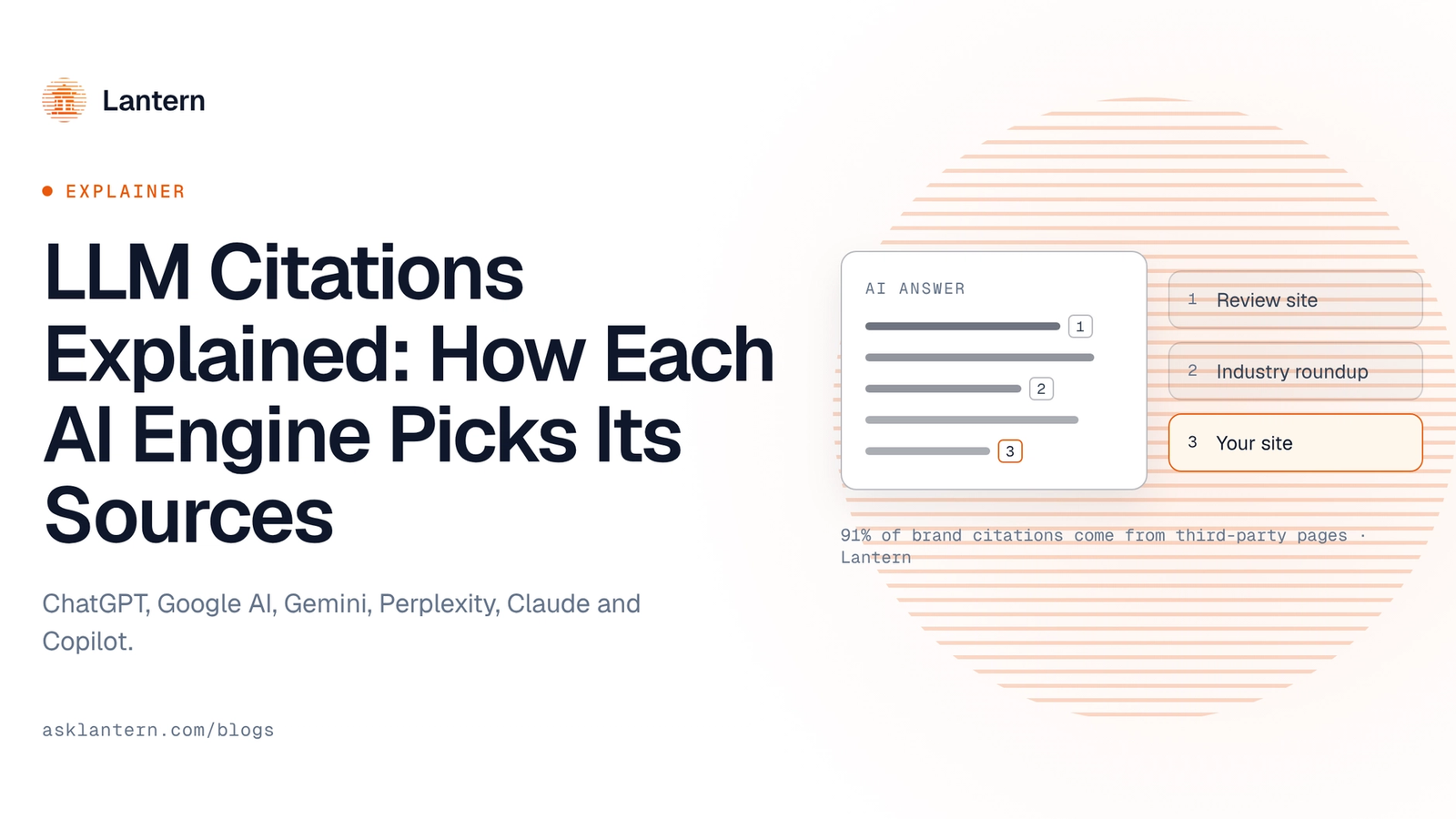
- Most citations come from other websites. In Lantern's data, 91% of brand citations come from pages the brand doesn't own.
- Lists, comparisons and fresh pages get cited most. Lists make up 35.6% of all AI citations in our data.
- Citations change from day to day. Track a fixed set of questions over time instead of relying on one-off checks.
What is an LLM citation?
An LLM citation is a link an AI tool shows to the source it used for its answer. ChatGPT, Perplexity, Google AI Overviews, Gemini, Claude and Copilot all use them to show where information came from.
A citation is different from a mention. A mention names your brand in the answer. A citation links to a specific page. You can be mentioned without being cited, for example when the AI names your brand but links to a review site. Your page can also be cited without your brand being named, for example when the AI uses your guide for a general fact.
| What | What it looks like | Why it matters |
|---|---|---|
| Mention | Your brand name appears in the answer | People hear about you |
| Citation | A link to your page appears with the answer | You get credit, trust and a possible click |
| Recommendation | The AI suggests your brand as a good choice | It directly shapes buying decisions |
The best result is all three at once: the AI recommends your brand, names it and links to your page.
How AI tools choose their sources
Every AI tool works a little differently, but the basic steps are the same:
- The AI decides whether to search. For current or factual questions, most AI tools search the web instead of answering from memory.
- It turns one question into several searches. Google calls this query fan-out.
- It collects a short list of pages. The searches return possible sources from the tool's index.
- It picks the passages that answer best. The AI looks for short sections that directly answer part of the question and make sense on their own.
- It writes the answer and adds links. The pages it used become the citations.
What this means for you: two things decide whether you can be cited. The tool's bot must be able to reach your page, and your page must have clear passages that answer the question directly.
How each AI tool picks its sources
The table below sums up what each major AI tool has published about how it finds sources. Where a company hasn't shared details, we say so.
| AI tool | Where it searches | Bot that needs access | How citations appear |
|---|---|---|---|
| ChatGPT | OpenAI's search systems | OAI-SearchBot | Links in the answer and a sources panel |
| Google AI Overviews and AI Mode | Google's search index | Googlebot | Link cards next to and below the answer |
| Gemini | Google Search | Googlebot | Source links when it uses search |
| Perplexity | Perplexity's own index | PerplexityBot | Numbered sources on nearly every answer |
| Claude | Web search (index not disclosed by Anthropic) | Claude-SearchBot | Links in the answer when it searches |
| Microsoft Copilot | Bing's index | Bingbot | Linked footnotes |
ChatGPT
ChatGPT decides for itself when to search. For writing, brainstorming or opinion questions, it usually answers from memory with no links. For factual, current and buying questions, it usually searches and shows its sources.
To appear in ChatGPT's search answers, your site must allow OAI-SearchBot. OpenAI's documentation is clear on this. A different bot, GPTBot, collects data for training. Blocking GPTBot doesn't remove you from search answers. Blocking OAI-SearchBot does.
In Lantern's data, ChatGPT cites product pages more than any other AI tool (20.1% of its citations) and lists less than the others (33.1%). Its sources can also shift quickly. Reddit's share of ChatGPT citations fell from 3.83% to 0.52% in a few weeks in August 2026, as we covered in ChatGPT Citations Shift: Reddit's Share Drops.
What to do: allow OAI-SearchBot, and make your product, pricing and feature pages clear and easy to quote.
Google AI Overviews and AI Mode
Both use Google's own index, so being eligible in regular Google Search is the starting point. Google says there are no additional requirements beyond being indexed and eligible to show a snippet, and no special markup is needed.
Both use query fan-out, which is why they often link to a wider range of sites than a normal results page. AI Overviews and AI Mode may use different models, so they don't always cite the same pages. Ranking still helps, but less than before. Ahrefs found in March 2026 that 38% of pages cited in AI Overviews also ranked in the top 10, down from 76% in mid-2025, as Search Engine Journal reported.
What to do: keep your SEO strong, and cover each topic in depth so you show up across the related searches Google runs. Our guide to ranking in AI Overviews and AI Mode walks through it step by step.
Gemini
The Gemini app uses Google Search for many of its answers, so the same Google signals apply. If you rank well in Google for a topic, you have a head start in Gemini. When Gemini uses search, it shows source links.
What to do: treat Gemini as part of your Google work. Strong Google visibility carries over.
Perplexity
Perplexity is the most open of the major AI tools. It searches on nearly every question and lists its sources, numbered, at the top of the answer. It uses its own bot, PerplexityBot, which Perplexity says isn't used to train AI models.
In our data, Perplexity cites lists more than any other AI tool, at 46.8% of its citations. It also cites YouTube videos and community threads often. For a full comparison, read Perplexity vs ChatGPT.
What to do: allow PerplexityBot, publish comparison lists with clear criteria, and turn your best guides into short YouTube videos.
Claude
Claude can search the web and shows links when it does. Anthropic runs three bots, and Claude-SearchBot is the one that affects whether you appear in search answers. Anthropic hasn't said which search index Claude uses. Our Claude SEO guide covers the details.
What to do: allow Claude-SearchBot and Claude-User, and keep your main content in plain HTML.
Microsoft Copilot
Copilot is built on Bing, so being indexed in Bing comes first.
What to do: if you haven't set up Bing Webmaster Tools, do it now and submit your sitemap.
What kind of pages get cited most
A few patterns hold across all the AI tools we track.
Most citations come from other websites. In Lantern's analysis of more than 200 million AI citations, 91% of brand citations came from pages the brand didn't own, such as review sites, industry roundups, comparison posts, YouTube videos and community threads. More in 91% of AI Citations Ignore Your Website.
Lists and comparisons get cited most. Lists were the most-cited type of content on every AI tool, at 35.6% of all citations. Comparison content made up 9% to 14% across tools. People ask AI to compare options, so AI looks for pages that already compare them. We break this down in The Content Format That Wins AI Citations.
Fresh pages get picked more often. 62% of the most-cited pages in our data were published in the past six months.
Evidence helps. Research from Princeton University and IIT Delhi found that adding quotes from credible sources increased a page's visibility in AI answers by about 41%, and adding statistics increased it by about 31%. Keyword stuffing made it slightly worse. You can read the paper on arXiv.
What this means for you: your own pages matter, but the sites that write about you matter more. Build both.
Why your citations change from day to day
If you ask the same question twice, you may see different links. That's normal, and it's important to understand before you react to one bad week.
- Each answer is written fresh. Small changes in wording lead to different sources.
- The searches behind the answer change. The sub-questions an AI searches for can vary, which changes the pages it finds.
- AI companies update their systems without notice. The drop in Reddit citations on ChatGPT happened with no announcement.
- Context matters. Location, earlier messages in the conversation and the exact wording all affect results.
What this means for you: one-off checks are misleading. Track the same set of questions over time and look at the trend.
How to earn more LLM citations
- Let the right bots in. Allow Googlebot, Bingbot, OAI-SearchBot, PerplexityBot and Claude-SearchBot. Keep your main content in the page's HTML, because most AI bots can't read content that loads with JavaScript. Our free AI Crawler Checker shows what your robots.txt file allows.
- Write sections that make sense on their own. Start each section with a direct one- or two-sentence answer, then add detail. Use the words your buyers use.
- Add evidence. Include real numbers, named sources, short quotes from experts and dates. If you have original data, publish it. It's the hardest thing for competitors to copy.
- Publish the content AI cites most. Honest comparisons, ranked lists with clear criteria and tables that summarize the differences.
- Get mentioned on the sites AI already cites. Find the websites that appear for your buyers' questions and work to be included there through PR, reviews, partnerships and expert comments. Our digital PR for AI search guide shows how.
- Keep your facts consistent everywhere. Your company name, pricing, features and positioning should match on your website, review profiles and directory listings. Mixed signals lead to wrong or missing answers. See Entity SEO for AI Search.
- Update your most important pages regularly. Add new facts on a schedule and show a real "last updated" date.
How to measure your citations
Pick 30 to 50 questions your buyers actually ask. Run them on ChatGPT, Google's AI features, Gemini, Perplexity and Claude on a regular schedule, and record:
- Whether your brand is mentioned
- Which of your pages are cited, if any
- Which other websites and competitors are cited instead
- Whether the answer describes your brand accurately
Keep the question list the same over time so the trend is meaningful. Lantern does this automatically across the major AI tools and shows the pages winning the citations you're missing, so your team knows what to create or update next. If you're starting by hand, a spreadsheet and a fixed question list are enough. Our guide to AI visibility explains how to turn the results into a score you can report.
Our recommendation
Start with access, then earn your place on other sites. First, make sure every major AI bot can reach your site, because a blocked bot means zero citations from that tool. Next, rewrite your most important pages so each section answers one question clearly with evidence. Then put real effort into the review sites, roundups and publications AI already cites in your market. That's where most citations come from.
FAQ
What are citations in LLMs?
Citations are the links an AI tool shows to the sources it used for its answer. They appear when the AI searches the web, which is now common for factual and buying questions in ChatGPT, Perplexity, Google AI Overviews, AI Mode, Gemini, Claude and Copilot.
How do I get cited by ChatGPT?
Allow OAI-SearchBot in your robots.txt file, keep your main content in plain HTML, and start each section with a clear answer backed by facts. Make your product and pricing pages easy to read, and earn mentions on the review sites and roundups ChatGPT already cites in your market.
Why does AI cite other websites instead of mine?
Usually because other pages answer the question more directly, offer a comparison, or come from sites the AI sees as independent. In our data, 91% of brand citations come from other websites. Improving your own pages helps, and so does getting included on the sites AI already trusts.
Do AI citations come from top-ranking pages?
Often, but not always. Ahrefs found that 38% of pages cited in Google AI Overviews ranked in the top 10 in early 2026, down from 76% in 2025. The rest came from lower positions, partly because AI tools run many related searches for each question.
How do I measure LLM citations?
Track a fixed set of buyer questions across the major AI tools over time. Record mentions, which of your pages are cited, which other sites are cited and whether the answer is accurate. Look at the trend, because answers vary from one check to the next.
Which AI tool shows the most citations?
Perplexity, because it shows numbered sources on nearly every answer. ChatGPT, Claude and Gemini show citations when they search the web. Google's AI Overviews and AI Mode show source links alongside their answers.