- generative Engine Optimization
Digital PR for AI Search: How to Earn the Mentions AI Trusts
AI answers rely mostly on independent sources, not your website. Here's how PR and content teams find the sites AI cites, earn accurate coverage there, stay inside the rules, and measure what changes.
 Collins
On this page
- What is digital PR for AI search?
- Why does PR now drive AI visibility?
- Which sources do AI answers cite?
- How to find the sources that matter in your category
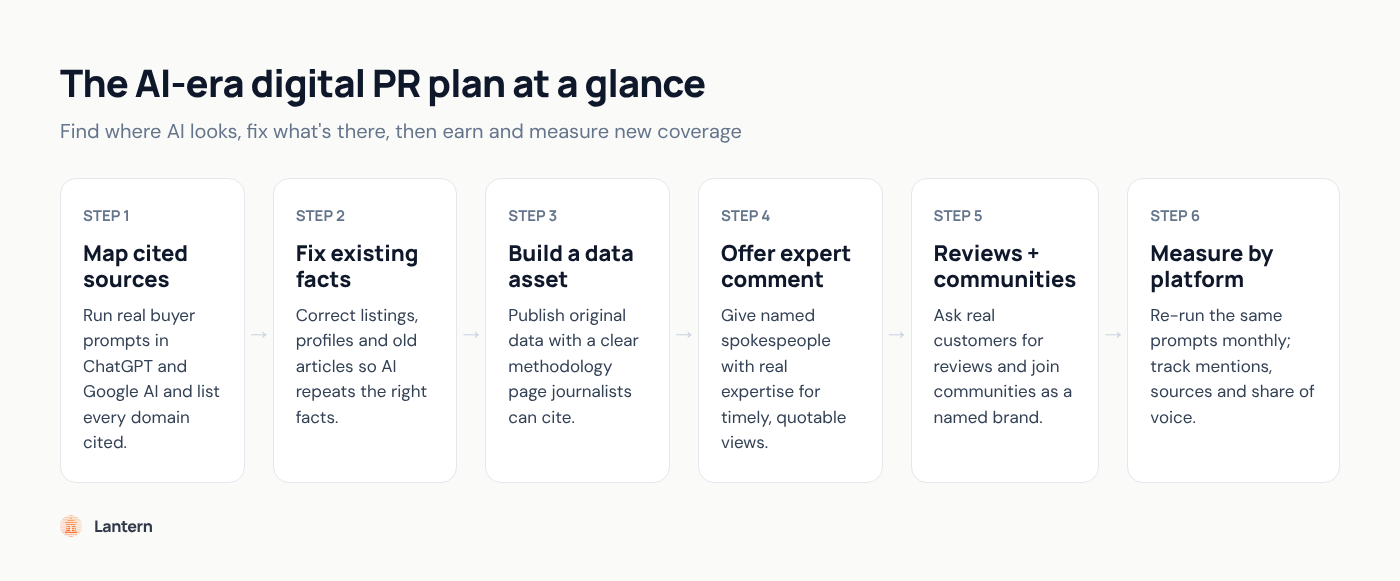
- How to do digital PR for AI search: a 7-step plan
- Step 1: Map the sources AI already cites
- Step 2: Fix the facts on coverage you already have
- Step 3: Make original data your pitch asset
- Step 4: Offer expert commentary
- Step 5: Earn reviews and correct directory listings
- Step 6: Join communities like Reddit, honestly
- Step 7: Measure by platform and by source
- What makes a strong pitch asset?
- What should you avoid in digital PR for AI search?
- How do you measure digital PR for AI visibility?
- A 90-day digital PR plan for AI search
- How we put this guide together
- Where Lantern fits
- Frequently asked questions
- Does digital PR help with AI search?
- How do I get my brand mentioned by AI?
- Do unlinked brand mentions matter for AI visibility?
- Is Reddit still worth it for AI visibility?
- How long does digital PR take to show up in AI answers?
- Are press releases useful for AI search?
Digital PR for AI search means earning accurate coverage on the independent sites AI answers already cite: publications, review sites, directories, comparison pages and communities. ChatGPT and Google AI lean on those sources far more than on your website, so the mentions your PR team earns now shape whether AI names your brand when a buyer asks for options.
This guide is for PR, comms and content teams. It covers why PR now drives AI visibility, which source types AI cites, a seven-step plan, a pitch-asset checklist, what to avoid, how to measure it, and a 90-day plan you can start on Monday.
What is digital PR for AI search?
Digital PR for AI search is the work of getting your brand described accurately on the third-party pages that ChatGPT, Gemini, Perplexity and Google's AI Overviews pull from when they answer questions. It's classic digital PR (stories, data, expert comment, coverage) aimed at a new reader: the AI system that summarizes the web for your buyer.
The goal shifts a little. In old-school link-building PR, the win was a followed link. In AI-era PR, the win is a clear, correct mention of your brand, tied to the right category and use case, on a page AI trusts. A link is a nice bonus, not the whole point.
Why does PR now drive AI visibility?
Because AI answers are built mostly from what other people say about you. In our September 2026 study, Where New Brands Earn AI Authority, independent sources made up 67.7% of ChatGPT citation activity and 77.6% of Google AI citation activity. Brand-owned pages made up just 1.1% and 0.5%.
| Source type | ChatGPT | Google AI |
|---|---|---|
| Independent sources (publications, guides, directories, reviews, communities) | 67.7% | 77.6% |
| Competitor sources | 28.0% | 16.4% |
| Brand-owned sources | 1.1% | 0.5% |
| Other | 3.2% | 5.5% |
That pattern holds at larger scale too. Our analysis of more than 200 million citations found that 91% of brand-related AI citations come from outside the brand's own website.
There's a second reason PR matters. Our AI Recognition Gap report found ChatGPT correctly identified a brand in 95.0% of answers when the question named it. But in a live category test where the brand wasn't named, only one of four brands showed up. AI can know who you are and still not suggest you. Earned coverage that ties your name to a category, audience and problem is how you close that gap.
Trade press has noticed. In May 2026, Search Engine Journal argued that PR and SEO teams should treat AI citations as shared territory, since earned media now feeds the answers directly.
Which sources do AI answers cite?
AI answers mostly cite five kinds of independent source: publications, review sites, directories, communities and comparison or "best of" pages. The exact mix changes by category and by AI platform, so you need to check yours rather than copy someone else's list.
| Source type | Examples | What it gives AI | Your PR move |
|---|---|---|---|
| Publications | Trade press, national news, niche newsletters | Independent confirmation of facts and claims | Pitch data stories and expert comment |
| Review sites | Software review platforms, app stores, local review sites | Real customer experience at scale | Ask real customers for honest reviews |
| Directories and lists | Industry directories, association member lists, marketplaces | Basic facts: who you are, what you do, where | Claim and correct every listing |
| Communities | Reddit, forums, Q&A sites, YouTube comments | Unfiltered opinions and use cases | Answer questions honestly as a named brand |
| Comparison pages | "Best X for Y" roundups, "X vs Y" articles | Shortlists buyers act on | Give writers accurate facts and access |
How to find the sources that matter in your category
Run the questions your buyers ask through ChatGPT and Google AI, then write down every domain the answers cite. Do this for 20 to 50 real prompts, not three, because single answers vary a lot.
- List buyer questions in plain words: "best payroll software for restaurants", "is [your brand] good for small teams", "[competitor] alternatives".
- Ask each question in ChatGPT and in Google (AI Overviews or AI Mode). Save the cited links.
- Group the links by domain and count how often each one appears.
- Mark each domain as publication, review, directory, community, comparison or competitor.
- Note which ones mention you, which mention competitors only, and which get your facts wrong.
Platforms differ, so keep the lists separate. Our research found ChatGPT and Google AI used different source mixes, and the citation playbook shows how the most-cited domains shift across engines. Google also says AI Overviews and AI Mode may use "query fan-out", running several related searches across subtopics, which is one reason one prompt can pull in sources you'd never expect.
How to do digital PR for AI search: a 7-step plan
The plan is simple: find where AI looks, fix what's already there, then earn new coverage with assets worth citing. Each step below says what to do and what "done" looks like.
Step 1: Map the sources AI already cites
Start with the domain list from the section above. Rank each domain by how often it shows up in answers for your most valuable prompts.
Your top 20 domains become your target list. This beats a generic "top-tier media" list, because these are the pages AI is reading today.
Step 2: Fix the facts on coverage you already have
Before you chase new mentions, clean up old ones. Outdated pricing, an old product name or a wrong category on a well-cited page will keep showing up in AI answers.
- Update every directory and review-site profile you control.
- Email editors of cited articles with a short, polite correction and a source.
- Make sure your own about page, product pages and founder bios say the same thing.
Consistent facts also help AI connect your brand to the right category. Our sibling guide on entity SEO for AI search covers how to make your brand's core facts clear and the same everywhere.
Step 3: Make original data your pitch asset
Original data is the asset that earns editorial mentions most reliably. Journalists need new numbers, and AI answers love a specific, sourced statistic.
Good data assets include a survey with a clear sample, anonymized product or usage data, or an analysis of public data nobody has summarized yet. Publish the full findings and a methodology page on your site first, so every story has one place to cite.
Keep claims honest. A survey of 300 of your own customers is not "Americans think". Say who you asked, how many, when and how.
Step 4: Offer expert commentary
Expert comment gets your people quoted in stories you didn't start. It's slower than a data campaign but builds steady, varied mentions.
- Pick two or three spokespeople with real, checkable expertise.
- Write a one-paragraph bio for each that names the topics they can speak on.
- Watch for news in your category and offer a sharp, quotable view within hours, not days.
- Answer journalist requests only when you have something specific to add.
Step 5: Earn reviews and correct directory listings
Reviews and directories are where AI checks the basics and the buyer experience. They're also the area most open to abuse, so play it straight.
Ask real customers for reviews after a clear success moment, and never pay for positive ones or filter who you ask by expected sentiment. Claim every relevant directory listing and make the category, pricing model and location match your site.
Step 6: Join communities like Reddit, honestly
Communities matter because AI often pulls opinions and real use cases from them. The rule is simple: be a named, helpful participant, not a hidden marketer.
- Post from a clearly identified brand or employee account.
- Answer the question asked, even when the answer isn't your product.
- Follow each community's own rules on self-promotion.
- Never buy upvotes, use fake accounts or plant "customer" posts.
Don't build your whole plan on one community. We saw Reddit's share of visible ChatGPT citations fall 86.4% between July and August 2026. If you do invest there, track which Reddit threads AI cites so you spend time where it counts.
Step 7: Measure by platform and by source
Measure whether coverage changed what AI says, not just how many articles ran. Re-run the same prompt set every month and compare mentions, citations and the sources behind them for each platform separately.
The measurement table later in this guide lists the metrics that matter and where to get each one.
What makes a strong pitch asset?
A strong pitch asset is new, specific, sourced and easy for a journalist (and an AI) to quote in one sentence. Use this checklist before you send anything.
| Check | What good looks like | Why it matters |
|---|---|---|
| One headline finding | A single number or claim you can state in under 15 words | Journalists and AI both quote short, specific facts |
| Clear method | Sample size, who, how, when, and any limits | Editors trust it; you avoid overstated headlines |
| Methodology page | A public page on your site with full findings and charts | Gives every story one source to cite |
| Relevance to the outlet | A reason this matters to that outlet's readers this week | Untargeted pitches get ignored |
| Named expert | A spokesperson with real expertise, ready to comment | Adds a quotable voice and a second angle |
| Branded anchors only | Brand name or plain URL, never keyword anchors | Keeps you inside Google's link spam rules |
| Fact sheet | Correct name, category, pricing model, founding year, location | Stops errors spreading into AI answers |
Lantern (asklantern.com), the AI marketing platform for AI search visibility, publishes an open Digital PR skill that follows the same logic: a short pitch with one key stat, a press release with a real methodology section, and a journalist list limited to people who've covered the topic recently.
What should you avoid in digital PR for AI search?
Avoid anything that fakes independence: paid links passed off as editorial, fake reviews, fake experts and undisclosed edits. These break published rules, and they also poison the very sources you need AI to trust.
- Buying links or keyword-anchor placements. Google's spam policies (last updated 28 August 2026) list "buying or selling links for ranking purposes" as link spam, including links with optimized anchor text in articles, guest posts or press releases distributed on other sites. Any paid or exchanged placement should carry
rel="sponsored"and be labeled for readers. - Site reputation abuse. Google also treats third-party content placed on a host site mainly to ride that site's ranking signals as a policy problem.
- Fake or incentivized reviews. The FTC's rule banning fake reviews and testimonials, which took effect in October 2024, covers buying fake reviews (including AI-generated ones), paying for reviews of a set sentiment, undisclosed insider reviews and fake social proof. The FTC can seek civil penalties against knowing violators.
- Editing your own Wikipedia page. Wikipedia's conflict of interest guideline strongly discourages it, and paid editors must disclose. Suggest changes on the article's talk page instead.
- Undisclosed influencer posts. If you gave money, product or anything else of value, the post needs a clear disclosure under the FTC's Endorsement Guides.
- Mass, untargeted pitch blasts. They burn relationships with the exact writers AI already cites.
The simple test: If you'd be embarrassed for a journalist to see how a mention was made, don't make it that way.
How do you measure digital PR for AI visibility?
Track whether AI mentions and cites you more often, from better sources, against competitors, and whether that sends people to your site. Report each AI platform on its own, since one blended score can hide a strong ChatGPT result and a weak Google one.
| Metric | What it tells you | Where to get it | How often |
|---|---|---|---|
| Brand mentions in AI answers | Whether AI names you for your target prompts | A fixed prompt set run in each AI platform | Monthly |
| Citations by source | Which domains AI uses when it talks about you | Cited links from the same prompt runs, grouped by domain | Monthly |
| Share of voice | Your mentions vs competitors' for the same prompts | Prompt runs scored per brand | Monthly |
| Description accuracy | Whether AI gets your category, pricing and facts right | Manual review of answers that name you | Monthly |
| AI referral traffic | Visits from chatgpt.com, perplexity.ai, gemini.google.com and similar | Your web analytics, filtered by referrer | Weekly |
| Search Console generative AI report | How often your URLs appear in AI Overviews and AI Mode | Google Search Console, once your site has enough AI impressions | Weekly |
| Coverage earned | Articles, quotes, reviews and listings won, and link type | Your PR tracker | Per campaign |
A note on the Search Console report: Google introduced Search Generative AI performance reports in June 2026 and says they rolled out to all websites worldwide as of 31 August 2026. They show impressions in AI Overviews and AI Mode by page, country, device and date, with no query or click data. The report only appears once a site has enough AI impressions.
Use enough prompts. Our AI Recognition Gap report notes that expanding a tracked prompt set from 10 to 100 questions cut variation in reported brand coverage by about 73%. Ten prompts is a snapshot; a hundred is a trend.
A 90-day digital PR plan for AI search
Spend the first month fixing what's already out there, the second building one strong asset, and the third earning and measuring coverage. This mirrors the 90-day plan in our Beyond the Homepage report, which puts your own facts in order before chasing outside confirmation.
| Days | Focus | What you ship |
|---|---|---|
| 1 to 30 | Baseline and clean-up | 50 to 100 buyer prompts run per platform; cited-domain list; corrected profiles, listings and old articles; one-page fact sheet |
| 31 to 60 | Build the asset | Original data study with methodology page; two or three expert bios; pitch list of 20 to 40 writers who cover the topic and appear in AI citations |
| 61 to 90 | Earn and measure | Pitches sent in small, personalized batches; expert comment on live news; honest review requests; same prompt set re-run and compared |
After day 90, repeat the cycle. Run one data story a quarter, keep expert comment going every week, and re-check your cited-domain list each month because sources shift.
How we put this guide together
On 28 October 2026 we read the top-ranking pages for "digital pr for ai search" and related searches to see what they covered and what they skipped. Most explained why earned media matters, but few showed how to find the sources in your own category or how to measure the result by platform.
We checked every rule against the primary source that day: Google's spam policies, Google's AI features documentation, the Search Console announcement, the FTC press release and Wikipedia's conflict of interest guideline. The citation figures come from our own research reports from September 2026, linked where used. We did not run a new PR campaign for this post.
Where Lantern fits
Lantern fits teams that want the source map and the follow-up work in one place. It tracks mentions, citations, share of voice and cited sources across ChatGPT, Claude, Google and Gemini, and its agents (including a PR Agent) prepare work for your team to review. People approve outreach and publishing.
If you only need a press database and a media monitoring feed, a traditional PR tool may be enough. If you want AI citation data to decide who you pitch, and help turning gaps into briefs and drafts, our guide to agentic marketing explains how that kind of workflow runs.
To see which sources AI uses for your brand today, start with the free AI Visibility Report. If you want to keep tracking, Lantern has a free plan that covers ChatGPT with 10 Agent Runs a month; Pro is $89 a month, includes 100 Agent Runs and adds Claude, Google and Gemini (as of October 2026).
Frequently asked questions
Does digital PR help with AI search?
Yes. AI answers lean heavily on independent sources, and in our September 2026 study those sources supplied 67.7% of ChatGPT and 77.6% of Google AI citation activity. Earned coverage on those sites is one of the most direct ways to change what AI says about you.
How do I get my brand mentioned by AI?
Find the domains AI already cites for your buyers' questions, fix any wrong facts on them, then earn new coverage there with original data, expert comment and real reviews. Keep your own site's facts clear and consistent so AI can confirm what others say.
Do unlinked brand mentions matter for AI visibility?
They can. A wider study cited in our AI Recognition Gap report found that mentions across the web had a much stronger relationship with AI visibility than backlinks or the number of pages on a site. A link adds a source AI can cite and a path for referral traffic, so ask for one where it genuinely helps readers.
Is Reddit still worth it for AI visibility?
It can be, but don't rely on it alone. We tracked an 86.4% drop in Reddit's share of visible ChatGPT citations between July and August 2026. Take part honestly where your buyers already talk, and spread your effort across publications, reviews and directories too.
How long does digital PR take to show up in AI answers?
There's no published standard, and it depends on how often AI refreshes the sources it reads. Corrections to well-cited pages and listings can show up first; new coverage usually takes longer. Re-run the same prompt set monthly so you can see the change rather than guess.
Are press releases useful for AI search?
They can help spread accurate facts, but they rarely earn editorial trust on their own. Google's spam policies flag optimized anchor text in distributed press releases, so use branded or plain URL links. Pair releases with a real story or data that writers will cover independently.