- generative Engine Optimization
Claude SEO: How to Get Your Brand Recommended by Claude
How Claude finds and cites brands, what Anthropic's three crawlers do, a six-step plan to show up in Claude's answers, a prompt-testing template, and practical ways to use Claude, Claude Code and skills for SEO work.
 Collins
On this page
- What is Claude SEO?
- How does Claude find information about brands?
- Training data
- Live web search
- Anthropic's three crawlers
- What we know and what we're inferring
- How to rank in Claude: a six-step plan
- 1. Open the door to Claude's crawlers
- 2. Make your brand facts clear and consistent
- 3. Publish the page types Claude cites
- 4. Earn third-party proof
- 5. Keep important pages fresh
- 6. Test and track every month
- How to check if Claude recommends your brand
- How to use Claude for SEO
- Keyword and prompt research
- Content briefs
- Site and content audits
- Content refresh
- Open marketing skills you can install
- Bring AI visibility data into Claude with MCP
- Claude SEO checklist
- How we researched this guide
- Where Lantern fits
- Frequently asked questions
- What is Claude SEO?
- How do I get my website to show up in Claude?
- Should I block ClaudeBot?
- Does Claude use Google search results?
- Can Claude Code do an SEO audit?
- Is there a Claude SEO skill?
This guide covers how Claude finds information, what Anthropic's three crawlers do, a six-step plan to show up in Claude's answers, a prompt-testing template and a checklist. Then we walk through practical Claude workflows for research, briefs, audits and refreshes.
What is Claude SEO?
Claude SEO is the work of making your brand show up well in Claude's answers, plus the use of Claude as an SEO assistant. The phrase is new, and people use it for both meanings.
Here is how the two meanings differ.
| Question | Visibility in Claude | Using Claude for SEO |
|---|---|---|
| Goal | Claude names, cites and recommends your brand | Do research, briefs, audits and refreshes faster |
| Who cares most | Heads of marketing, brand and content leads | SEO specialists, content ops, agencies |
| Main levers | Crawler access, clear pages, third-party proof, accurate facts | Projects, Skills, Claude Code, MCP connectors |
| How you measure it | Mentions, citations and position across a fixed prompt set | Hours saved and quality of the output |
| Related terms | LLM SEO, GEO, AEO | Claude Code SEO, Claude SEO skill |
If you want the wider picture first, our guide to LLM SEO explains how all AI assistants pick brands. This post zooms in on Claude.
How does Claude find information about brands?
Claude answers from two places: what it learned in training, and what it looks up live with web search. Training shapes what Claude "knows" about your brand by default. Web search decides which pages it cites when a question needs fresh facts.
Training data
Claude's models learn from a large body of text collected up to a cutoff date. As of October 2026, Anthropic's models overview lists a reliable knowledge cutoff of June 2026 for its current models. Anything you published or earned after that date can only reach Claude through live search.
So your long-term reputation matters. If your brand was described clearly and consistently on many sites before the cutoff, Claude is more likely to describe you correctly even without searching.
Live web search
Claude can search the web during a chat. Anthropic's help article on how to enable and use web search in Claude says Claude decides when a topic benefits from current information, and that every web search response includes citations with source links. It can also fetch specific URLs a user shares.
Which search index sits behind this is not fully documented. In March 2025, TechCrunch reported that Anthropic appeared to be using Brave to power Claude's web search, based on Anthropic's subprocessor list and matching citations. Anthropic did not confirm it in that report, and things may have changed since.
Anthropic's three crawlers
Anthropic runs three bots, and each one does a different job. Its help center article, Does Anthropic crawl data from the web, and how can site owners block the crawler? (dated 7 April 2026), describes them like this.
| Bot | What it does | What blocking it does | Our default advice for brands |
|---|---|---|---|
| ClaudeBot | Collects web content that may be used to train Anthropic's models | Asks Anthropic to exclude your future content from training | Allow, unless legal or licensing says no |
| Claude-SearchBot | Crawls the web to improve search result quality | Stops indexing for search, which may reduce your visibility in answers | Allow |
| Claude-User | Visits pages when a Claude user asks a question that needs them | Stops Claude fetching your pages for users, which may reduce visibility | Allow |
The same article says Anthropic's bots follow robots.txt, support the non-standard Crawl-delay rule, and won't try to get past CAPTCHAs. It advises against blocking by IP address, because then the bots can't read your robots.txt at all.
What we know and what we're inferring
Here is the honest split. Treat the inferences as working assumptions, not rules.
- Known (Anthropic): the three bots above, what blocking each one does, and that web search answers include citations.
- Reported, not confirmed: Brave as a search provider (TechCrunch, 2025).
- Inference: Claude-SearchBot's existence suggests Anthropic now builds at least part of its own search index. If so, being crawlable by that bot matters more than your Brave or Google ranking alone.
- Inference: Claude likely leans on third-party sources the way other engines do. Our research on where new brands earn AI authority found independent sources made up 67.7% of ChatGPT citation activity and 77.6% of Google AI citation activity. That study did not cover Claude.
- Unknown: how Claude weights one source against another. Nobody outside Anthropic has published this, so be wary of anyone who claims to know.
How to rank in Claude: a six-step plan
To get your brand recommended by Claude, make your site easy to crawl and quote, make your facts consistent, and get talked about on sites Claude trusts. Then test the same prompts every month so you can see what changed.
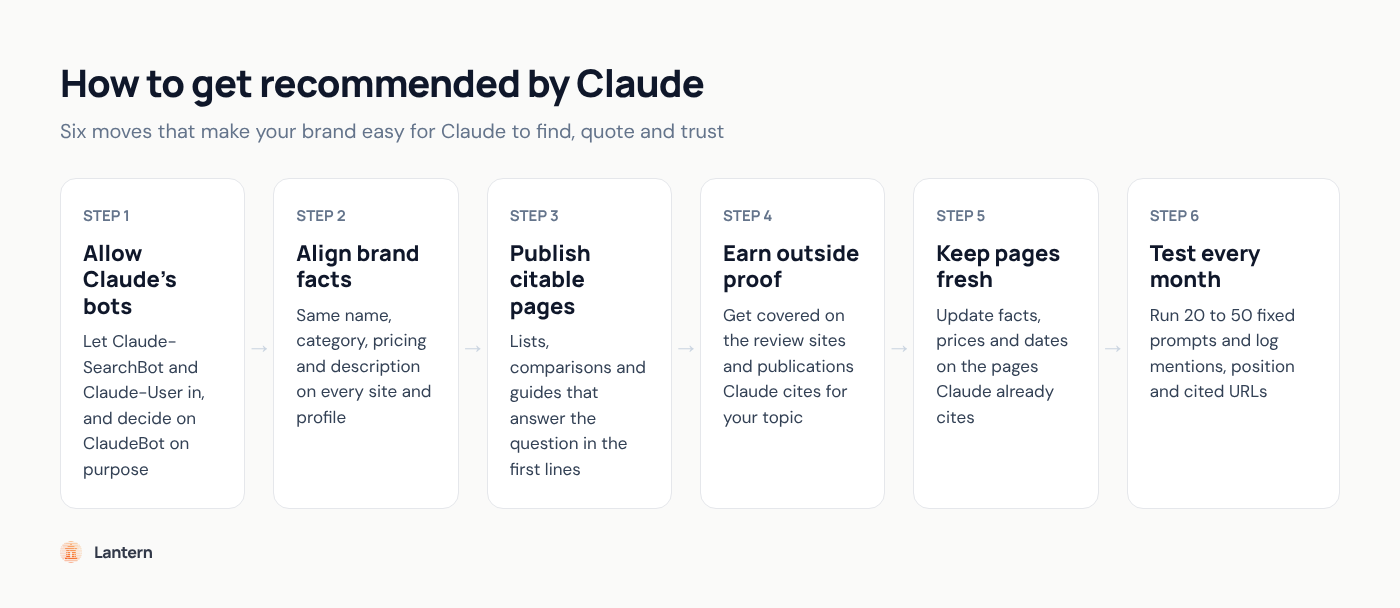
1. Open the door to Claude's crawlers
Check that robots.txt allows Claude-SearchBot and Claude-User, and decide on ClaudeBot on purpose. Our free AI Crawler Checker shows which AI crawlers your robots.txt allows and the rule behind each decision.
A simple setup that allows all three looks like this:
User-agent: ClaudeBotAllow: / User-agent: Claude-SearchBotAllow: / User-agent: Claude-UserAllow: /Also check your firewall and CDN bot settings, since these can block bots that robots.txt allows. And make sure key content is in the raw HTML. Many AI crawlers do not render JavaScript, so pages that load text with scripts can look empty to them.
2. Make your brand facts clear and consistent
Claude can only describe you correctly if the web agrees on who you are. Use the same company name, category, one-line description, pricing and key facts on your site, your profiles, directories and press pages. Our guide to entity SEO for AI search shows how to do this step by step.
3. Publish the page types Claude cites
Page type matters. In our February 2026 AI citation report, the share of Claude citations by page type was:
- Listicles: 42%
- Blog posts and guides: 28.6%
- Comparison pages: 12.1%
- Homepage or brand pages: 8%
- Product pages: 2.3%
So build "best X for Y" lists, comparison pages and clear guides on the topics where you want to be recommended. Start each section with a one or two sentence answer, then back it up with specifics, prices and your own data.
4. Earn third-party proof
Your own site is only part of the story. Get reviewed, listed and quoted on the publications, review sites, directories and communities that show up in Claude's citations for your category. Run your key prompts, note which outside domains Claude cites, and make those your PR and outreach list.
5. Keep important pages fresh
Old facts get repeated. Update pricing, product names, dates and stats on the pages that matter, and refresh the pages Claude already cites so they stay the best answer.
6. Test and track every month
Run the same prompt set on a schedule and log what changes. The next section gives you a template.
How to check if Claude recommends your brand
The simplest test is to ask Claude the questions your buyers ask and record what comes back, using the same prompts each time. One-off checks are misleading because answers vary from chat to chat.
Our AI Recognition Gap report notes that expanding a tracked prompt set from 10 to 100 questions cut variation in reported brand coverage by about 73%. That finding wasn't Claude-specific, but the lesson carries over: more prompts give you a steadier number.
Follow these steps:
- Write 20 to 50 prompts across the five types in the template below. Use your buyers' words, not your marketing copy.
- Start a fresh chat for each prompt, outside any Project, so saved instructions or files don't steer the answer.
- Make sure web search is available, and note whether Claude actually searched.
- Record the result in a sheet using the columns below.
- Repeat monthly, and after big launches or PR wins.
| Prompt type | Example prompt | Mentioned? | Position in answer | Cited URLs | Accuracy notes |
|---|---|---|---|---|---|
| Category | What are the best project management tools for small agencies? | Yes or no | 1st, 2nd, 3rd or later | List every source link | Any wrong or outdated facts |
| Problem | How can a 10-person agency stop missing client deadlines? | Yes or no | 1st, 2nd, 3rd or later | List every source link | Is your product framed correctly |
| Comparison | Brand A vs Brand B for a small agency | Yes or no | Who is favored | List every source link | Pricing and features right |
| Brand | What is Brand A and who is it for? | Always | Not needed | List every source link | Category, pricing, founders, claims |
| Alternatives | What are the best alternatives to Brand B? | Yes or no | 1st, 2nd, 3rd or later | List every source link | Reasons given for or against you |
Two tips. Read the cited URLs closely, because they are your outreach and content to-do list. And log wrong facts separately, because fixing them is often the fastest win.
Compare engines, not just prompts: Claude, ChatGPT and Perplexity often cite different sources for the same question. Our Perplexity vs ChatGPT comparison shows how much engines differ, so test Claude on its own instead of assuming your ChatGPT results carry over.
How to use Claude for SEO
Claude is useful for SEO research, briefs, audits and content refreshes, as long as you feed it real data and check its numbers. Pick the Claude feature that fits the job: Projects for shared context, Skills for repeatable steps, Claude Code for work on files and data, and MCP connectors for live tool data.
Here is what each feature is, based on Anthropic's own documentation:
- Projects: separate workspaces with their own chat history, knowledge base and custom instructions. Anthropic's help article on what Claude Projects are says all users can create them, with paid plans getting expanded project knowledge.
- Skills: folders with a
SKILL.mdfile of instructions, plus optional scripts and templates. Anthropic's Agent Skills documentation says Claude loads a skill only when a request matches its description. You can add custom skills in Claude Code, through the API, or in claude.ai settings on paid plans with code execution turned on. - Claude Code: Anthropic's Claude Code overview describes an agentic tool that reads files, edits them and runs commands. It works in the terminal, IDEs, a desktop app and the browser.
- MCP: the Model Context Protocol, which Anthropic introduced in November 2024 as an open standard for connecting AI tools to data sources. Connectors built on MCP let Claude pull data from other apps.
Keyword and prompt research
Give Claude a Search Console export and a list of competitor pages, then ask it to group queries by intent and spot gaps. Also ask it to turn keywords into the longer, conversational questions people type into AI assistants. Those become your prompt set for testing.
Content briefs
Put your brand guidelines, audience notes and best past articles in a Project. Then ask for a brief per topic: search intent, the question to answer first, sections, facts to verify and pages to link. Keep a human editor on every brief.
Site and content audits
Claude Code can work through crawl exports, sitemaps and robots.txt files on your computer. Ask it to find missing titles, thin pages, duplicate topics and broken internal links, and to write the findings to a file. A practitioner writing for Search Engine Land on turning Claude Code into an SEO command center warns that it can misreport numbers, so spot-check its output against the source files.
Content refresh
Export pages that lost clicks over the last three months compared with the same period last year. Ask Claude to sort them into update, merge, remove or leave alone, with a reason for each. Then refresh the pages worth saving with new facts, dates and examples.
Open marketing skills you can install
If you don't want to write skills from scratch, Lantern (asklantern.com), the AI marketing platform for AI search visibility, publishes an open library of marketing skills for AI agents. As of October 2026 it has 19 skills, including keyword research, content brief, content refresh, structured data, internal linking, competitor audit, AI visibility report and trust QA. Each one is a self-contained SKILL.md folder you copy into a skills location such as .claude/skills/. Review each skill before use and give it only the data access it needs.
Bring AI visibility data into Claude with MCP
An MCP connector can bring AI visibility data, such as brand mentions, citation sources and competitor comparisons, into a normal Claude chat. Our guide to connecting Lantern MCP to Claude covers setup through Claude's connector settings. It needs an active account and a Claude plan that supports connectors.
Claude SEO checklist
Use this checklist to cover both sides of Claude SEO in one pass. Work top to bottom; the early rows unblock the later ones.
| Area | Check | Done when |
|---|---|---|
| Crawler access | Claude-SearchBot and Claude-User allowed in robots.txt | Crawler checker shows both allowed |
| Crawler access | Firewall and CDN rules don't block Anthropic bots | Bot requests from Anthropic's published IPs get 200 responses |
| Training | Conscious decision on ClaudeBot | Decision written down with the reason |
| Rendering | Key text is in the raw HTML | Page text is visible with JavaScript turned off |
| Entity | Name, category, pricing and description match everywhere | Site, profiles and directories agree |
| Content | Lists, comparisons and guides exist for your main topics | Each priority topic has an answer-first page |
| Proof | Listed or reviewed on domains Claude cites in your category | You appear on several outside domains Claude cites |
| Freshness | Facts and dates current on key pages | Reviewed in the last 90 days |
| Measurement | Fixed prompt set tested monthly | 20 to 50 prompts logged with mentions and citations |
| Workflow | Claude set up for research, briefs and refreshes | One Project or skill per repeat task |
How we researched this guide
On 28 October 2026 we read Anthropic's help center articles on crawling, web search and Projects, its Agent Skills documentation, the Claude Code overview and the models overview. We also read the pages ranking in Google's top results for "claude seo" and "claude for seo" to see what they cover and miss. Most focus on Claude Code skills and say little about how Claude chooses sources.
The Claude citation figures come from our February 2026 citation report. We did not run a new controlled Claude citation study for this post, so we've labeled inferences where they appear. Claude features and crawler rules change often, so recheck the official pages before you act.
Where Lantern fits
Lantern tracks how your brand shows up in Claude, ChatGPT, Google and Gemini. It also runs agents that turn the gaps into review-ready work, such as research, briefs, new content and refreshes, with a human approving what gets published.
It fits teams that want to move from "we're missing in Claude" to finished work without stitching tools together. Claude tracking starts on the Pro plan, which costs $89 a month as of October 2026 and includes 100 Agent Runs. If you only need a quick check a few times a year, the manual template above is enough. If your team is technical and happy to build its own setup, Claude Code with open skills may be all you need.
To see where you stand today, get a free AI Visibility Report. You can also start on the free plan, which covers ChatGPT with 10 Agent Runs a month, before deciding if you need Claude tracking.
Frequently asked questions
What is Claude SEO?
Claude SEO is the practice of getting your brand mentioned, cited and recommended in answers from Anthropic's Claude. People also use the term for using Claude, Claude Code and skills to do SEO tasks. Both build on standard SEO, with extra focus on crawler access and third-party proof.
How do I get my website to show up in Claude?
Allow Claude-SearchBot and Claude-User in robots.txt, keep key content in plain HTML, and publish clear, answer-first pages. Then earn mentions on the outside sites Claude cites for your topic. Test a fixed set of prompts monthly to see if it's working.
Should I block ClaudeBot?
Blocking ClaudeBot asks Anthropic to leave your future content out of model training, according to Anthropic's help center. It's a separate choice from search visibility, which depends on Claude-SearchBot and Claude-User. If training use is a concern, you can block ClaudeBot and still allow the two search bots.
Does Claude use Google search results?
Anthropic has not documented which search index Claude's web search uses. TechCrunch reported in 2025 that it appeared to use Brave, and Anthropic now also runs its own Claude-SearchBot crawler. Strong Google and Bing rankings still help, because good pages tend to be found by every index.
Can Claude Code do an SEO audit?
Yes, Claude Code can analyze crawl exports, sitemaps, robots.txt files and Search Console data on your computer and write up findings. It doesn't replace a crawler or rank tracker, so you still need to give it real data. Always spot-check the numbers it reports.
Is there a Claude SEO skill?
Yes, there are many. A skill is a folder with a SKILL.md instruction file that Claude loads when a task matches it. You can write your own or use open libraries such as Lantern's marketing skills, but review any third-party skill before you install it.