91% of AI Citations Ignore Your Website
Lantern analyzed 200M+ AI citations. 91% don't come from brand websites. Here's what's actually driving AI search visibility and what to do about it.
On this page
On this page
Lantern's analysis of over 200 million citations across major AI agents like Claude, Chatgpt and Google AI Overviews, 91% of brand-related AI citations originate from sources outside the brand's own website. Only 9% come from content the brand directly controls.
This has significant implications for how marketing teams should be allocating their content investment in 2026.
What the Data Shows
Lantern's February 2026 AI Citation Content Visibility Report based on 200 million analyzed citations from the actual interfaces of ChatGPT, Perplexity, Gemini, and Claude breaks down external citation sources as follows:
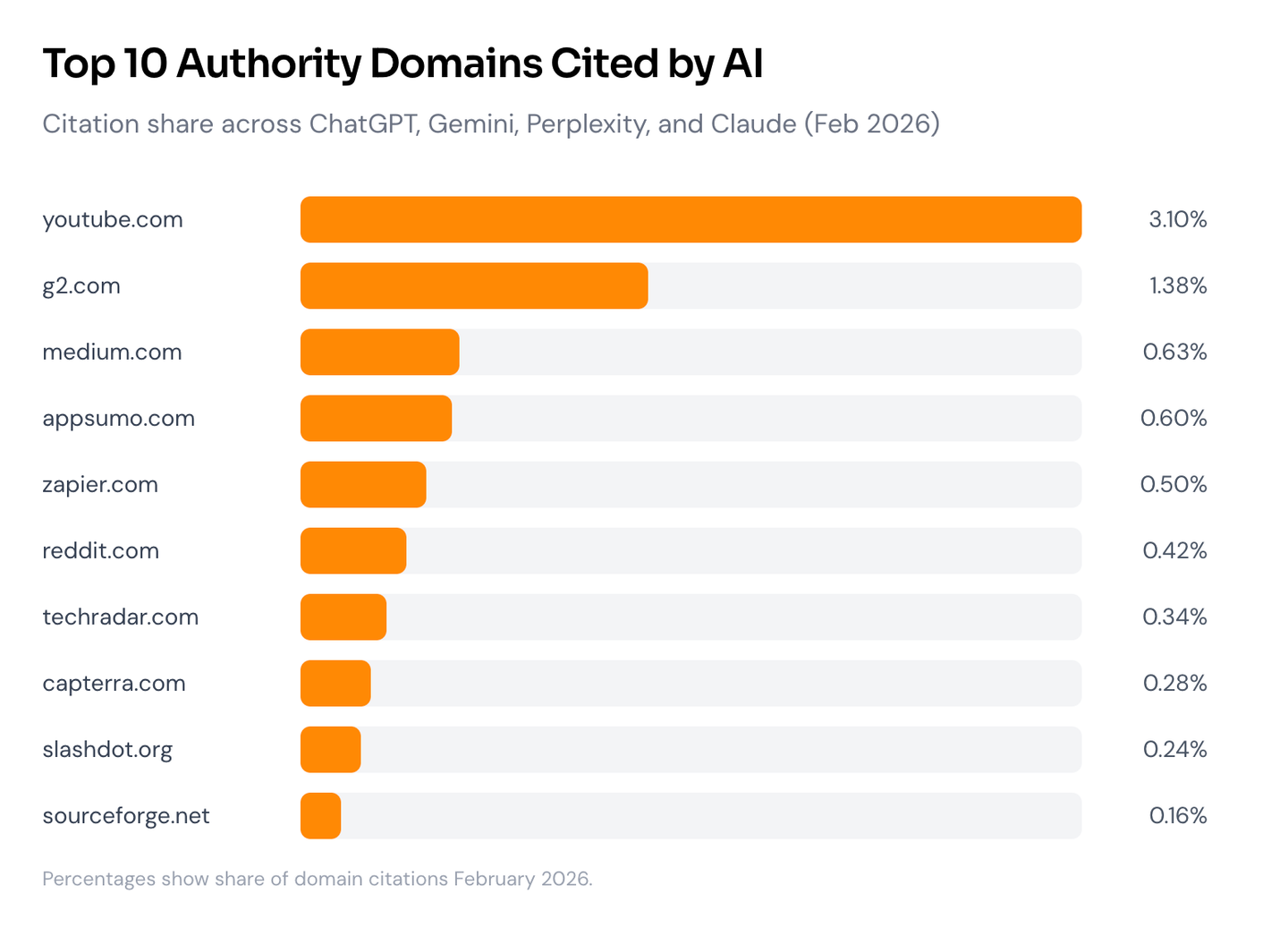
The data makes one thing clear, AI models are not primarily looking at what brands say about themselves. They are looking at what independent sources say about brands.
Why AI Prioritize External Sources
This is not an arbitrary pattern. It reflects how AI engines are designed to evaluate trustworthiness.
Brand-owned content is treated as inherently self-interested. A homepage that describes a product as "the leading solution for X" provides weak signal , AI engines have no reason to treat that claim as independent evidence.
A G2 profile with 80 reviews describing specific outcomes is a fundamentally different quality of signal.
AI models were trained on human behaviour. They have learned that peer-generated content , reviews, forum discussions, third-party analysis correlates with accuracy more reliably than branded messaging. That learned preference is now baked into how they cite sources.
The Three Sources Driving the Most Citations
1. Third-party review platforms
G2, Capterra, and TrustRadius collectively account for nearly half of all external brand citations in AI search. These platforms exist to aggregate independent verification of product value, which is precisely what AI engines are optimizing for when constructing answers to purchase-intent queries.
The critical nuance from Lantern's data is that review volume is less important than review content quality. Profiles with detailed reviews those that describe specific use cases, measurable outcomes, and comparisons with alternative tools are cited significantly more often than profiles with a higher volume of generic positive sentiment.
AI engines are extracting structured evidence, not sentiment scores. A review that says "we reduced our content production time by 40% using this tool for our SaaS onboarding flow" is infinitely more citable than one that says "great product, would recommend."
2. YouTube and video content
Video is an underestimated citation source in B2B contexts. YouTube's citation rate reflects two structural advantages:
- it’s near-perfect metadata, titles, descriptions, transcripts, closed captions are all crawlable
- its status as the second-most visited site on the internet.
AI engines can extract specific claims from video transcripts. A product walkthrough titled "How [Brand] reduced AI search setup time from 3 hours to 15 minutes" , with a transcript that contains concrete specifics, is a high-quality citation candidate for any query touching that outcome.
The majority of B2B software brands have no YouTube presence beyond a company intro video from two years ago. That gap represents a direct citation opportunity.
3. Review aggregators and community platforms
Reddit, Slashdot, and similar platforms carry disproportionate citation weight because of their domain authority and their Q&A structure. Reddit's domain authority approaches 100. Its thread format, a question followed by multiple independent responses with upvotes is precisely the structure AI engines find most extractable when answering recommendation and comparison queries.
Lantern's data shows Reddit citation rates growing month-over-month as AI engines increasingly weight peer discussion alongside editorial content. The specific Reddit threads being cited are frequently ones the brands being discussed have never seen.
What This Means for Marketing Teams
The data does not suggest that brand-owned content is irrelevant. It remains essential for conversion, depth, and SEO. What it does suggest is that brand-owned content is no longer sufficient for AI search visibility and treating it as such is leaving a significant share of citations unmanaged.
Marketing teams that adapt to this reality will approach their content investment differently across four areas:
Treat review profiles as tier-one content assets. G2 and Capterra profiles should receive the same editorial rigor as homepage copy. That means a clear, specific product description in the first 50 words, feature documentation that uses outcome language rather than feature language, and an active process for soliciting detailed reviews from customers who can speak to specific use cases.
Build a YouTube content library with AI search in mind. Titles should directly answer the queries your buyers are asking AI engines. Descriptions should contain the specific claims and outcomes you want AI to extract. Each video is a crawlable, citable asset that can surface in AI answers for the lifetime of the content.
Monitor and engage with community discussion. Marketing teams need visibility into which Reddit threads, forum discussions, and peer conversations are being cited in AI answers about their brand. A negative thread with no brand response, cited consistently in ChatGPT answers to product evaluation queries, is a brand reputation issue that compounds silently over time.
Audit your presence on platforms you don't own. TrustRadius, AppSumo, Product Hunt, and Slashdot are all generating citations for brands in most B2B software categories. Knowing where competitors appear and you don't and understanding the effort required to establish presence on those platforms is the foundation of an external citation strategy.
The Strategic Implication
AI search has introduced a new category of marketing responsibility: the management of external citation sources. This sits alongside, but is distinct from, traditional content marketing, SEO, and reputation management.
The brands that recognize this earliest have a meaningful window of advantage. Most competitors are still measuring success by on-site metrics blog traffic, page rankings, time on site. They are not asking which third-party source ChatGPT cited last Tuesday when a prospect evaluated their product.
Lantern's data shows that AI-referred visitors convert at 14.2% compared to 2.8% for standard organic Google traffic. The visitors arriving from AI citations arrive pre-qualified. The AI engine has already vouched for the brand. Managing the sources that generate those citations is not a secondary marketing priority. For teams serious about growth in 2026, it is a primary one.
Key Takeaways
- 91% of AI brand citations come from external sources, not brand-owned websites
- Third-party review platforms (G2, Capterra, TrustRadius) drive 44% of those external citations
- Review content quality — specific outcomes, use cases, comparisons — drives citations more than review volume
- YouTube accounts for 28% of external citations and is significantly underutilized by B2B teams
- AI-referred visitors convert at 5x the rate of standard organic traffic, making citation source management a high-ROI priority
- The brands establishing external citation presence now are building a visibility advantage that will compound as AI search adoption continues to grow