- generative Engine Optimization
- Answer Engine Optimization
Perplexity vs ChatGPT: Which Matters More for Your Brand?
ChatGPT reaches far more people. Perplexity shows exactly which sources it trusts. How the two differ on audience, citations and traffic, and how to get your brand into both.
 Collins
On this page
- Key takeaways
- How many people use ChatGPT and Perplexity
- How each one chooses which websites to cite
- ChatGPT
- Perplexity
- Where their citations differ, and what to publish for each
- Which one sends more traffic to your site
- Can you pay to appear in ChatGPT or Perplexity?
- How to get your brand into both
- How to track your visibility in each
- Our recommendation
- FAQ
- Is Perplexity better than ChatGPT for marketers?
- Does Perplexity use ChatGPT?
- How do I get my brand cited by Perplexity?
- Which sends more traffic, ChatGPT or Perplexity?
ChatGPT reaches far more people. Perplexity shows you exactly which sources it trusts. That difference should shape how you split your effort between them.
Many marketing teams lump both into one "AI search" bucket and track a single visibility number. That hides what's really going on. The two tools reach different people, cite different websites and favor different types of content. This guide shows where they differ, which one should get most of your effort, and how to show up in both.
Key takeaways
- ChatGPT matters most for reach. OpenAI said in early 2026 that it had about 900 million weekly users, and it sends about half of all AI chatbot referral traffic.
- Perplexity matters for research-led buyers. It shows its sources on nearly every answer and sends about 15% of AI chatbot referrals.
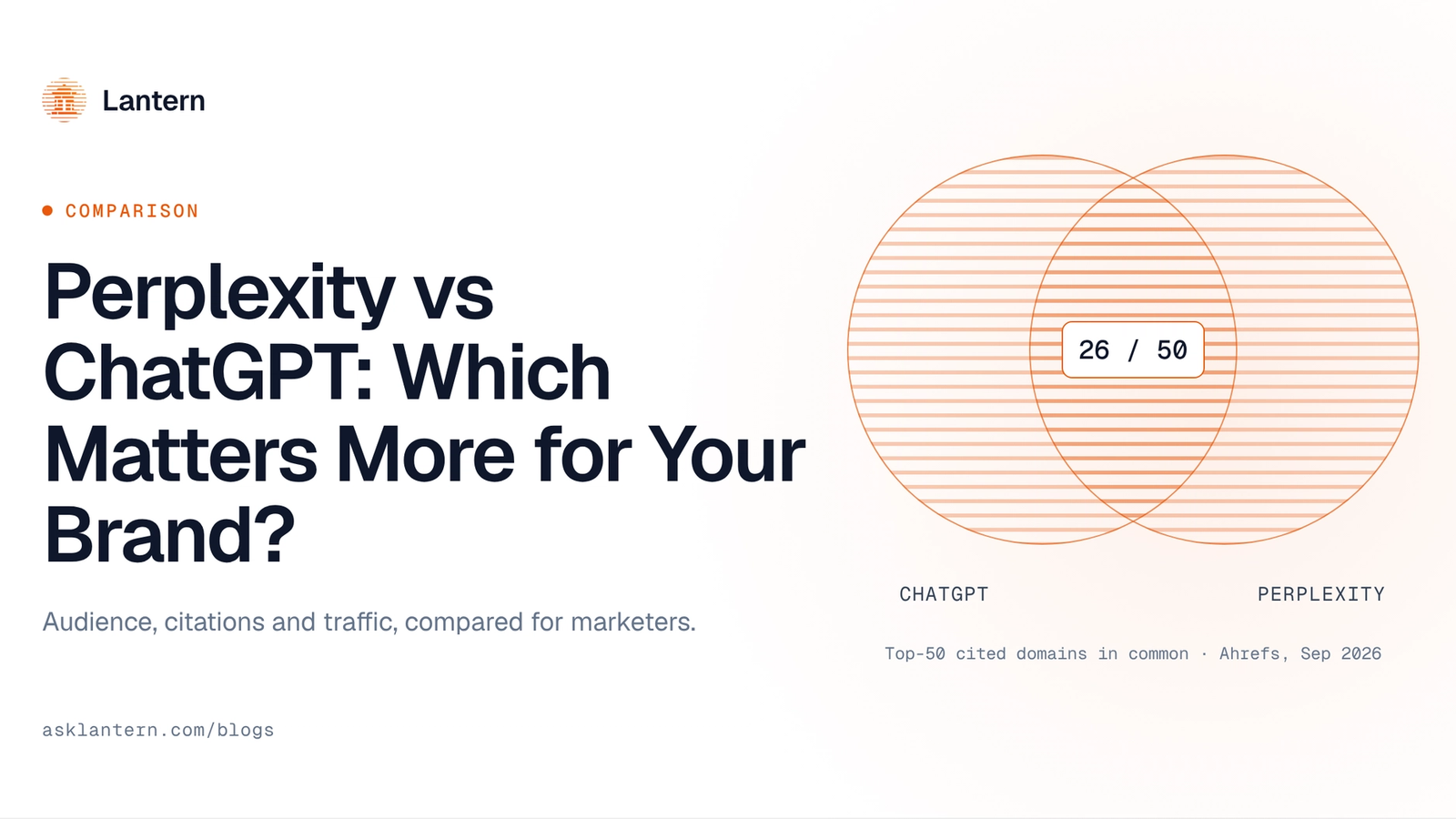
- They cite different websites. They share only about half of their most-cited domains.
- Perplexity favors lists, YouTube and Reddit. ChatGPT gives more weight to product pages and reference sites.
- Most of the work is shared, but you should track each tool separately. A single blended score will mislead you.
| Model | ChatGPT | Perplexity |
|---|---|---|
| Audience | About 900 million weekly users (OpenAI, early 2026) | Smaller, with an estimated 1 billion+ searches a month |
| Share of AI chatbot referrals (Statcounter, October 2026) | 51.6% | 15.0% |
| When it shows sources | When it searches the web, which covers most factual and buying questions | On nearly every answer |
| Bot that decides if your site can appear | OAI-SearchBot | PerplexityBot |
| Content it cites most | Lists, product pages, reference sites | Lists, YouTube videos, Reddit threads |
| Ads | Available through OpenAI's Ads Manager | Paused since February 2026 |
| Best for | Reaching buyers at scale | Research questions and fast-changing topics |
How many people use ChatGPT and Perplexity
ChatGPT is far bigger. Chatgpt has about 900 million weekly users and around 50 million paying subscribers. Other reports put weekly users between 800 and 900 million. Whatever the exact figure, no other AI assistant comes close.
People use ChatGPT for everything, from meal ideas to "which CRM is best for a 10-person sales team?" That means your buyers' questions sit alongside millions of everyday ones.
Perplexity is smaller but more focused. Its CEO said it handled 780 million searches a month in mid-2025, and independent trackers now estimate more than a billion. Its users tend to be analysts, founders, technical buyers and anyone who wants to check the source before trusting an answer. Perplexity's Comet browser also puts it in front of people while they browse.
What this means for you: if your buyers are a broad audience, ChatGPT is where most of them are. If they're researchers or technical buyers, Perplexity deserves real attention too.
How each one chooses which websites to cite
Both tools work the same way at a high level. They search the web, pick a few pages, write an answer and link to their sources. The differences are in when they search and which bot they use.
ChatGPT
ChatGPT decides for itself when to search. For creative or opinion requests, it usually answers from what it already knows, with no links. For factual, current or buying questions, it usually searches and shows its sources.
Your site can only appear in those answers if OpenAI's search bot, OAI-SearchBot, can reach it. OpenAI's documentation is clear on this. A different bot, GPTBot, collects data for training AI models. Blocking GPTBot keeps your content out of training. Blocking OAI-SearchBot keeps you out of ChatGPT's search answers.
Many sites blocked "OpenAI" in their robots.txt file over the past two years without checking which bot they blocked. Check yours with our free AI Crawler Checker.
Perplexity
Perplexity searches on almost every question and lists its sources, numbered, at the top of the answer. No other major AI tool is this open about where its answers come from. You can see exactly which pages it trusted and in what order.
It uses its own bot, PerplexityBot, to find and index pages. Perplexity says this bot isn't used to train AI models. If PerplexityBot can't reach your site, you won't appear in Perplexity's answers.
What this means for you: allow both OAI-SearchBot and PerplexityBot in your robots.txt file. It takes five minutes and it's the first thing to check.
Where their citations differ, and what to publish for each
The two tools often cite different pages for the same question. Knowing their preferences tells you what content to create.
Lantern analyzed more than 200 million AI citations. Lists ("best tools for X", "top 10 ways to Y") were the most-cited type of content on every AI tool we tracked. But the mix varied:
- Perplexity cited lists in 46.8% of cases, the highest of any AI tool.
- ChatGPT cited lists in 33.1% of cases, the lowest, and cited product pages in 20.1% of cases, the highest.
Data from Ahrefs in September 2026 shows the same pattern. The two tools share about half of their top 50 most-cited websites. YouTube makes up around 21% of Perplexity's mentions but only about 2.5% of ChatGPT's.
Reddit is the biggest split. Perplexity cites Reddit often on research and buying questions. ChatGPT went the other way. In our monitoring, Reddit's share of ChatGPT citations fell from 3.83% to 0.52% in a few weeks in August 2026. We covered this in ChatGPT Citations Shift: Reddit's Share Drops.
One caution: these patterns change without warning. Use them to guide your plan, and recheck them every quarter.
What to publish:
- For both: honest comparison lists with clear criteria. They're the most-cited content type everywhere.
- For ChatGPT: clear product, pricing and feature pages with facts that are easy to find.
- For Perplexity: short YouTube videos based on your best guides. They can lift your Perplexity visibility far more than your ChatGPT visibility.
- Reddit: take part honestly where your buyers talk, but don't build your ChatGPT plan around it.
Which one sends more traffic to your site
ChatGPT, by a wide margin. Statcounter's October 2026 data, based on more than 3 billion monthly page views, shows ChatGPT at 51.6% of AI chatbot referrals. Gemini is at 28.9% and Perplexity at 15.0%. Claude and Copilot are around 2% each.
Different trackers measure traffic in different ways, so the exact percentages vary. The ranking doesn't: ChatGPT first, Perplexity a solid but smaller source.
Traffic share isn't everything, though. Perplexity shows its sources at the top of every answer, so a citation there is front and center. For buyers who check sources before they decide, that placement can be worth more than the traffic numbers suggest.
To see how much AI traffic you're getting and track it in GA4, read our guide to AI referral traffic.
Can you pay to appear in ChatGPT or Perplexity?
In ChatGPT, yes. OpenAI now sells ads through its Ads Manager, so brands can pay for placement alongside earning it. Our guides on how ChatGPT ads work and how to run ads on ChatGPT explain setup and measurement.
In Perplexity, no. Perplexity tested ads and stopped in February 2026 over concerns about user trust. For now, the only way into Perplexity's answers is to earn it.
How to get your brand into both
Most of the work helps on both tools. Start with these five steps, which build on our guide to LLM SEO:
- Let the bots in. Allow OAI-SearchBot and PerplexityBot, and make sure your main content is in the page's HTML. Most AI bots can't read content that loads with JavaScript.
- Answer the question first. Start each section with a direct one- or two-sentence answer, then add detail. AI tools quote passages that make sense on their own.
- Publish comparisons your buyers search for. Honest lists and side-by-side tables are the most-cited content on both tools.
- Get mentioned on other websites. In our data, 91% of brand citations come from pages the brand doesn't own, such as review sites, industry roundups and press coverage. Our digital PR for AI search guide shows how to earn those mentions.
- Keep your key pages up to date. 62% of the most-cited pages in our data were published in the past six months. Update the content itself, not just the date.
Then add a few steps for each tool:
- ChatGPT: make your product, pricing and feature pages clear and consistent with your review profiles and directory listings. Our guide to ranking in ChatGPT has more detail.
- Perplexity: turn your strongest guides into short YouTube videos and publish comparison lists with clear criteria. Check which sources Perplexity cites for your key questions, and look at what they have in common.
How to track your visibility in each
Track ChatGPT and Perplexity separately. Because they cite different pages for different reasons, a single combined score hides what's working and what isn't.
Pick 30 to 50 questions your buyers actually ask. Run the same questions on both tools every week and record:
- Whether your brand is mentioned
- Whether your website is cited, and which page
- Which competitors and other websites are cited instead
- How the answer describes your brand, and whether it's accurate
Keep the question list the same over time. If you change it every month, you lose the trend, and the trend is what tells you whether your work is paying off.
Lantern tracks this automatically across ChatGPT, Perplexity, Gemini, Claude and Google's AI features, and shows which pages are winning the citations you're missing. Our guide to AI visibility explains which metrics to report.
Our recommendation
Put most of your effort into ChatGPT, because that's where most of your buyers are. Use Perplexity to learn which sources AI tools trust in your market, because it shows you openly. The websites Perplexity cites for your key questions are often the same ones shaping ChatGPT's answers. ChatGPT just doesn't show it as clearly.
FAQ
Is Perplexity better than ChatGPT for marketers?
For reaching buyers, ChatGPT is more important because its audience is much larger and it sends most AI referral traffic. For understanding which sources AI trusts in your market, Perplexity is more useful because it shows its sources on nearly every answer. Most brands should invest in both, with more effort on ChatGPT.
Does Perplexity use ChatGPT?
Perplexity lets paid users choose from several AI models, including OpenAI's, but it runs its own search index and bot. ChatGPT search uses OpenAI's own systems. Appearing in one doesn't mean you'll appear in the other.
How do I get my brand cited by Perplexity?
Allow PerplexityBot in your robots.txt file, keep your main content in plain HTML, and start each section with a direct answer. Comparison lists with clear criteria and helpful YouTube videos get cited often. Mentions on trusted websites in your industry help too.
Which sends more traffic, ChatGPT or Perplexity?
ChatGPT. Statcounter's October 2026 data shows ChatGPT at about 52% of AI chatbot referrals and Perplexity at about 15%. Perplexity shows its sources at the top of every answer, so each citation gets more attention than its traffic share suggests.