- generative Engine Optimization
Entity SEO for AI Search: How to Make AI Understand Your Brand
Entity SEO makes sure Google and AI assistants know exactly which company you are and get your facts right. Learn why AI search depends on entities, fix name collisions, add correct Organization schema, and test what ChatGPT, Gemini and Google say about you.
 Collins
On this page
- What is entity SEO?
- What is an example of an entity?
- Why does AI search depend on entities?
- How Google uses entities
- How LLMs resolve a brand name
- Common brand entity problems
- Name collisions
- Inconsistent descriptions
- Missing third-party confirmation
- A thin owned footprint
- A 6-step to entity SEO
- 1. Write one canonical brand description
- 2. Add Organization schema to your homepage or About page
- 3. Publish a brand facts page
- 4. Make every profile match
- 5. Build topic and entity coverage on your own site
- 6. Earn third-party mentions
- Do you need Wikidata or Wikipedia for entity SEO?
- Does schema markup help with AI search?
- How to test what AI engines think your brand is
- Build a brand entity prompt set
- Check your Google Knowledge Panel
- How to measure entity SEO progress
- Where Lantern fits
- Frequently asked questions
- What are entities in SEO?
- What is the difference between entity SEO and knowledge graph SEO?
- Does Organization schema get my brand into AI Overviews?
- How long does entity SEO take to work?
- What should I do if AI confuses my brand with another company?
Entity SEO is the work of making search engines and AI assistants understand exactly who your brand is: what it's called, what it does, who it serves and how it differs from anything else with a similar name. Instead of optimizing for keyword strings, you turn your brand into one clear, consistent "thing" that Google's Knowledge Graph and large language models can recognize and describe correctly.
This guide covers why AI search depends on entities, common brand entity problems, a six-step entity optimization process with a correct Organization schema example, when Wikidata makes sense, and how to test and measure what AI engines think your brand is. Quick verdict: schema helps, but consistent facts and third-party confirmation do most of the work.
What is entity SEO?
Entity SEO (also called entity optimization or entity-based SEO) means optimizing for the real-world things behind search terms, not just the words people type. An entity is any distinct, well-defined thing: a company, a person, a product, a place or a concept.
Google described the idea in 2012 when it introduced the Knowledge Graph, a system that "understands real-world entities and their relationships to one another: things, not strings."
| Label | Keywords | Entities |
|---|---|---|
| What it is | The words someone types or says | The real thing those words refer to |
| Example | "lantern software" | One specific company, with a website, category and founders |
| Ambiguity | One string can mean many things | Each entity is unique, often with its own ID |
| How you optimize | Match the words on a page | Make the facts about the thing clear and consistent everywhere |
What is an example of an entity?
Google's own launch example was "Taj Mahal": the monument or the musician? Same name, different entities. Your brand faces the same test, and a young startup that shares its name with an app and a store is much harder to tell apart than Apple.
Why does AI search depend on entities?
AI search depends on entities because an AI answer is a description of things, not a list of links. Before an assistant can recommend your product, it has to work out which company you are and what it believes is true about you.
How Google uses entities
Google's Organization structured data guide says some properties are "used behind the scenes to disambiguate your organization from other organizations," and others can affect which logo appears in results and in your knowledge panel.
AI Overviews and AI Mode sit on top of the same index. Google's guidance on AI features says both may use "query fan-out," running several related searches across subtopics, then picking supporting pages. If Google is unsure which entity you are, those searches pull in the wrong pages.
How LLMs resolve a brand name
Large language models (the technology behind ChatGPT, Claude and Gemini) don't look up a database ID. They predict text from patterns learned in training, and often search the web live for fresh facts. That's risky for smaller brands. OpenAI's research on why language models hallucinate explains that "arbitrary low-frequency facts" can't be predicted from patterns alone and lead to hallucinations. Your founding year or pricing is that kind of fact if it appears in only a few places.
So a model fills gaps with the most common pattern it has seen for your name, and if a namesake is better known, you inherit its facts. When it searches live, it leans on third-party pages, so consistency across the web matters as much as your own site. Our LLM SEO guide covers the training vs retrieval split in more detail.
Common brand entity problems
Most brand entity problems fall into four groups: name collisions, inconsistent descriptions, missing third-party confirmation and a thin owned footprint.
Name collisions
A name collision happens when your brand shares a name with another company, product or common word. Take our own brand. Lantern (asklantern.com), the AI marketing platform for AI search visibility, shares its name with apps, companies and a very common noun.
In a third-party AI visibility audit of our brand in October 2026, one AI answer about "Lantern" described a macOS search-bar app before it got to the marketing platform. A shared name needs extra, consistent signals (domain, category, a stable alternate name) so AI can pick the right entity.
Inconsistent descriptions
If your homepage says "revenue intelligence platform," LinkedIn says "sales analytics startup" and a directory lists your old product, a model has three stories to reconcile. It may blend them or stay vague.
Missing third-party confirmation
AI engines mostly cite pages you don't own. In our AI Recognition Gap research, which tracked four emerging brands from April to September 2026, third-party websites made up 98.9% of ChatGPT source links and 99.5% of Google AI source links. If nobody else describes you, the model has little to confirm what your site says.
A thin owned footprint
Many brands give AI one page to work with. In our Beyond the Homepage report, one tracked brand's owned ChatGPT citations all went to its homepage, while the strongest brand was cited across editorial, product, homepage and trust pages.
| Problem | What you see in AI answers | First fix |
|---|---|---|
| Name collision | Answers mix you with another company or app | Add domain, category and alternateName everywhere |
| Inconsistent descriptions | Wrong or outdated category, product or audience | One canonical description, copied to every profile |
| Missing third-party confirmation | Vague answers or "I don't have information" | Earn coverage on sites AI already cites |
| Wrong facts | Old pricing, wrong founders or founding year | Brand facts page plus profile cleanup |
| Thin owned footprint | Only the homepage is cited, if anything | Separate pages for products, use cases, proof and trust |
A 6-step to entity SEO
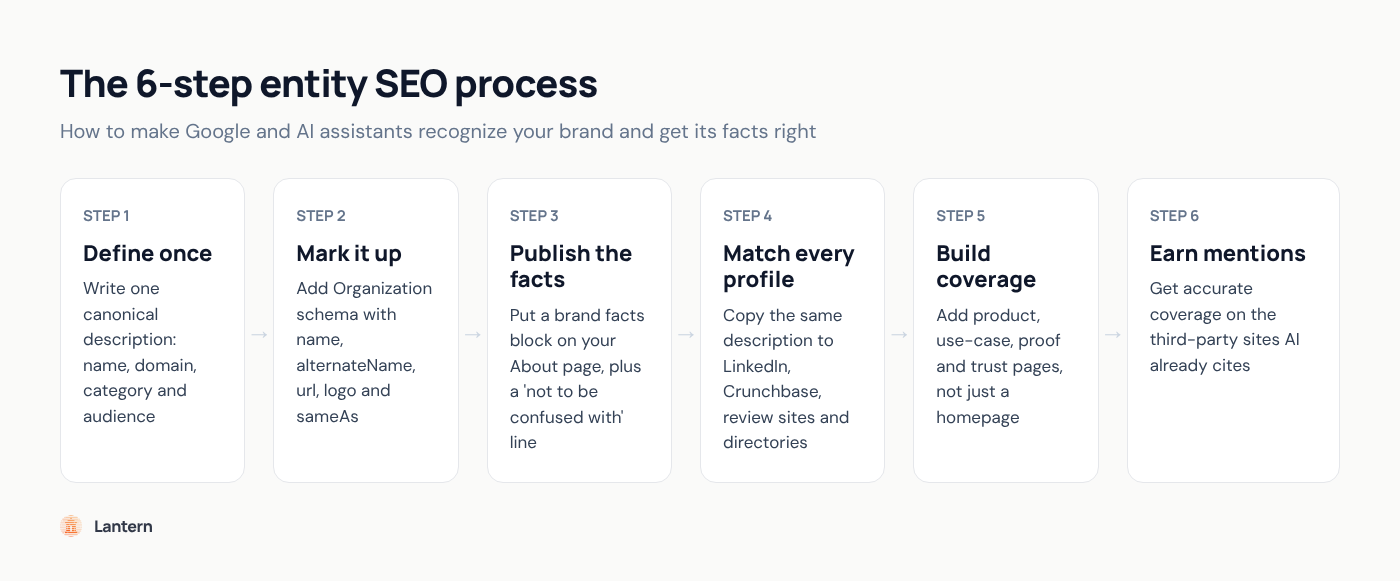
Entity SEO for a brand is six jobs: define yourself once, mark it up, publish the facts, make every profile match, build topic coverage and earn outside confirmation. Do them in that order, because each step depends on the one before.
1. Write one canonical brand description
Write one sentence that says who you are, your category and who you serve, plus a 50 to 80 word version. Name your domain if your name is shared and use the category words buyers use, not a slogan. Store it with approved facts (founding year, headquarters, founders, pricing model, product names) where the whole team can copy it.
2. Add Organization schema to your homepage or About page
Organization schema is structured data (machine-readable code) stating your official name, URL, logo and profiles. Google recommends placing it on your home page or a single page describing your organization, like About. It isn't needed on every page.
Here is a correct JSON-LD example for a made-up company, using properties from Google's Organization guide and the schema.org vocabulary:
{ "@context": "https://schema.org", "@type": "Organization", "@id": "https://www.example.com/#organization", "name": "Northwind", "alternateName": ["Northwind Metrics", "northwind-metrics.com"], "url": "https://www.example.com/", "logo": "https://www.example.com/images/northwind-logo.png", "description": "Northwind is a revenue analytics platform for B2B SaaS finance teams.", "foundingDate": "2022", "sameAs": [ "https://www.linkedin.com/company/northwind-metrics", "https://www.crunchbase.com/organization/northwind-metrics", "https://www.g2.com/products/northwind-metrics/reviews" ]}A few rules that trip teams up:
- sameAs should list only official profiles that clearly identify you. Schema.org defines it as the URL of a page that "unambiguously indicates the item's identity." Add a Wikidata URL only if you have a real item.
- name and alternateName should match the site name you declare in WebSite markup on your home page, per Google's site name documentation.
- logo must be at least 112x112 pixels, per Google's guide.
- description should be your canonical sentence, word for word.
Everything in the markup must also appear on the page. Google's structured data policies say: "Don't mark up content that is not visible to readers of the page." Validate with Google's Rich Results Test. Our structured data skill is a reusable checklist for writing and validating JSON-LD.
3. Publish a brand facts page
Your About page should answer "What is [Brand]?" in its first paragraph, then give a short facts block a model can lift in one piece:
- Official name and any former names
- What the product does and for whom
- Founded, headquarters, founders or leadership
- Pricing model (link to your pricing page)
- Official profiles and contact details
- "Not to be confused with" line, if you have a name collision
A plain sentence like "Northwind is not affiliated with Northwind Traders" gives AI a direct way to separate two entities. If AI tools already get your facts wrong, our guide to correcting AI hallucinations about your brand covers the cleanup process.
4. Make every profile match
Copy your canonical description into every profile you control: LinkedIn, Crunchbase, review directories like G2, Capterra and Product Hunt, Google Business Profile if you have a location, industry and marketplace listings, and your own docs, press kit and llms.txt file.
Check the category, product names, founding year and logo on each, since forgotten profiles are a common source of wrong AI answers. Link each profile back to your site and list the official ones in sameAs.
5. Build topic and entity coverage on your own site
A model associates you with a category when your site explains that category and your role in it. Beyond the Homepage describes a five-layer content architecture, where each layer answers a question an AI system must resolve before recommending a brand:
- Entity foundation: who you are (homepage, About, contact).
- Category proof: what you do (product, service, use-case pages).
- Independent evidence: reviews, comparisons, research, coverage.
- Trust layer: methodology, author, legal, security pages.
- Discovery layer: audience, industry and problem pages.
In that research, ChatGPT leaned on editorial pages (38.1% of owned citations for the strongest brand) while Google AI leaned on product and service pages (53.6%). You need both: pages that explain the category and pages that describe your offer precisely. Use the same product names on every page and link related pages.
6. Earn third-party mentions
Outside confirmation is what turns a claim into an accepted fact. In our citation authority research, independent sources made up 67.7% of ChatGPT and 77.6% of Google AI citation activity for emerging brands. Brand-owned sources made up 1.1% and 0.5%.
Aim for accurate coverage on the publications, comparison pages, review sites and communities that already appear in AI answers for your category, using your real name, category and domain. Our sibling guide on digital PR for AI search covers how to earn those mentions without paid link schemes.
Do you need Wikidata or Wikipedia for entity SEO?
You don't need either, and most young companies shouldn't force it. Wikidata is a public knowledge base many systems draw on, so a correct item can help, but it has rules.
Wikidata's notability policy says an item is acceptable if it meets at least one of three criteria:
- It has a valid sitelink to a Wikimedia page, such as a Wikipedia article.
- It refers to a "clearly identifiable conceptual or material entity" that can be described using "serious and publicly available references."
- It fulfills a structural need, such as making statements in other items more useful.
For most startups, only the second criterion is realistic. That means independent public sources like press coverage or official registries, not your own site or paid listings, and the policy says the final decision "is always up to the community." If you have serious independent coverage, a factual, sourced item is reasonable. If not, focus on steps 4 and 6 first. Wikipedia has its own notability rules, separate from Wikidata's, so read them before anyone on your team creates or edits a page.
Does schema markup help with AI search?
Schema markup helps Google understand your organization and can affect rich results and your knowledge panel. It is not a special switch for AI answers. Google's AI features guide says plainly: "There's also no special schema.org structured data that you need to add," and that there are "no additional requirements to appear in AI Overviews or AI Mode."
Treat Organization schema as part of a consistent entity footprint, not a ranking hack. It's cheap and reduces ambiguity, but it won't fix a brand nobody else talks about.
How to test what AI engines think your brand is
Ask AI engines directly with a fixed prompt set, repeat it across engines and record the answers. Then check Google's view through its Knowledge Panel.
Build a brand entity prompt set
Write 20 to 30 prompts in three groups. Use your real brand name and category.
| Group | Example prompts | What you're checking |
|---|---|---|
| Recognition | What is [Brand]? Who founded [Brand]? Is [Brand] the same as [other company]? | Does it pick the right entity and get basic facts right? |
| Facts | How much does [Brand] cost? What does [Brand] integrate with? Where is [Brand] based? | Are pricing, features and details current? |
| Association | What is [Brand] used for? Who is [Brand] best for? What are alternatives to [Brand]? | Is it linked to the right category, audience and competitors? |
| Discovery | Best [category] tools for [audience]? How do I [problem you solve]? | Does it mention you when your name isn't in the question? |
Run each prompt in ChatGPT, Google AI Mode or AI Overviews, Gemini, Claude and Perplexity. Engines search and cite differently (see our guides on Claude SEO and Perplexity vs ChatGPT). Log the engine, date, answer, whether it picked the right entity, wrong facts and sources cited.
Run each prompt more than once, because AI answers change from run to run. Our AI Recognition Gap report notes that expanding a tracked prompt set from 10 to 100 questions cut variation in reported brand coverage by about 73%.
Expect a gap between recognition and discovery. In the AI Recognition Gap research, ChatGPT correctly identified a tracked brand in 95.0% of answers when the question named it, and Google AI did so in 56.8%. Yet only one of the four brands appeared in a live category test that didn't name it.
Check your Google Knowledge Panel
Search your brand name, then brand plus category, in a private window. Note whether a Knowledge Panel appears, which entity it shows and whether its details are right.
Google's Knowledge Panel help page says panels are created automatically once there's enough public information, and that you can't directly control when they appear. If a panel about you exists, you can get verified, claim it and suggest changes. No panel yet is normal for a young company.
How to measure entity SEO progress
Measure entity SEO as stages, not one score: correct recognition, correct facts, category association, then mentions in unbranded answers.
| Metric | What it tells you | How to check | How often |
|---|---|---|---|
| Correct entity rate | Share of brand prompts that pick you, not a namesake | Recognition prompts across engines | Monthly |
| Fact accuracy | Share of answers with correct pricing, founders, category | Facts prompts, checked against your facts page | Monthly |
| Category association | Whether answers place you in the right category and audience | Association prompts | Monthly |
| Discovery rate | Share of unbranded prompts that mention you | Discovery prompts, 50 to 100 questions | Monthly |
| Knowledge Panel status | Whether Google shows a panel and if it's accurate | Brand searches in Google | Quarterly |
| Profile consistency | How many profiles match your canonical description | Manual audit of every listing | Quarterly |
| Third-party mentions | New accurate mentions on sites AI already cites | Mention tracking and cited-source reports | Monthly |
Report each AI engine separately. One average can hide a strong ChatGPT result and a weak Google AI result. For a full method, see our guide on how to track brand mentions in AI search.
Fix recognition before chasing discovery: If AI tools still confuse you with another company, unbranded "best tools" prompts won't improve much. Get the correct entity rate and fact accuracy close to 100% first, then put effort into category coverage and third-party mentions.
Where Lantern fits
Lantern tracks how AI engines describe and mention your brand: the free plan covers ChatGPT, and Pro ($89/month as of October 2026) covers ChatGPT, Claude, Google and Gemini with 100 Agent Runs a month. Its Brand Kit keeps your approved facts in one place, and its agents research, brief, write and refresh the content that fills your gaps, with a person approving anything that gets published.
It fits marketing teams that want to go from "AI gets us wrong" to finished pages. For a single check, a spreadsheet and the prompt set above will do. If your main gap is press coverage, a PR partner may matter more than software.
To see where you stand today, get a free AI Visibility Report. If you'd rather run the tests yourself, you can start on Lantern's free plan.
Frequently asked questions
What are entities in SEO?
Entities are the distinct real-world things search engines recognize: people, companies, products, places and concepts. Google stores them and their relationships in its Knowledge Graph.
What is the difference between entity SEO and knowledge graph SEO?
People use the terms almost interchangeably. Knowledge graph SEO usually means work aimed at Google's Knowledge Graph and Knowledge Panel specifically. Entity SEO is broader and also covers how large language models like ChatGPT, Claude and Gemini describe your brand.
Does Organization schema get my brand into AI Overviews?
Not on its own. Google says no special schema is needed for AI Overviews or AI Mode; pages must be indexed and eligible for a snippet. Organization schema helps Google understand who you are but guarantees no placement.
How long does entity SEO take to work?
Fixes to your own site and profiles can show up in live-search AI answers once the pages are recrawled. Changes to what models learned in training take longer, because they wait for the next model update. Knowledge Panels depend on enough independent public information, so they usually come last.
What should I do if AI confuses my brand with another company?
Add your domain and category wherever your name appears, use alternateName in your schema and add a "not to be confused with" line to your About page. Then align profiles, earn clear mentions and re-run recognition prompts monthly.