- Answer Engine Optimization
- generative Engine Optimization
ChatGPT Is Building Its Own Search Console for Brands
OpenAI is testing new tools that could let businesses track their mentions, measure clicks, and manage how they appear in ChatGPT. Here's what we know.
Gideon
On this page
OpenAI is testing new tools that could let businesses track their mentions, measure clicks, and manage how they appear in ChatGPT. Here's what we know.
For years, Google Search Console has helped businesses understand how people find them through search.
Now, ChatGPT could be getting something similar.
According to reports from Search Engine Roundtable and Digiday, OpenAI is testing a new set of business tools that would give brands visibility into how they appear in ChatGPT answers.
It's an important development for AI search, and potentially one of the clearest signals yet that OpenAI wants businesses to take their presence in ChatGPT seriously.
What is OpenAI building?
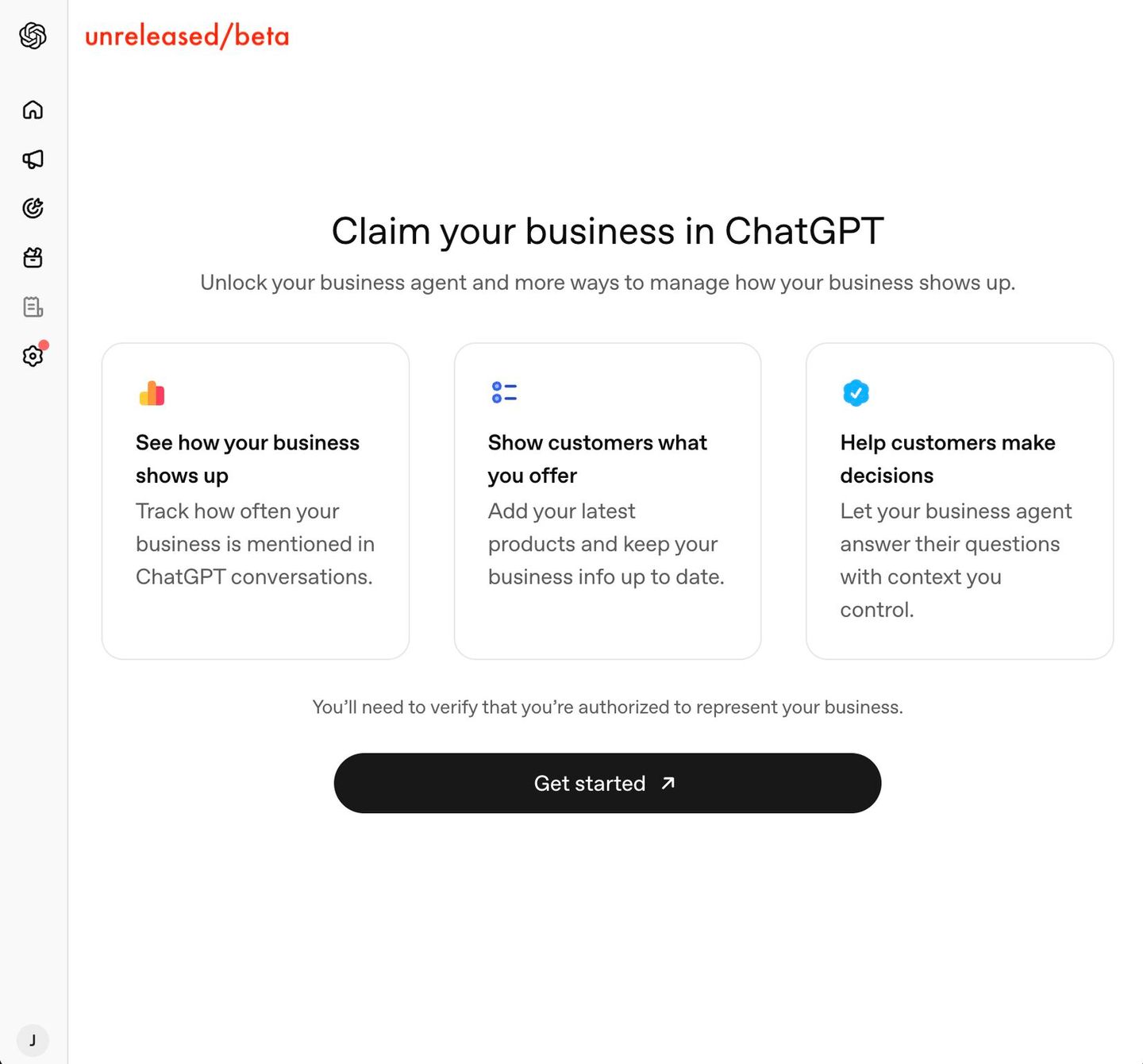
The reported tools sit inside a new ChatGPT Business Hub, which hasn't officially launched.
Businesses would be able to:
- Track brand mentions: See how often their business appears in ChatGPT responses.
- Measure clicks: Understand how many visits ChatGPT sends to their website.
- Manage business information: Keep products and company details up to date.
- Create a business agent: Answer customer questions using information supplied by the business.
Businesses would first need to verify ownership. Connecting a Shopify store is reportedly one way to do this.
The dashboard is expected to show daily impressions and clicks, giving brands a direct view of their performance inside ChatGPT.
For marketers, that's a meaningful change.
Until now, understanding AI search visibility has largely depended on third-party tools that monitor prompts, mentions, citations, and competitors.
OpenAI could soon provide some of that information directly.
But there's a catch
The reported dashboard won't show everything.
According to Digiday, businesses won't be able to see the specific prompts driving mentions, individual user data, or how they compare against competitors.
That means a brand might discover that its ChatGPT mentions increased by 30%, but still struggle to answer:
- Which questions are customers asking?
- Why is ChatGPT recommending us?
- Which competitors are appearing instead?
- What should we do to improve?
Why this matters for GEO
Google gave businesses Search Console, Business Profiles, and eventually an extensive advertising ecosystem.
OpenAI appears to be exploring a similar path.
First, businesses get visibility into how they're discovered. Then they gain more control over their information and how customers interact with them.
There's also a commercial opportunity. As brands become more aware of their presence in ChatGPT, they'll have more reasons to invest in improving it, organically or through advertising.
For GEO, this could make AI search performance a more established part of marketing reporting.
Instead of asking whether ChatGPT matters, teams may increasingly ask how much visibility they're getting and whether it's improving.
What should brands do now?
There's no confirmed public launch date for ChatGPT Business Hub, and OpenAI has not officially announced the tools.
But brands don't need to wait to start preparing.
Start by understanding where you stand.
Look at which competitors get recommended when buyers ask about your category, and the sources influencing those answers.
Then identify where your brand is missing, underrepresented, or inaccurately described.
Most importantly, turn those findings into action through better content, stronger positioning, and ongoing optimization.
At Lantern, that's the approach we're building around: connecting AI search intelligence with the agents that can act on it.
As AI search analytics become more accessible, simply knowing your visibility score won't be enough.
The next advantage will come from knowing what to do with it.