- generative Engine Optimization
How to Optimize Content for LLMs and AI Search
What Google, Microsoft and independent research say actually works when writing for AI search, turned into a practical checklist for marketing teams.
 Collins
On this page
- Key takeaways
- What the platforms actually say
- How AI tools read your page
- What the research says works
- How to optimize content for LLMs: a practical checklist
- 1. Start from the questions, not the keyword
- 2. Give every section a clear heading and a direct answer
- 3. Add evidence to every major claim
- 4. Use lists and tables for comparisons and steps
- 5. Keep key content visible and in HTML
- 6. Show who wrote it and why they know
- 7. Keep your facts consistent across the web
- 8. Update your top pages on a schedule
- 9. Earn mentions on the sites AI already trusts
- What not to do
- How to tell if it's working
- Our recommendation
- FAQ
- How do I optimize content for LLMs?
- Do I need to write differently for AI search?
- Should I break my content into chunks for AI?
- Does schema markup help with AI search?
- Does llms.txt help with AI search?
- What content gets cited most by AI tools?
There's a lot of advice about writing for AI, and much of it contradicts itself. Some guides say to chop pages into small chunks. Others say to add special files and markup. Google now says you need neither.
This guide sticks to what the platforms themselves have published, what independent research has tested, and what Lantern's citation data shows. Then it turns that into a practical checklist for marketing and content teams.
Key takeaways
- There is no separate "AI writing style". Google says AI features run on its core search systems and need no special formatting, schema or files.
- Structure still matters. Microsoft says AI assistants break pages into smaller pieces and pick the best ones, so clear headings and direct answers help.
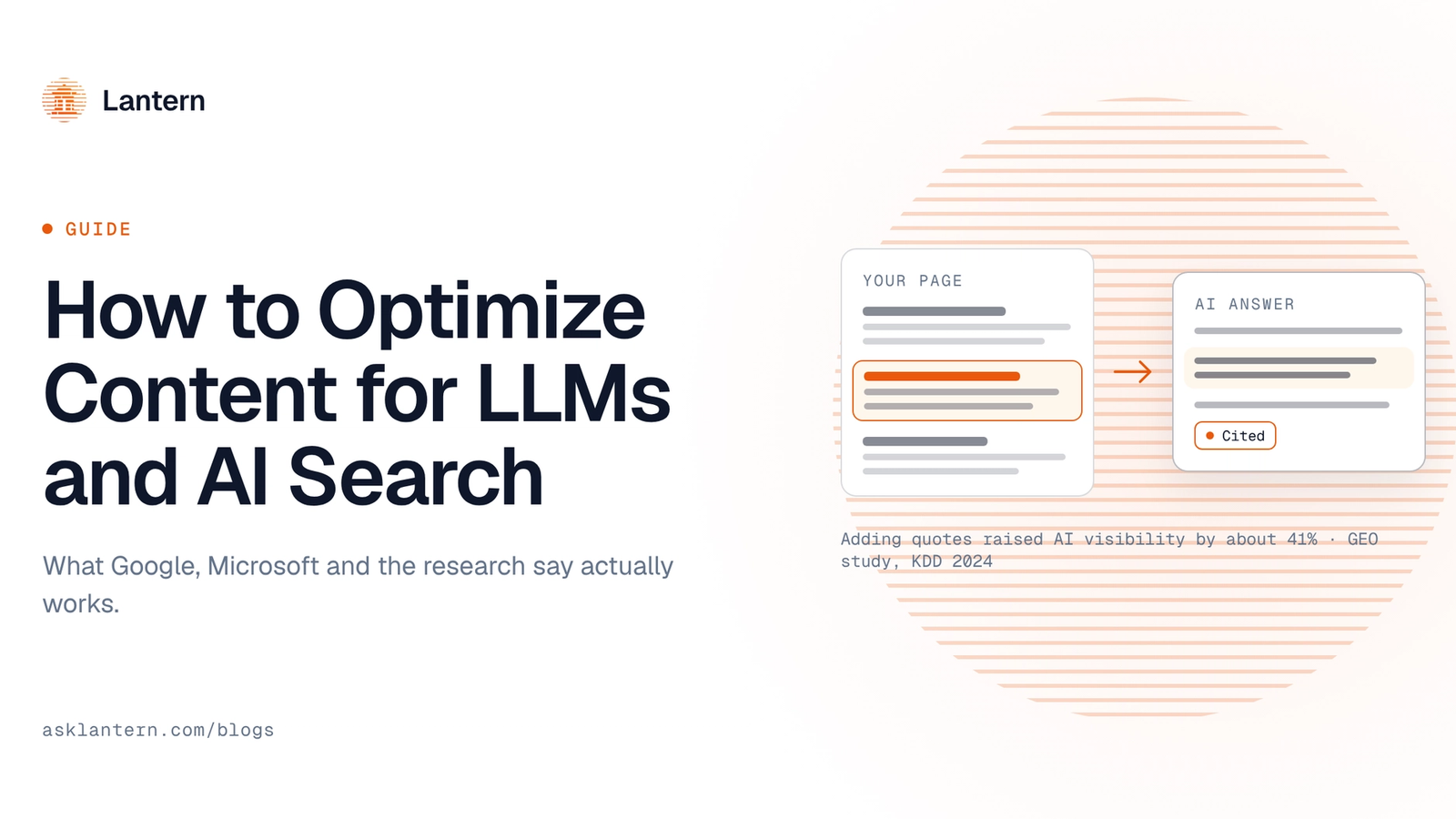
- Evidence beats keywords. In a Princeton and IIT Delhi study, adding quotes and statistics raised visibility in AI answers by about 41% and 31%. Keyword stuffing made it worse.
- Original content wins. Google asks for "non-commodity" content: first-hand experience and a real point of view, not a summary of other pages.
- Your own page is only part of it. In Lantern's data, 91% of brand citations in AI answers come from other websites.
What the platforms actually say
Before changing anything, it helps to know what Google and Microsoft have said on the record. They agree on most points and differ on a few.
| Topic | Google (AI optimization guide, July 2026) | Microsoft (Bing guidance, October 2025) |
|---|---|---|
| Is AI search different from SEO? | No. AI features use Google's core ranking systems | SEO basics still apply, but AI picks individual pieces of a page |
| Page structure | Clear headings and sections help | Specific headings act "like chapter titles" for AI |
| Breaking content into chunks | Not required. There's "no ideal page length" | Avoid long walls of text that "blur ideas together" |
| Special writing style | Not needed. AI understands synonyms and meaning | Clear question-and-answer pairs can be lifted "word for word" |
| Schema markup | No special AI schema. Normal structured data still helps | Recommended, so machines can read your data "with confidence" |
| llms.txt | Google Search doesn't use it | Not covered |
| Hidden content | Not covered | AI may skip content hidden in tabs or menus |
Sources: Google's AI optimization guide and Microsoft's guide to inclusion in AI search answers.
What this means for you: write for people, with clear structure. Don't chop good pages into fragments, and don't rely on special files or markup to do the work.
How AI tools read your page
AI search tools don't read a page from top to bottom the way a person does. Microsoft puts it plainly: they break pages into smaller pieces, rank those pieces, and assemble the best ones into an answer.
Before that, they decide what to look for. Google, ChatGPT and Perplexity often split one question into many smaller searches, a process Google calls query fan-out. Your page competes for each of those smaller searches separately.
Two things follow:
- Each section has to make sense on its own. If a key point only works after three paragraphs of setup, it's hard for an AI to lift.
- Covering the whole topic matters more than one keyword. A page that answers the main question but skips pricing, setup or alternatives misses most of the searches behind it.
What the research says works
The best independent evidence comes from the original GEO study, published by researchers from Princeton University and IIT Delhi and presented at the KDD 2024 conference. They tested different edits to web pages and measured how visible each page became in AI-generated answers. You can read the full paper on arXiv.
- Adding quotes from credible sources increased visibility by about 41%, the biggest gain.
- Adding statistics increased it by about 31%.
- Citing sources increased it by about 27%.
- Improving readability increased it by about 28%.
- Keyword stuffing made visibility about 8% worse.
Lower-ranked pages gained the most. In one test, citing sources raised visibility for pages in fifth position by 115%.
Lantern's own data, from more than 200 million AI citations, adds three patterns:
- Lists are the most-cited format, at 35.6% of all citations. Comparison content makes up 9% to 14% across AI tools. More in The Content Format That Wins AI Citations.
- Fresh pages get picked. 62% of the most-cited pages were published in the past six months.
- Other websites matter most. 91% of brand citations come from pages the brand doesn't own.
What this means for you: the edits that work for AI are the same ones that make content more trustworthy to people. Evidence, specifics and clear writing.
How to optimize content for LLMs: a practical checklist
Use this on your most important pages first, starting with the ones that target your buyers' main questions.
1. Start from the questions, not the keyword
List the smaller questions behind your page's main topic. Use Google's "People also ask", your sales calls, and a fan-out tool. Group them into 6 to 8 topics, such as pricing, setup, integrations, alternatives and who it's for. Then check which ones your page answers.
2. Give every section a clear heading and a direct answer
Use headings that say what the section covers, ideally in the words your buyers use. Start each section with a one- or two-sentence answer, then add the detail. Microsoft notes that clear question-and-answer pairs can be lifted almost word for word.
3. Add evidence to every major claim
Include real numbers with their source and date, short quotes from named experts or customers, and links to primary sources. If you have original data, such as survey results, usage data or test results, put it on the page. It's what competitors can't copy.
4. Use lists and tables for comparisons and steps
When readers compare options or follow a process, a table or a numbered list is clearer for people and easier for AI to reuse.
5. Keep key content visible and in HTML
Don't hide important answers in tabs, accordions, images or PDFs. Many AI crawlers can't read content that loads with JavaScript, and Microsoft warns that hidden content may be skipped.
6. Show who wrote it and why they know
Add a named author with relevant experience, explain how you tested or researched the topic, and show when the page was last updated. Google's guidance asks for first-hand experience and a real point of view.
7. Keep your facts consistent across the web
Your company name, product names, pricing and positioning should match on your website, review profiles, directories and social pages. Mixed signals lead to wrong or missing answers. Our guide to entity SEO for AI search explains how.
8. Update your top pages on a schedule
Refresh facts, figures and examples every few months. Change the content, not just the date. Google warns against updating dates to look fresh. Our post on why old content loses AI citations has a refresh plan.
9. Earn mentions on the sites AI already trusts
Find the review sites, industry roundups and publications that appear for your buyers' questions, and work to be included there. Our digital PR for AI search guide covers how. Google notes that chasing fake or paid mentions "isn't as helpful as it might seem".
What not to do
- Don't mass-produce thin pages. Google ties this to its scaled content abuse policy, whether the pages are written by people or AI.
- Don't stuff keywords or variations. The GEO research found it hurt visibility, and Google says its AI understands synonyms.
- Don't chop pages into tiny fragments. Google says chunking isn't required. Write complete sections with clear headings instead.
- Don't expect llms.txt to help in Google. Google Search doesn't use it. Some other AI tools may, so it does no harm. Our llms.txt guide covers when it's worth it.
- Don't hide your best answers. Content in tabs, images and PDFs is easy for AI to miss.
How to tell if it's working
Pick 30 to 50 questions your buyers ask and run them on ChatGPT, Google AI Overviews and AI Mode, Gemini, Perplexity and Claude every month. For each one, record whether your brand is mentioned, which of your pages are cited, and which other sites appear instead. In Google Search Console, check the Generative AI performance report alongside your usual Performance report.
Lantern tracks this across the major AI tools, shows which pages are winning the citations you're missing, and helps your team update content to close the gaps. Our guide to LLM SEO covers the wider strategy.
Our recommendation
Don't rewrite your site for AI. Improve your most important pages so they answer every question a buyer has, with a clear heading and a direct answer for each, backed by real evidence. Then put the same effort into what other websites say about you. That combination works in Google, ChatGPT and every other AI tool, because they're all looking for the same thing: clear, trustworthy answers.
FAQ
How do I optimize content for LLMs?
Cover the full topic your buyers ask about, give each section a clear heading and a direct answer, and back your claims with numbers, quotes and sources. Keep key content visible in HTML, keep your facts consistent across the web, and update important pages regularly.
Do I need to write differently for AI search?
No. Google says there's no special writing style for AI and that its systems understand synonyms and meaning. Clear, well-structured, evidence-based content works for both people and AI.
Should I break my content into chunks for AI?
Google says chunking isn't required and there's no ideal page length. Microsoft advises against long walls of text. The practical answer is to write complete sections with clear headings, each starting with a direct answer.
Does schema markup help with AI search?
Google says no special schema is needed for its AI features, but normal structured data still helps your pages in Search. Microsoft recommends schema so machines can read your data reliably. Use accurate structured data that matches the page.
Does llms.txt help with AI search?
Google says Google Search doesn't use llms.txt. Some other AI tools may read it, so adding one does no harm, but don't expect it to improve your visibility in Google.
What content gets cited most by AI tools?
In Lantern's analysis of more than 200 million AI citations, lists were the most-cited format at 35.6%, and 62% of the most-cited pages were published in the past six months. Pages with clear answers, real data and comparisons tend to be cited most.