Why Your Old Content Is Losing AI Citations
62% of the most cited pages in AI search were published in the last 6 months. Here's why freshness matters, which content to refresh first, and how to do it right.
On this page
On this page
There is a specific kind of content graveyard that most marketing teams have built without realizing it.
It sits in the blog archive. Posts from 2022 and 2023 that ranked well, drove traffic for a year, and then quietly faded. Guides that took weeks to produce and now generate a trickle of organic visits. Case studies that were accurate when published and have not been touched since. Comprehensive resource pages that covered the category thoroughly at the time.
For traditional SEO, old content with established authority still pulls its weight. A well-linked page from three years ago can hold a first-page ranking for years with minimal intervention. The accumulation of backlinks, domain authority, and search history creates a kind of momentum that keeps older content relevant longer than its publication date would suggest.
AI search does not work the same way.
Lantern's February 2026 AI Citation Content Visibility Report based on analysis of over 200 million citations across ChatGPT, Perplexity, Gemini, and Claude found that 62% of the most cited pages were published within the last six months. Content published in the last three months alone accounts for 37% of all top citations. Pages more than two years old account for just 9%.
For marketing teams that have built their content strategy around a library of established evergreen content, this data requires a direct response.
Why Freshness Matters More to AI
To understand why AI engines weight freshness so heavily, it helps to understand what they are trying to do when they select a citation source.
Google's ranking algorithm has decades of accumulated signal backlink history, user engagement data, domain authority built across millions of pages over years. When Google ranks a two-year-old page highly, it is drawing on a rich body of evidence that the page has consistently satisfied user intent over time.
AI engines are working from a different premise. They are synthesizing answers to questions in real time, and they are making judgments about source reliability with less historical signal than Google has accumulated. In the absence of that deep historical evidence, freshness becomes a proxy for accuracy. A page published last month is more likely to reflect the current state of a fast-moving topic than a page published two years ago. AI engines have learned this heuristic and apply it when selecting which sources to cite.
This is particularly pronounced in categories where the underlying information changes rapidly. AI search itself is one of the fastest-moving topics in technology. A guide to AI search visibility published in early 2024 may be technically accurate about concepts that have not changed but structurally outdated about the tools, platforms, and citation patterns that have evolved significantly in the intervening period. AI engines, when constructing an answer about AI search visibility in 2026, have strong reasons to prefer a source published in late 2025 or early 2026 over one from two years prior.
The same logic applies across most B2B SaaS categories. Pricing changes. Features change. Competitive landscapes shift. Regulatory environments evolve. The content that was the most accurate answer to a question in 2023 may be a misleading answer to the same question in 2026 and AI engines have enough signal to recognize the difference.
The Freshness Distribution in Detail
Lantern's citation data breaks down the freshness distribution of the most cited pages as follows:
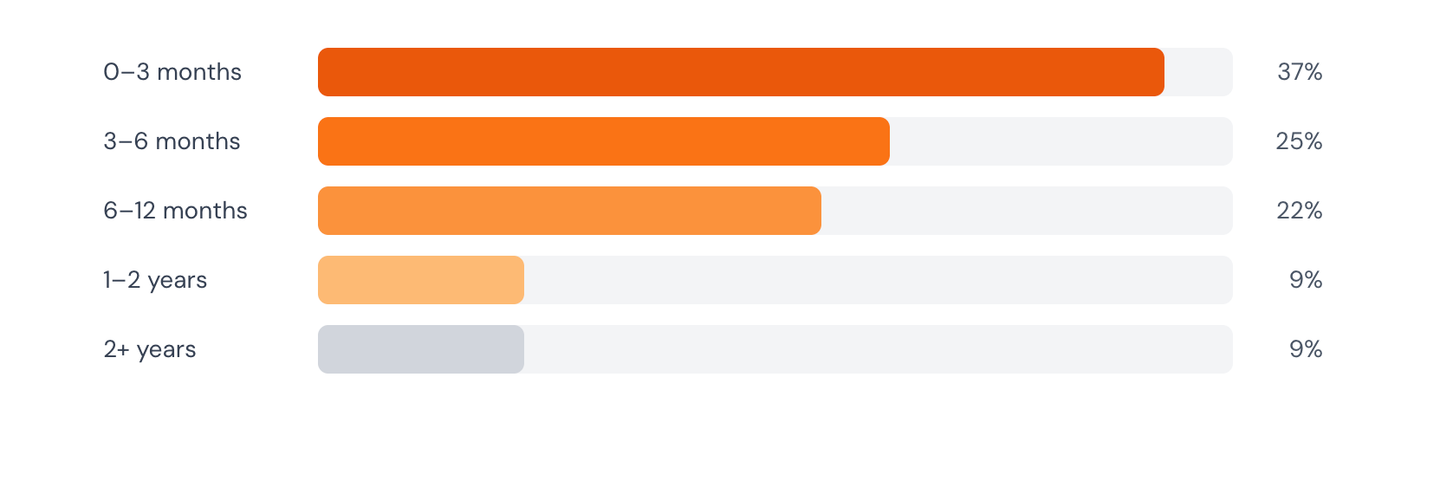
Source: Lantern AI Citation Content Visibility Report, February 2026
Two observations are worth examining carefully.
First, the drop-off between the 6–12 month bracket and the 1–2 year bracket is steep. Content that is six to twelve months old still earns 22% of top citations a meaningful share. Content that crosses the one-year threshold drops to 9%. The one-year mark appears to be a significant inflection point in AI citation eligibility, at least in fast-moving categories.
Second, the 2+ year bracket holds steady at 9% identical to the 1–2 year bracket. This is the high-authority exception at work. The pages earning citations from content that is more than two years old are predominantly on domains with exceptional authority YouTube, G2, Reddit, major publications with decades of indexed content. For most brand-owned content, the 2+ year bracket is effectively zero. The pages holding that share are not typical blog posts from mid-market B2B companies. They are the most authoritative pages on the most authoritative domains on the internet.
The practical implication is direct. For most marketing teams, content older than twelve months is competing for a small and shrinking share of AI citations and the competition for that share is against platforms with structural authority advantages that most brands cannot replicate.
The High-Authority Exception and Why It Does Not Apply to Most Brands
The one nuance in the freshness data that requires careful interpretation is the domain authority override.
Lantern's data confirms that pages on high-authority domains continue to earn citations regardless of age. A Wikipedia article from 2015, a G2 review from 2022, a YouTube video from 2019 these continue to surface in AI citations not because they are fresh but because the domains they sit on have accumulated authority signals that AI engines treat as reliability proxies independent of recency.
This exception is real but narrow. It applies to domains with domain authority scores in the top percentile the Reddits, the G2s, the YouTubes, the major publications. It does not apply to the typical brand-owned blog, regardless of how well that blog has performed historically.
A B2B SaaS company with strong organic rankings and a respected industry blog is not in the same authority tier as these platforms. Its content does not benefit from the same authority override. For brand-owned content, freshness is not a tiebreaker. It is a primary criterion.
What "Fresh Content" Actually Means for AI Citations
The freshness signal AI engines use is not simply publication date. It encompasses several factors that marketing teams can influence directly.
Publication date and dateModified markup. The most direct freshness signal is the datePublished and dateModified properties in a page's structured data markup. AI engines read these values explicitly. A page with a dateModified value from last month is treated as recently updated regardless of its original publication date. A page with no dateModified markup or one that has not been updated since publication is assessed against its original publication date only.
The critical distinction is that dateModified should reflect substantive updates, not cosmetic ones. Changing a word in a sentence does not constitute a meaningful update for AI citation purposes. Adding new data, revising outdated statistics, expanding sections with current information, updating competitive comparisons, or restructuring content to improve extractability these constitute substantive updates that justify a refreshed dateModified date.
Content accuracy against current reality. AI engines cross-reference claims in content against other sources they trust. A page that states statistics or facts that are contradicted by more recent sources loses citation confidence regardless of its freshness markup. Updating the dateModified date without updating the underlying content does not improve AI citation rates — and may actively harm them if the AI engine detects inconsistencies between the page's claimed recency and its factual currency.
Structural updates that improve extractability. A content refresh that adds FAQ schema, improves header specificity, adds a summary section, or restructures prose into a more extractable format improves AI citation eligibility beyond the freshness signal alone. The most effective content refreshes address both recency and structure simultaneously.
How to Identify Which Old Content to Refresh First
Not all old content is worth refreshing. The investment in a content refresh should be prioritized against the return it is likely to generate which depends on the topic's relevance to current buyer queries, the page's existing authority, and the gap between its current state and what AI engines are citing in the same space.
Start with high-traffic pages that have declined. Pages that historically drove significant organic traffic but have seen consistent decline over the past 12 months are the highest-priority refresh candidates. They have established authority, inbound links, and indexed history assets that a refreshed piece can leverage immediately. The decline signals that the content is no longer satisfying current search intent, which almost always correlates with reduced AI citation eligibility.
Identify pages covering fast-moving topics. Any content covering AI tools, marketing technology, competitive landscapes, pricing, regulatory environments, or market statistics is almost certainly outdated in ways that affect AI citation eligibility. These pages require substantive updates not a paragraph added at the bottom noting that "the landscape has evolved since this was published," but a genuine revision that reflects the current state of the topic throughout.
Cross-reference against your prompt coverage gaps. Lantern's prompt gap analysis identifies the queries your buyers are directing at AI engines where your brand is not appearing. For each gap, check whether you have existing content that covers the topic even if that content is outdated. An existing page on a relevant topic, refreshed to reflect current information and optimized for AI extraction, will outperform a new page on the same topic in almost every case because it starts with established authority rather than building from zero.
Deprioritize content on stable topics. Not all content ages equally. A foundational explainer on a concept that has not changed significantly is less urgent to refresh than a competitive comparison or a statistics-heavy industry overview. Apply your refresh investment where the underlying information has actually changed, not uniformly across the archive.
The Refresh Process That Maximizes AI Citation Eligibility
A content refresh optimized for AI citations is not the same as a light editorial update. It is a structured process that addresses freshness, accuracy, structure, and extractability simultaneously.
Audit the existing content against current reality. Before writing a single new word, identify every claim in the existing piece that is outdated, every statistic that has a more current version, every competitive reference that no longer reflects the market, and every tool or platform mentioned that has changed significantly. This audit is the foundation of the refresh. Content that is updated superficially without addressing substantive inaccuracies loses citation confidence even with a refreshed date.
Update all data points to the most current available sources. Every statistic should reference the most recent study or report available. Every competitive comparison should reflect current product capabilities and pricing. Every tool recommendation should account for what has launched, changed, or been discontinued since the original publication. AI engines cross-reference factual claims. Current data increases citation confidence. Outdated data reduces it.
Add a summary section at the top. A concise summary of the page's key points placed before the main content rather than at the end gives AI engines an immediately extractable overview of the piece's content. This is the section most likely to be cited when an AI engine needs a brief, attributable answer rather than a deep explanation. A three to five sentence summary that captures the page's core argument and most important data points is a high-value addition to any refreshed piece.
Restructure for extractability. Review every H2 and H3 for standalone claim value. Headers that read as document navigation labels "Overview," "Introduction," "Further Reading" should be replaced with headers that make specific, citable claims. Add FAQ schema for the questions the page addresses. Ensure the opening paragraph of each section places its primary claim before elaboration. These structural changes improve AI citation eligibility independent of the freshness update.
Update internal links. A content refresh is an opportunity to connect the updated piece to newer content your team has published since the original publication date. Updated internal links signal to both traditional search engines and AI engines that this piece is integrated into your current content ecosystem rather than an orphaned archive entry.
Update dateModified only after all substantive changes are complete. The dateModified date should reflect when meaningful updates were made, not when the refresh process was initiated. Set it after the content, structure, and data have all been revised.
Building a Sustainable Refresh Cadence
A one-time content refresh initiative addresses the current backlog but does not solve the underlying problem. Content ages continuously. The refresh cadence that maximizes AI citation eligibility is one that is built into the ongoing content operation rather than treated as a periodic project.
The practical approach is to segment your content library by refresh priority and assign each segment a review interval. Fast-moving topics competitive comparisons, tool roundups, statistics-heavy industry overviews, pricing guides should be reviewed every three to six months. Conceptual explainers and process guides that cover stable fundamentals can be reviewed annually. Foundational reference content on slow-changing topics can operate on an eighteen-month review cycle.
Lantern's site audit surfaces content freshness gaps automatically identifying pages with stale dateModified dates that cover topics where more recent competitor content is earning citations. This removes the manual work of auditing the archive and ensures that the highest-priority refresh candidates surface before the gap has been open long enough to significantly affect AI search visibility.
The teams that build refresh cadence into their content operations rather than treating it as reactive work triggered by traffic decline maintain AI citation eligibility across their content library as a continuous state rather than recovering it periodically after it has been lost.
Key Takeaways
- 62% of the most cited pages in AI search were published within the last six months content freshness is a primary citation criterion, not a tiebreaker
- The one-year mark is a significant inflection point content older than twelve months competes for a sharply reduced share of AI citations in most categories
- The high-authority domain exception applies to platforms like YouTube, G2, and Reddit not to typical brand-owned content regardless of historical performance
- Freshness for AI citations encompasses
dateModifiedmarkup accuracy, factual currency against current sources, and structural updates that improve extractability not publication date alone - Refresh priority should go to high-traffic pages in decline, content covering fast-moving topics, and pages that map to current prompt coverage gaps identified in your AI citation audit
- The most effective content refreshes address accuracy, structure, and extractability simultaneously not just the
dateModifieddate - A sustainable refresh cadence segmented by topic volatility and built into ongoing content operations maintains AI citation eligibility continuously rather than recovering it after decline
Lantern identifies which pages in your content archive are losing AI citation eligibility due to freshness gaps and surfaces them as prioritized refresh candidates before the gap affects your visibility. Start your free trial at asklantern.com