- Answer Engine Optimization
- generative Engine Optimization
Where Does ChatGPT Get Its Information?
Where ChatGPT gets its information, from training data to live web search, which websites it actually cites, and how brands can influence what it says.
 Collins
On this page
- Key takeaways
- ChatGPT's information sources at a glance
- Source 1: Training data
- Source 2: Web search
- Source 3: Live page visits
- Source 4: Product data for shopping questions
- Source 5: The user's own context
- Which websites ChatGPT cites
- Why ChatGPT gets brand facts wrong
- How to influence what ChatGPT says about your brand
- How to measure it
- Our recommendation
- FAQ
- Where does ChatGPT get its information?
- Does ChatGPT use Google or Bing?
- Is ChatGPT's information up to date?
- How do I get my website cited by ChatGPT?
- Can I stop ChatGPT from using my content?
- Why does ChatGPT say wrong things about my brand?
ChatGPT gets its information from two main places: what its model learned during training, and what it finds by searching the web while it answers. For brands, the second source matters most, because it decides which websites ChatGPT cites and links to today.
This guide explains each source ChatGPT draws on, which websites it actually cites based on Lantern's analysis of more than 200 million AI citations, and what your team can do to show up in its answers.
Key takeaways
- ChatGPT answers from training data, live web search, product data and the user's own context. Each source works differently and is influenced differently.
- Web search decides citations. When ChatGPT searches, it pulls from an index built by OpenAI's search bot, OAI-SearchBot, and from third-party search providers including Bing.
- Most of what ChatGPT says about your brand comes from other websites. 91% of brand citations in Lantern's data point to third-party sources.
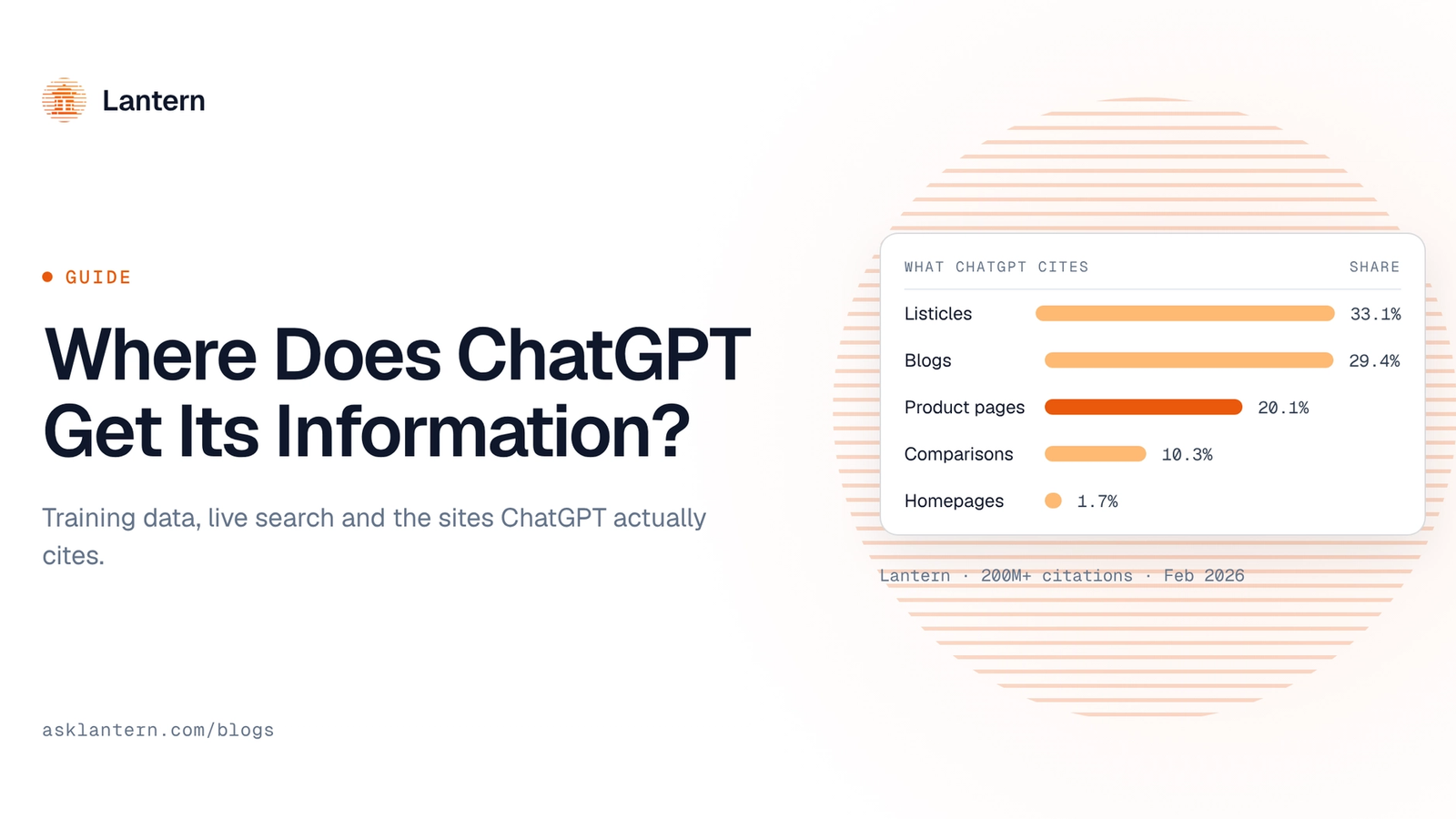
- ChatGPT cites product pages far more than other AI engines, at 20.1% of its citations against 0.4% for Perplexity.
- You can't edit what the model learned, but you can change what it finds. Fresh, accurate, crawlable pages and strong third-party coverage are how you do it.
ChatGPT's information sources at a glance
| Source | What it is | When ChatGPT uses it | How you can influence it |
|---|---|---|---|
| Training data | Text the model learned from before its knowledge cutoff | Every answer, as background knowledge | Slowly, through what the public web says about you over time |
| Web search | Live search results from OpenAI's index and partners such as Bing | Questions about recent events, prices, products, comparisons and anything that benefits from current sources | Allow OAI-SearchBot, publish clear current pages, earn third-party coverage |
| Live page visits | ChatGPT opening a specific page a user asks about | When a user shares a link or asks about a specific page | Keep important content in the page HTML |
| Product data | Product listings and merchant information | Shopping questions | Keep product pages and product feeds accurate |
| The user's own context | Memory, uploaded files and connected apps | When a user has turned these on | You can't influence this directly |
Source 1: Training data
ChatGPT's underlying model learned from a large body of text before its knowledge cutoff. OpenAI lists three sources for that training data:
- Publicly available information on the internet, collected by OpenAI's training crawler, GPTBot.
- Information from third-party partners, such as licensed content.
- Information from users, human trainers and researchers, including conversations from users who haven't opted out.
OpenAI filters this data, avoids paywalled content and removes sites that collect large amounts of personal information.
Training data gives ChatGPT its general knowledge: what a product category is, which brands are well known, how a process works. It doesn't update between model releases. If your brand changed its pricing, product or positioning after the cutoff, the model's built-in knowledge may still describe the old version.
What this means for you: you can't edit what a model has already learned. You can only shape what future models learn, by making sure accurate information about your brand is widely published. Blocking GPTBot keeps your content out of future training, but it doesn't remove anything already learned and it doesn't affect ChatGPT search.
Source 2: Web search
ChatGPT searches the web automatically when a question is likely to benefit from current information, and users can also turn search on themselves. This is where citations come from: answers that use search show inline links and a list of sources.
ChatGPT search draws on two kinds of index:
- OpenAI's own index, built by its search crawler, OAI-SearchBot. If your robots.txt blocks OAI-SearchBot, your pages won't appear as sources in ChatGPT search answers.
- Third-party search providers, including Bing. ChatGPT sends search queries to partners without information that identifies the user, along with a general location to improve local results.
For a single question, ChatGPT often runs several searches covering different angles, a technique known as query fan-out. A question about the best project management tool for a small agency might lead to searches for pricing, reviews and comparisons. Pages that answer those sub-questions clearly have more chances to be cited.
What this means for you: allow OAI-SearchBot and Bingbot in robots.txt, and check your CDN or firewall isn't blocking them. Our AI crawler list covers the full setup.
Source 3: Live page visits
When a user pastes a link or asks ChatGPT to look at a specific page, it fetches that page in real time using a separate agent, ChatGPT-User. Because a person asked for the visit, robots.txt rules may not apply to it in the same way.
ChatGPT's crawlers read the HTML your server sends. They don't run JavaScript, so content that only appears after scripts run, such as some pricing tables or product details, may be invisible to ChatGPT even when a user asks about that exact page.
Source 4: Product data for shopping questions
For shopping questions, ChatGPT shows product results with images, prices and links to retailers. It builds these from product information across the web, including merchant product feeds and retailer pages.
This is where ChatGPT differs most from other AI engines. In Lantern's data, product pages make up 20.1% of ChatGPT's citations, against 0.4% for Perplexity and Gemini. Our guide to ChatGPT shopping explains how products get recommended.
Source 5: The user's own context
ChatGPT also uses information the user gives it: past conversations through memory, files they upload and apps they connect, such as email or cloud storage. ChatGPT can now show which saved memories informed an answer.
This source is personal to each user, so brands can't influence it directly. It does explain why two people can get different answers about the same brand: their history and settings differ.
Which websites ChatGPT cites
ChatGPT cites a mix of formats, but it leans more on product pages and less on brand homepages than any other engine. These figures come from Lantern's AI Citation Content Visibility Report, based on more than 200 million citations collected from the live interfaces of ChatGPT, Perplexity, Gemini and Claude in February 2026.
| Content type | Share of ChatGPT citations | Average across Gemini, Perplexity and Claude |
|---|---|---|
| Listicle | 33.1% | 43.8% |
| Blog or guide | 29.4% | 26.2% |
| Product page | 20.1% | 1.0% |
| Comparison | 10.3% | 11.9% |
| Homepage or brand page | 1.7% | 9.1% |
| Review or aggregator | 2.1% | 2.2% |
Three patterns stand out:
- Third-party sources dominate. Across engines, 91% of brand citations come from sites the brand doesn't own. In our research on emerging brands, brand-owned sources made up just 1.1% of ChatGPT citation activity.
- Independent platforms lead. YouTube, G2, Medium, AppSumo and Zapier were the most-cited domains across AI engines in February 2026.
- Sources change quickly. Reddit's share of visible ChatGPT citations fell from 3.83% to 0.52% between July and August 2026. A strategy built on one platform can lose visibility overnight.
Freshness matters too. In the same dataset, 62% of the most-cited pages across AI engines had been published in the last six months.
Why ChatGPT gets brand facts wrong
When ChatGPT describes your brand inaccurately, the cause is almost always one of these:
- Outdated training data. The model learned an old version of your pricing or product, and the question didn't trigger a search.
- Thin third-party coverage. Few independent sources describe you, so ChatGPT fills gaps from weak or old pages.
- Conflicting sources. Review sites, directories and your own pages say different things, and ChatGPT picks one.
- Content it can't read. Key facts load with JavaScript, or a bot block stops ChatGPT from reaching your pages.
Our guide to correcting AI mistakes about your brand walks through fixes for each.
How to influence what ChatGPT says about your brand
You can't submit information to ChatGPT directly, but you can control most of what it finds. Work through these steps in order.
- Open the door. Allow OAI-SearchBot, ChatGPT-User and Bingbot in robots.txt, and confirm your CDN isn't blocking them. Make sure key content is in the page HTML.
- Make your own facts easy to find. Publish clear product, pricing and comparison pages that state who you're for and what you do in plain words near the top. These are the pages ChatGPT cites at 20.1%.
- Fix inconsistent facts across the web. Update your profiles on review sites, directories, LinkedIn and partner pages so they match your website.
- Earn independent coverage. Detailed customer reviews, comparison articles, YouTube videos and press coverage give ChatGPT trustworthy sources to cite.
- Publish the formats ChatGPT cites. Listicles, guides and comparison pages make up more than 70% of its citations.
- Keep pages current. Refresh important pages with real updates at least every six months.
How to measure it
Track ChatGPT separately from other engines, because its sources and formats differ. Three measures matter most:
- Mention rate: how often ChatGPT names your brand for the prompts your buyers ask, across 50 to 100 prompts.
- Citation sources: which pages and domains ChatGPT cites when it talks about your category, and whether any of them are yours.
- Referral traffic and conversion: visits from chatgpt.com in GA4, set up as a separate AI referral channel so they aren't hidden in direct traffic.
Lantern tracks all three across ChatGPT and the other major AI engines, and shows which sources drive each mention.
Our recommendation
Focus on what ChatGPT finds, not what it learned. Training data changes slowly and you can't edit it. Search results change every day, and they decide which brands ChatGPT cites and links to.
Start with access and accuracy: let OAI-SearchBot in, and make your own product and pricing facts clear. Then put most of your effort into the third-party sources that make up the bulk of ChatGPT's citations. For more on the ChatGPT-specific plan, see our guide on how to rank in ChatGPT.
FAQ
Where does ChatGPT get its information?
ChatGPT uses what its model learned in training, live web search, real-time visits to pages users ask about, product data for shopping questions, and the user's own memory, files and connected apps. For questions about current products and brands, web search is usually the main source.
Does ChatGPT use Google or Bing?
ChatGPT search uses OpenAI's own index, built by OAI-SearchBot, and third-party search providers including Bing. That's why being crawlable by both OAI-SearchBot and Bingbot matters for ChatGPT visibility.
Is ChatGPT's information up to date?
Its built-in knowledge stops at the model's training cutoff, but ChatGPT searches the web for questions that need current information. Answers without search can still reflect older facts.
How do I get my website cited by ChatGPT?
Allow OAI-SearchBot in robots.txt, put clear answers in your page HTML, keep pages current and earn coverage on independent sites. Product, comparison and listicle pages are cited most often.
Can I stop ChatGPT from using my content?
Yes. Blocking GPTBot keeps your content out of future model training, and blocking OAI-SearchBot removes your pages from ChatGPT search answers. Most brands should block neither, because both reduce how much ChatGPT knows about them.
Why does ChatGPT say wrong things about my brand?
Usually because of outdated training data, thin or conflicting third-party information, or pages ChatGPT can't read. Fixing your own facts, aligning your profiles across the web and earning fresh coverage corrects most errors over time.