10 Most-Cited Domains Across ChatGPT, Perplexity, Gemini, and Claude. Here's the Pattern
Lantern's February 2026 AI Citation Content Visibility Report analyzed over 200 million citations collected directly from the interfaces of ChatGPT, Perplexity, Gemini, and Claude.
On this page
On this page
When AI engines answer a question, they do not pull from the entire internet equally. They have strong preferences for certain domains, certain content structures, certain trust signals that determine which sources make it into a synthesized answer and which are passed over entirely.
Lantern's February 2026 AI Citation Content Visibility Report analyzed over 200 million citations collected directly from the interfaces of ChatGPT, Perplexity, Gemini, and Claude. The ten domains that appeared most frequently in those citations are not random. They share structural and strategic characteristics that explain, with specificity, what AI engines are actually optimizing for when they choose a source.
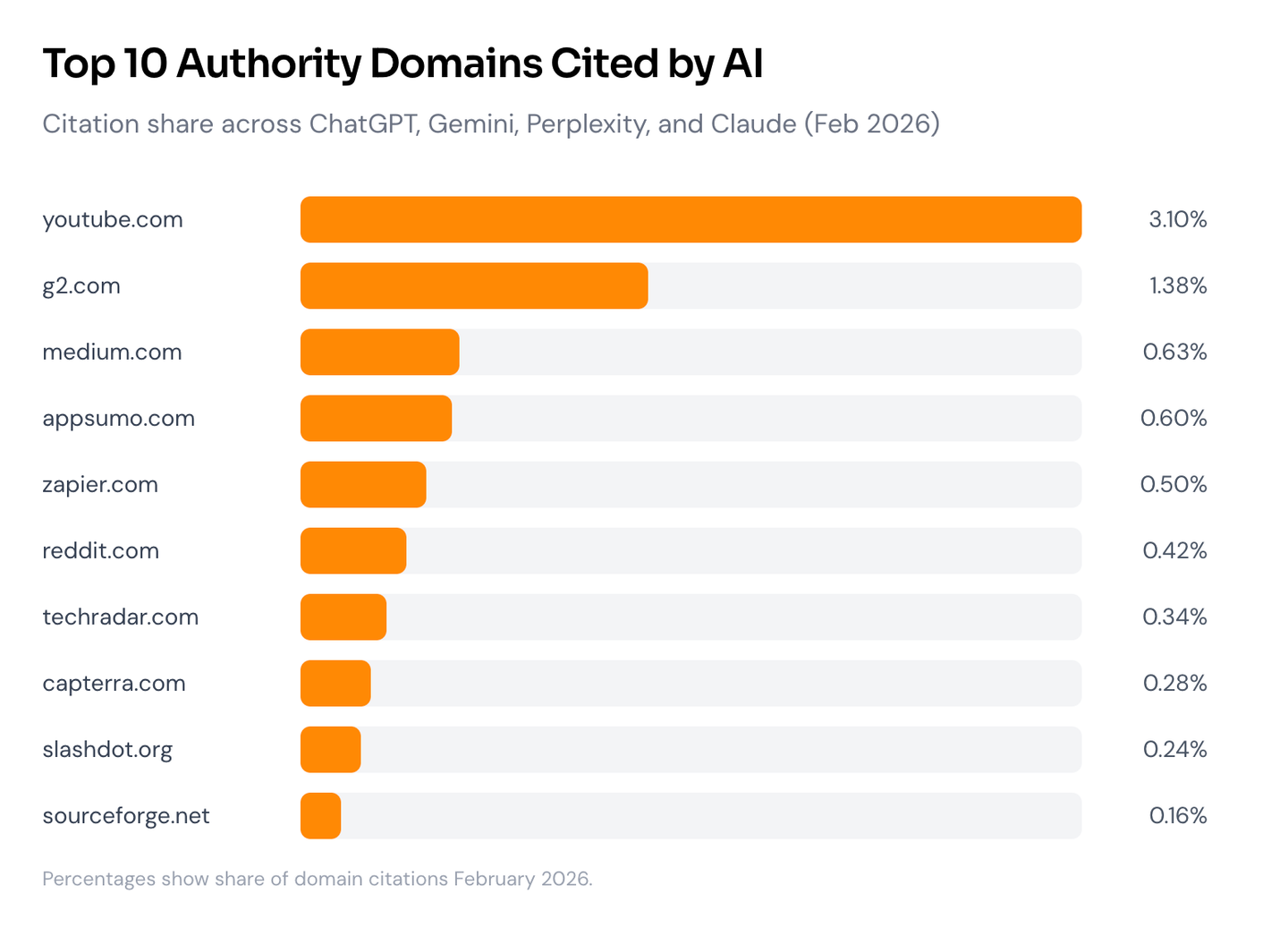
Source: Lantern AI Citation Content Visibility Report, February 2026. Citation share = percentage of all tracked citations attributed to the domain.
1. youtube.com
YouTube is the most-cited domain in AI search by a significant margin, accounting for more than twice the citation share of the second-ranked domain. This finding is consistent across every major study of AI citation patterns published in the past twelve months. Across Google's AI-powered search products, YouTube is the number one most cited domain overall, appearing in 29.5% of Google AI Overviews.
The reasons are structural. YouTube's metadata infrastructure titles, descriptions, closed captions, transcripts, chapter markers provides AI engines with multiple layers of indexed, crawlable, extractable content per video. AI systems analyze metadata including titles, descriptions, tags, and timestamps, which helps them quickly understand what a video is about and how it relates to specific topics.
The strategic implication extends beyond simply having a YouTube presence. YouTube typically appears in positions 6 to 10 in AI-generated answers rather than as the primary source, suggesting AI engines use video content strategically as supporting evidence that complements text-based authority. A brand that publishes authoritative written content alongside a corresponding YouTube video creates two independent citation candidates for the same query a structural advantage that text-only content strategies cannot replicate.
YouTube mentions show the strongest correlation with AI visibility of any factor measured, with a 0.737 correlation across ChatGPT, AI Mode, and AI Overviews, outperforming even branded web mentions.
2. g2.com
G2's position as the second most-cited domain reflects a fundamental principle about how AI engines evaluate brand claims: independent verification outweighs self-reported information. G2 exists specifically to collect practitioner-generated assessments of software products, and AI engines treat its content as among the most reliable sources available for software evaluation queries.
Domains with profiles on platforms like G2, Capterra, and Trustpilot have a 3x higher chance of being chosen by ChatGPT as a source compared to sites without such presence. The existence of a profile matters. Its quality matters more. AI engines are extracting specific claims from G2 content use cases, outcome descriptions, competitive comparisons not aggregating sentiment scores. Reviews that describe measurable outcomes in specific operational contexts are significantly more citable than reviews that express general satisfaction.
G2's citation share also reflects its structural authority. The platform has accumulated decades of indexed content, a large volume of inbound links from high-authority domains, and consistent crawlability across its review and comparison page infrastructure. For software brands, no single external platform carries more citation weight.
3. medium.com
Medium's presence in the top three is the finding most likely to surprise marketing teams accustomed to dismissing the platform as a secondary publishing channel. It reflects something important about what AI engines are optimizing for beyond domain authority in the traditional sense.
Medium hosts a large volume of practitioner-written content first-person accounts of implementing specific tools, detailed technical walkthroughs, operational breakdowns of industry problems that AI engines cite because it provides the kind of specific, earned, experience-based information that branded content rarely delivers. The author's demonstrated familiarity with the subject matter is readable in the content itself, and AI engines respond to that signal.
The lesson from Medium's citation share is not that brands should migrate their publishing to Medium. It is that the content characteristics that make Medium content citable specificity, practitioner voice, concrete operational detail, absence of promotional hedging are characteristics that content published anywhere can adopt. ChatGPT is more likely to cite content that uses definite language rather than vague language, contains a question mark, has a high entity density, and uses simple writing structures. Medium content, by virtue of its contributor base, happens to exhibit these properties at high rates.
4. appsumo.com
AppSumo's inclusion in the top five is the most counterintuitive finding in the dataset for many marketing professionals. AppSumo is primarily known as a software deals marketplace a platform where early-stage tools offer lifetime deals to generate user adoption. It is not conventionally regarded as an authority source.
Its citation share reflects two things. First, AppSumo's deal listings function as structured product profiles they contain specific feature descriptions, use case language, and user-generated reviews that AI engines can extract when answering software evaluation queries. Second, AppSumo has accumulated substantial domain authority and inbound link volume from years of being referenced by the startup and indie software community across blogs, newsletters, and social platforms.
For software brands, AppSumo's citation share represents a specific opportunity. Brands appearing on four or more platforms are 2.8 times more likely to appear in ChatGPT responses, because cross-platform consistency is one of the strongest signals of entity legitimacy an AI system can detect. AppSumo is one of those platforms and it is one most brands either have not considered or have dismissed as below their positioning.
5. zapier.com
Zapier's citation share is earned through a specific and reproducible content strategy: comprehensive, use-case-specific documentation that directly answers the questions people ask AI engines.
Zapier has spent years building an extensive library of integration guides, workflow tutorials, and app-specific documentation. Each piece of content is structured around a precise operational question how to connect two specific tools, how to automate a specific workflow, what a specific integration does and does not support. This content is not designed to rank for broad keywords. It is designed to be the definitive answer to a narrow question, and that structural property makes it highly extractable for AI engines constructing specific answers.
Semantic completeness whether content provides a complete, self-contained answer that requires no external context or additional clicks to understand is the strongest predictor of AI Overview selection. Zapier's content library is almost entirely composed of semantically complete answers to narrow questions. That is not a coincidence. It is the output of a content strategy that, whether intentionally or not, is optimally aligned with how AI engines select sources.
The implication for marketing teams is direct: content that answers one specific question completely outperforms content that addresses many questions partially, regardless of word count or topical breadth.
6. reddit.com
Reddit's presence reflects AI engines' strong preference for peer-generated, experience-based content over institutional or branded sources for recommendation and evaluation queries. Domains with millions of brand mentions on Reddit have roughly four times higher chances of being cited than those with minimal activity.
Reddit's domain authority approaching 100 is one factor. Its content structure is another. Reddit threads, particularly in active subreddits organized around specific professional disciplines or product categories, function as distributed Q&A repositories. A well-answered thread on a B2B software subreddit can surface in AI responses to evaluation queries for years after it was posted, because the combination of domain authority, Q&A structure, and authentic practitioner voice makes it persistently extractable.
The brand management implication is significant. Reddit conversations about a brand happen whether or not the brand participates. AI engines cite those conversations regardless of whether the brand has reviewed them. A negative thread on a relevant subreddit, left unanswered for two years, is being actively cited in AI responses to queries about that brand's product today. Visibility into which threads are being cited and the ability to respond strategically is not optional for brands serious about AI search presence.
7. techradar.com
TechRadar's position reflects a different trust signal: institutional editorial credibility. As a long-running technology publication with substantial domain authority, a large archive of product reviews, and a recognizable editorial brand, TechRadar is treated by AI engines as a reliable third-party evaluator for technology products.
What distinguishes TechRadar's content from brand-owned product descriptions is the same property that distinguishes all high-citation external sources: independence. TechRadar's reviewers have no commercial interest in a favorable outcome for the products they assess. AI engines treat that independence as a quality signal, and it translates directly into citation frequency.
For brands seeking coverage on editorial technology platforms, TechRadar's citation share provides a clear commercial rationale. A TechRadar review or product listing is not simply a PR outcome. It is a citation asset that surfaces in AI-generated answers to product evaluation queries, often for years after publication.
8. capterra.com
Capterra's citation share alongside G2 confirms that the review aggregator category as a whole carries significant weight in AI citation patterns for software brands. The two platforms together account for 1.66% of all citations in Lantern's dataset a combined share that represents a concrete, manageable, high-return optimization target for any B2B software marketing team.
Capterra's structural advantage mirrors G2's: independent reviews organized by product category, searchable by use case, with a feature comparison infrastructure that AI engines find highly extractable. Capterra's particular strength lies in its penetration among mid-market and SMB buyers, meaning its citation weight is especially significant for queries from that buyer segment.
The presence of both G2 and Capterra in the top ten makes one point unambiguous: for B2B software brands, review platform management is a primary AI search optimization lever, not a secondary one.
9. slashdot.org
Slashdot is the oldest platform on this list founded in 1997 and its citation share reflects one of the clearest demonstrations of how domain history compounds into AI citation authority.
Slashdot has accumulated nearly three decades of indexed technical content, inbound links from across the technology web, and a reputation among AI training datasets as a reliable source for technology news and community discussion. Its citation share is not driven by recent content production. It is driven by the weight of accumulated authority that no newer platform can replicate on a short timeline.
Sites with over 32,000 referring domains are 3.5 times more likely to be cited by ChatGPT than those with up to 200 referring domains. Slashdot has accumulated referring domains across decades of operation. Its lesson for marketing teams is less about tactical replication and more about the principle it embodies: authority compounds over time, and the platforms that invested in building it early now extract disproportionate citation returns from that investment.
10. sourceforge.net
SourceForge rounds out the top ten as a software discovery and open-source repository platform with a citation profile similar to Slashdot: decades of accumulated domain authority, a large archive of indexed software content, and a user-generated review layer that provides the independent validation signal AI engines favor.
SourceForge's citation share is particularly relevant for software brands in categories with active open-source alternatives. When users ask AI engines to compare commercial and open-source options, or to evaluate tools in technical categories, SourceForge listings provide AI engines with structured, independent, historically indexed content to draw from.
The Five Characteristics Every Domain in This List Shares
Across ten domains spanning six different content categories, five structural characteristics are present in every case.
Independent validation over brand-generated claims. Every domain in this list derives its citation authority from content it did not create in its own commercial interest. YouTube hosts creator and brand content, but its citation weight comes from the independence of the channel from the subjects being discussed. G2 and Capterra host reviews written by practitioners with no financial stake in the outcome. Reddit hosts peer discussion. Medium hosts practitioner-written analysis. TechRadar and TechRadar editorial review products independently. Even AppSumo, Zapier, Slashdot, and SourceForge derive their authority from community-generated and independently produced content. AI engines are systematically rewarding independence over self-interest.
Structured, extractable content architecture. Every domain in this list hosts content that AI engines can parse without extensive interpretation. YouTube provides transcripts, timestamps, and metadata. G2 and Capterra provide structured review fields, feature comparisons, and category tags. Zapier provides step-by-step workflow documentation. Reddit provides Q&A thread structures. Medium provides clearly delineated article content with author attribution. Slashdot and SourceForge provide structured listing and discussion content. The common property is that AI engines do not have to work hard to understand what the content says or how it relates to a query. Structure reduces friction for citation selection.
Sustained domain authority built over time. Every domain in this list has been accumulating referring domains, indexed content, and citation history for at least a decade. YouTube has become the most-cited domain in AI Overviews, growing its citation share by 34% in six months, with 18.2% of all out-of-top-100 citations pointing to YouTube URLs. Even the fastest-growing domain in this list is building on a foundation of existing authority. There are no recently launched domains in the top ten. AI citation authority reflects the same compounding dynamics as traditional domain authority, but it is accumulating at different rates across different platforms than traditional SEO metrics would predict.
High content volume with consistent topical focus. Every domain in this list has published or hosted a large volume of content organized around consistent subject matter. Zapier covers integrations and automation comprehensively. G2 covers software evaluation comprehensively. TechRadar covers technology news and product reviews comprehensively. Reddit's most-cited subreddits are organized around specific disciplines. Topical depth the property of having addressed a subject area comprehensively enough that AI engines develop confidence in a domain's authority on that subject is a consistent characteristic of every domain in this list.
Cross-platform entity recognition. No domain in this list achieved its citation share in isolation. Each is referenced, linked to, and mentioned across a wide range of other authoritative platforms. Brands appearing on four or more platforms are 2.8 times more likely to appear in ChatGPT responses, because cross-platform consistency is one of the strongest signals of entity legitimacy an AI system can detect. The top ten most-cited domains are cited partly because they are the platforms AI engines have learned to associate with reliable information and that association was built through consistent, cross-platform recognition over years.
What This Means for Marketing Teams
The ten most-cited domains in AI search are not accidents. They are the output of specific, reproducible strategic decisions that any brand can learn from, even if they cannot replicate the scale of a platform that has been building authority since 1997.
The actionable conclusions from this analysis are direct. Presence on G2 and Capterra is not optional for B2B software brands seeking AI search visibility. YouTube content is no longer a secondary channel — it is the most-cited domain in AI search and the strongest correlating factor with AI visibility measured across 75,000 brands. AppSumo and SourceForge represent underutilized citation opportunities that require relatively low investment to establish. Community presence on Reddit, in relevant subreddits, produces citation returns that brand-owned content cannot achieve regardless of quality.
The underlying principle is consistent across all ten: AI engines cite sources they have learned to trust, and that trust is built through independence, structure, sustained authority, topical depth, and cross-platform recognition. Brands that build toward those properties — across the platforms where AI engines are already looking — are building citation authority that compounds in the same way traditional domain authority did, but faster, and on a different set of platforms than most content strategies currently prioritize.
Key Takeaways
- YouTube is the most-cited domain in AI search at 3.10% citation share, more than double the second-ranked domain, and shows the strongest correlation with overall AI visibility of any measurable factor
- G2 and Capterra together account for 1.66% of all citations — the most actionable immediate optimization opportunity for B2B software brands
- Medium's 0.63% citation share reflects AI engines' preference for specific, practitioner-written, experience-based content — a content characteristic, not a platform dependency
- AppSumo's presence in the top five demonstrates that software deals and discovery platforms carry significant citation weight that most brands have not yet claimed
- Zapier's citation share is built entirely on semantically complete, use-case-specific documentation — the content architecture most predictive of AI engine selection
- All ten domains share five properties: independent validation, structured content architecture, sustained domain authority, high-volume topical focus, and cross-platform recognition
- Brands appearing on four or more trusted platforms are 2.8 times more likely to appear in ChatGPT responses than those with a narrower footprint
Data sourced from the Lantern AI Citation Content Visibility Report, February 2026. Based on analysis of 200 million+ citations collected directly from ChatGPT, Perplexity, Gemini, and Claude.