- Answer Engine Optimization
- generative Engine Optimization
ChatGPT Shopping: How Products Get Recommended
How ChatGPT shopping works in 2026, how it picks products, what changed with checkout, and how to get your products recommended before the holidays.
 Collins
On this page
- Key takeaways
- What is ChatGPT shopping?
- Why OpenAI moved away from checkout
- How ChatGPT chooses which products to recommend
- Can you pay to appear in ChatGPT shopping results?
- How to get your products recommended in ChatGPT
- Getting ready for the holiday season
- How to measure your ChatGPT shopping visibility
- Our recommendation
- FAQ
- How does ChatGPT shopping work?
- Can you still buy products directly in ChatGPT?
- How does ChatGPT decide which products to recommend?
- Are ChatGPT product recommendations paid?
- How do I get my products into ChatGPT?
- Is ChatGPT shopping available outside the US?
More shoppers now ask ChatGPT what to buy before they search Google or visit a store. ChatGPT answers with a short list of products, images, prices and links. If your products aren't on that list, the shopper may never see them.
This guide explains how ChatGPT shopping works today, how it picks products, what changed in 2026, and what marketing and ecommerce teams can do to get their products recommended, ahead of the holiday season.
Key takeaways
- ChatGPT is now a product discovery tool, not a checkout. In March 2026, OpenAI scaled back buying inside ChatGPT and focused on helping people find and compare products.
- Recommendations are organic. OpenAI says shopping results come from publicly available retail sites and are chosen for relevance, using product details, price, reviews and third-party content.
- Product feeds matter more and more. Large retailers now send their catalogs straight to ChatGPT, and third-party tracking suggests most product picks now come from those feeds.
- Ads are separate. ChatGPT ads appear below the answer and are labeled as sponsored.
- Reviews and consistent product data decide a lot. ChatGPT pulls from what other sites say about your products, not just your own pages.
What is ChatGPT shopping?
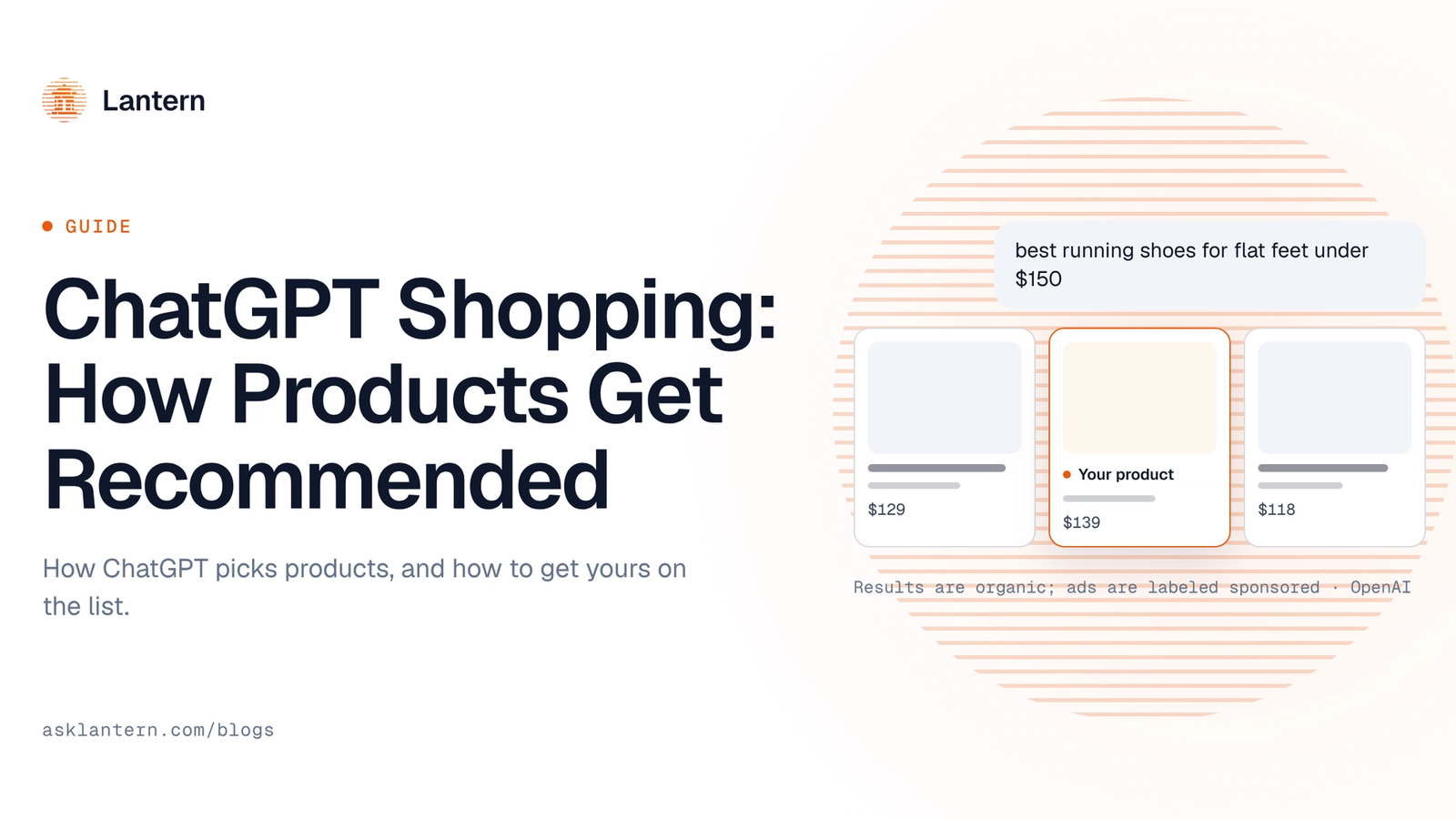
ChatGPT shopping is the set of features that help people find, compare and choose products inside ChatGPT. When someone asks a buying question, such as "best running shoes for flat feet under $150", ChatGPT can show product cards with images, prices, short descriptions and links to retailers.
For bigger decisions, people can use shopping research, launched in November 2025. It asks a few questions about budget, needs and preferences, searches the web for prices, reviews and specs, and builds a buying guide. It's available to logged-in users on Free, Go, Plus and Pro plans.
In March 2026, OpenAI added side-by-side product comparisons, image search for similar items, and the ability to narrow results through conversation.
| Date | What changed |
|---|---|
| September 2025 | Instant Checkout launches, letting US users buy some products inside ChatGPT |
| November 2025 | Shopping research launches, building buying guides from web results |
| March 2026 | OpenAI scales back Instant Checkout and focuses on product discovery, comparisons and visual search |
| March 2026 | Major retailers including Target, Sephora, Nordstrom, Best Buy and The Home Depot send catalogs through OpenAI's commerce protocol |
| May 2026 | OpenAI tests ads created from merchants' product catalogs |
| October 2026 | ChatGPT tests AI-generated feature labels on some product results |
Why OpenAI moved away from checkout
Instant Checkout launched in September 2025 so people could buy a single item without leaving ChatGPT. Adoption was limited. Merchants had to build a new checkout and give up some control, and Walmart told eMarketer that purchases inside ChatGPT converted three times worse than clicks through to Walmart.com.
In March 2026, OpenAI said the feature "did not offer the level of flexibility that we aspire to provide" and shifted its focus to discovery. Shoppers now usually click through to the retailer's own site to buy. Some large retailers, including Walmart, run their own apps inside ChatGPT instead.
What this means for you: the goal is to be recommended and clicked, not to sell inside ChatGPT. That makes ChatGPT shopping a visibility and brand problem as much as an ecommerce one. We covered the background in ChatGPT Instant Checkout: What Changed in 2026.
How ChatGPT chooses which products to recommend
OpenAI hasn't published its full ranking method, but it has shared the main inputs.
- Relevance to the shopper's request. OpenAI says products are chosen based on how well they match what the person asked for, using product information, price, reviews and other third-party content.
- Publicly available retail sites. OpenAI describes shopping research results as "organic and based on publicly available retail sites". It reads product pages directly and says it avoids "low-quality or spammy sites".
- Merchant product feeds. Retailers can send their catalogs to ChatGPT through OpenAI's Agentic Commerce Protocol. One AI-visibility vendor's tracking, reported by Search Engine Journal in September 2026, found that about 65% of product recommendations came from feeds after a change in July 2026. OpenAI hasn't confirmed this.
- What others say about the product. Reviews, comparison articles, forums and videos all shape how ChatGPT describes a product and whether it recommends it.
OpenAI is also testing short labels on some product images, generated by ChatGPT. OpenAI says these are based on the information available to the model, including third-party data, and are "not guaranteed or verified statements". More in ChatGPT Product Labels.
What this means for you: two things decide your visibility. Whether ChatGPT can get accurate, complete data about your products, and whether the rest of the web speaks well of them.
Can you pay to appear in ChatGPT shopping results?
Not in the organic results. OpenAI says shopping recommendations are organic. ChatGPT does sell ads, which appear below the answer and are labeled as sponsored. In May 2026, OpenAI began testing ads that are generated directly from a merchant's product catalog, similar to Google Shopping ads.
If you're considering paid placement, our guides on how ChatGPT ads work and how to run ads on ChatGPT cover setup and measurement.
How to get your products recommended in ChatGPT
- Let OpenAI's search bot in. Allow OAI-SearchBot in your robots.txt file so ChatGPT can read your product pages. Our free AI Crawler Checker shows what your site allows.
- Get your product feed into ChatGPT. Shopify and Etsy merchants can connect through their platform. Other retailers can apply through OpenAI's merchant form at chatgpt.com/merchants. OpenAI hasn't published full eligibility rules, and access outside the US is still limited.
- Fill in every product detail. Include a clear title, description, price, availability, brand, category, images, GTINs, sizes and colors. Basic fields get a product listed. Complete details help it match specific requests like "waterproof", "under $100" or "for wide feet".
- Write product descriptions the way shoppers ask. Describe who the product is for, what problem it solves and how it compares. ChatGPT matches products to requests written in everyday language.
- Keep prices and stock accurate everywhere. Your site, feed, marketplaces and retailers should show the same price and availability. OpenAI admits ChatGPT can get prices wrong, and mismatched data makes that more likely.
- Build genuine reviews. Ask real customers for reviews on your site and on the review platforms in your category. Reviews feed both the recommendation and the way ChatGPT describes your product.
- Get into comparison and gift guides. ChatGPT leans on lists and buying guides. In Lantern's data, lists make up 35.6% of all AI citations. Pitch your products to the publications and creators that write "best of" guides in your category. Our digital PR for AI search guide shows how.
- Make policies easy to find. Clear shipping, returns and warranty information helps shoppers decide and gives ChatGPT facts to repeat.
Getting ready for the holiday season
Holiday shoppers ask ChatGPT for gift ideas, deals and comparisons. A few weeks of work now can make a difference:
- Check your top 20 products. Ask ChatGPT the buying questions your customers ask and see whether your products appear and how they're described.
- Update feeds and pages with holiday details. Add gift-friendly descriptions, delivery cut-off dates and any offers, and make sure prices match everywhere.
- Fix wrong information quickly. If ChatGPT repeats an old price or a wrong feature, update the source it's likely drawing from: your product page, feed, marketplace listing or a review site.
How to measure your ChatGPT shopping visibility
Track a fixed set of 20 to 50 buying questions every week. For each one, record whether your products appear, where they sit in the list, how they're described, and which competitors appear instead. In GA4, track referral traffic from chatgpt.com to see clicks and sales. Our guide to AI referral traffic shows how to set it up.
Lantern tracks product and brand mentions across ChatGPT and other AI tools, and shows which sources are shaping the answers in your category.
Our recommendation
Treat ChatGPT as a new shelf in the store, not a new checkout. Make sure it can read accurate, complete data about every product, through your site and a product feed. Then work on what the rest of the web says about you, because reviews and buying guides decide which products make the list. Start with your best sellers before the holiday rush, and check the results every week.
FAQ
How does ChatGPT shopping work?
When someone asks a buying question, ChatGPT searches retail sites and product feeds, then shows a short list of products with images, prices and links. For bigger purchases, shopping research asks follow-up questions and builds a buying guide. Shoppers usually click through to the retailer's site to buy.
Can you still buy products directly in ChatGPT?
Mostly not. OpenAI scaled back Instant Checkout in March 2026 and now focuses on product discovery. Some large retailers, such as Walmart, run their own shopping apps inside ChatGPT.
How does ChatGPT decide which products to recommend?
OpenAI says it chooses products based on relevance to the request, using product information, price, reviews and other third-party content from publicly available retail sites. Merchant product feeds now play a large role.
Are ChatGPT product recommendations paid?
No. OpenAI says shopping results are organic. ChatGPT ads are separate, appear below the answer and are labeled as sponsored.
How do I get my products into ChatGPT?
Allow OAI-SearchBot on your site, submit a complete product feed through your platform or OpenAI's merchant form, keep prices and stock accurate, and build genuine reviews. Getting included in comparison and gift guides in your category also helps.
Is ChatGPT shopping available outside the US?
OpenAI hasn't published a full list of supported countries. Merchant access to product feeds has focused on the US so far, and ChatGPT ads opened to advertisers in the UK in June 2026. Check OpenAI's merchant page for the latest availability in your market.