- generative Engine Optimization
- Answer Engine Optimization
Google's AI Search Guide: 6 GEO Myths It Retires
Google's 2026 guide to AI search retires six popular GEO tactics, from chunking content to llms.txt. What to stop doing, what our citation data adds, and what actually works.
 Collins
On this page
- Key takeaways
- The six myths at a glance
- Myth 1: You need to chunk your content for AI
- Myth 2: You need an llms.txt file to appear in AI search
- Myth 3: You need special schema markup for AI search
- Myth 4: You need to write differently for AI
- Myth 5: Create a page for every query AI search fans out to
- Myth 6: Any mention of your brand anywhere boosts AI visibility
- What actually moves AI search visibility in Google
- How to measure it
- Our recommendation
- FAQ
- Does Google use llms.txt for AI Overviews or AI Mode?
- Should I break my content into chunks for AI search?
- Is there special schema markup for AI Overviews?
- Is GEO different from SEO in Google?
- Can I use AI to write content for AI search?
- How do I see my performance in AI Overviews?
Most GEO advice you read in 2026 tells you to break pages into small chunks, publish an llms.txt file, add special AI schema and create a page for every question people might ask an AI. None of it is needed to appear in Google's AI Overviews or AI Mode, and some of it can hurt you.
Google's official guide to optimizing for generative AI search, published in May 2026 and last updated in July, settles the question. Here are the six myths it retires, what our citation data adds to each, and where your team's time is better spent.
Key takeaways
- AI search in Google runs on the same ranking and quality systems as normal search. If a page can't rank or show a snippet, it can't be cited.
- You don't need to chunk content, write llms.txt, add AI schema or rewrite for AI. Google Search doesn't use any of them.
- Creating a page for every fan-out query is now named as scaled content abuse, the spam policy behind most of the big traffic losses of the past two years.
- Original, first-hand content is the factor that matters most over time. It's the one thing on the list your competitors can't copy.
- Earned mentions matter, manufactured ones don't. 91% of brand citations in Lantern's data come from third-party sites, but Google is clear that inauthentic mentions don't help.
The six myths at a glance
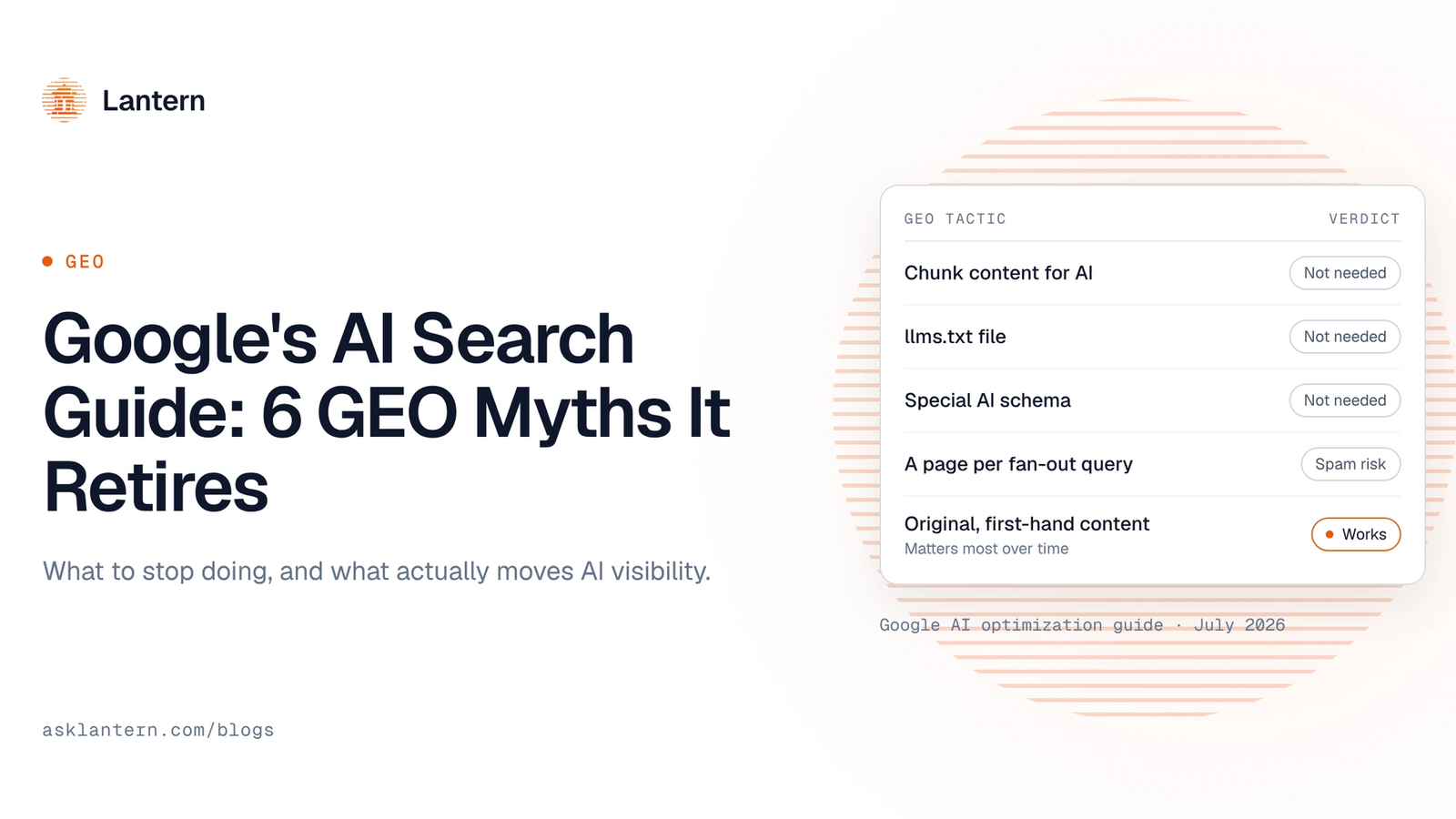
| Myth | What's true | What to do instead |
|---|---|---|
| You need to chunk content into small pieces | AI search can find the relevant section of a normal page | Write clear sections with descriptive headings |
| You need an llms.txt file | Google Search doesn't use llms.txt or other AI-only files | Make sure Googlebot can crawl and index your pages |
| You need special schema for AI | No AI-specific schema exists | Keep standard structured data accurate and matched to the page |
| You must write differently for AI | AI matches meaning and synonyms, not exact phrases | Write for your reader in plain, well-organised language |
| Create a page for every fan-out query | Mass-producing variations is scaled content abuse | Build fewer, more complete pages on topics you know |
| More mentions anywhere means more AI visibility | Inauthentic mentions aren't as helpful as they seem | Earn real coverage, reviews and expert citations |
Myth 1: You need to chunk your content for AI
You don't. Google's systems can handle a page that covers several subtopics and pull out the section that answers a query. The guide puts it plainly: there's no requirement to break content into tiny pieces, and there's no ideal page length.
The chunking advice came from a misreading of how retrieval works. AI systems do split pages into passages internally, but that happens on their side. Rewriting your page into a stack of disconnected 50-word blocks makes it worse for readers and gives Google nothing it couldn't already do.
What does help is ordinary good structure. Use descriptive headings, answer the question a section asks in its first sentence or two, and keep each section focused. That's writing for people, and it also happens to make passages easy to lift.
What this means for you: stop restructuring good pages into fragments. Spend that time making the answers on the page better.
Myth 2: You need an llms.txt file to appear in AI search
You don't need one for Google. Google Search doesn't use llms.txt, AI text files or special Markdown versions of pages, and the guide states that having them will neither harm nor help your visibility in Google Search.
The data elsewhere points the same way. An Ahrefs study of 137,210 domains in May 2026 found that 97% of llms.txt files received zero requests in a month, and AI retrieval bots made up only about 1.1% of the requests that did arrive. We covered the full evidence in our guide to llms.txt.
There is one narrow case for the file: coding agents and documentation tools that are pointed to it. For a marketing site, it's a 30-minute housekeeping task at most, not a growth lever.
What this means for you: check that Googlebot, Bingbot and the AI search bots can reach your pages first. Our AI crawler list shows which ones matter, and the free AI Crawler Checker shows what your robots.txt allows.
Myth 3: You need special schema markup for AI search
There's no AI-specific schema. Structured data isn't required for generative AI search, and there's no special schema.org markup that gets you into AI Overviews or AI Mode.
Standard structured data is still worth having. It makes pages eligible for rich results and helps search engines understand what a page is about. The rule that matters is accuracy: markup must match what's visible on the page. Markup that describes content readers can't see is a spam risk, not a shortcut.
FAQ markup is a good example. FAQ rich results have been limited to authoritative government and health sites since 2023, so FAQ schema won't earn most brands a special result. A real FAQ section is still useful to readers, so keep it if your audience has genuine follow-up questions.
What this means for you: keep Article, Organization, Product and Breadcrumb markup accurate. Don't buy tools or services that promise "AI schema".
Myth 4: You need to write differently for AI
You don't. Google's AI systems match meaning, synonyms and related concepts, so you don't need to cover every long-tail phrasing or repeat exact-match keywords. The guide asks for content that's well written and easy to follow, with clear paragraphs, sections and headings.
Independent research backs this up. In the GEO study presented at KDD 2024, keyword stuffing gave little or no gain in AI answers, while adding real statistics, quotes and cited sources raised visibility by roughly 30 to 40%. Clarity and evidence help. Writing "for the machine" doesn't.
What this means for you: write for your buyer. Back your claims with numbers and sources, and say things plainly. That's also what the content guide we follow recommends.
Myth 5: Create a page for every query AI search fans out to
This is the most expensive myth, because it can put your whole site at risk. AI Mode and AI Overviews use query fan-out: the model runs several related searches at once to build an answer. A question about fixing a weedy lawn might fan out to "best herbicides for lawns" and "remove weeds without chemicals".
Some teams read this as an instruction to publish a page for every possible sub-question. Google now names that directly: creating pages for every variation to manipulate rankings violates the scaled content abuse spam policy, and a high number of pages doesn't make a site higher quality.
The right response to fan-out is coverage, not volume. A complete page on a topic you know well, which answers the follow-up questions a buyer would ask, will match many fan-out queries on its own. Our guide to query fan-out shows how to find those follow-up questions.
What this means for you: map the sub-questions in your category, then fill the gaps inside your strongest existing pages before you create new ones.
Myth 6: Any mention of your brand anywhere boosts AI visibility
Mentions matter, but only real ones. AI answers lean heavily on what other sites say about you. In Lantern's analysis of more than 200 million AI citations, 91% of brand citations came from sources outside the brand's own website, led by review platforms, YouTube and community sites.
That has created a market for paid placements, spun guest posts and planted forum comments. Google's guide warns that seeking inauthentic mentions across the web isn't as helpful as it might seem, because the AI features sit on top of the same spam systems that filter low-quality pages out of search.
The mentions that hold up are earned: detailed customer reviews, independent coverage, comparison articles that test your product, and expert quotes in industry press. They also survive platform changes. When Reddit's share of ChatGPT citations fell 86.4% in a month in 2026, brands that relied on planted threads lost visibility overnight.
What this means for you: treat third-party presence as a PR and customer-marketing job. Our guide to digital PR for AI search covers how to earn the coverage AI trusts.
What actually moves AI search visibility in Google
With the myths cleared away, the list of things that work is short. They're the same things that work in search, applied with more care.
- Make sure you're eligible. A page must be indexed and able to show a snippet. Check crawl access, indexing and that important content is in the HTML, not loaded only by JavaScript. Most AI crawlers don't render JavaScript at all.
- Publish non-commodity content. Google calls this the factor most likely to influence your AI search presence over time. That means original data, first-hand testing, expert opinion and clear recommendations, not a rewrite of the top ten results.
- Add images and video. AI features can show relevant images and videos alongside text. In our data, YouTube is the single most-cited domain across ChatGPT, Gemini, Perplexity and Claude, at 3.1% of all citations.
- Keep pages current. In Lantern's data, 62% of the most-cited pages were published in the last six months. When you refresh, update real facts, not just the date.
- Earn third-party coverage. Reviews, comparisons and press coverage carry more weight in AI answers than anything on your own domain.
- Keep product and business data current. Merchant Center and Business Profile data feed AI answers for shopping and local queries.
How to measure it
Use Google's own data first. Search Console's Generative AI performance report shows how your pages perform in Google's generative AI features. Track impressions and clicks there alongside your normal search reports, because AI answers often raise impressions while lowering clicks.
Google's guide adds a fair warning: no third-party tool has access to Google's internal ranking or AI systems. That's true of every visibility tool, including ours. What tools like Lantern measure is the output: which brands and pages AI answers actually cite for the prompts your buyers use, across Google and the other AI engines Search Console doesn't cover. Use that output to find gaps, and use Search Console to confirm results in Google.
Our recommendation
Stop spending time on AI-specific tricks. Every hour put into chunking pages, maintaining llms.txt files or buying mentions is an hour not spent on the work that moves visibility.
Put your effort into three things: pages that offer something original, a technical setup that lets every search crawler read them, and real coverage on the sites AI answers already trust. That's GEO in 2026. It looks a lot like good SEO, because in Google it is.
FAQ
Does Google use llms.txt for AI Overviews or AI Mode?
No. Google Search doesn't use llms.txt or other AI-only files, and publishing one neither helps nor harms your Google visibility. Some coding agents and documentation tools do read it, so it can still be useful for developer docs.
Should I break my content into chunks for AI search?
No. Google's AI systems can find the relevant section of a normal page, and there's no ideal page length. Use clear headings and answer each section's question early, then write for your reader.
Is there special schema markup for AI Overviews?
No. There's no AI-specific schema, and structured data isn't required to appear in Google's AI features. Keep standard markup accurate and matched to visible content.
Is GEO different from SEO in Google?
In Google, no. Google treats optimizing for generative AI search as SEO, because AI Overviews and AI Mode run on its core ranking and quality systems. Other AI engines such as ChatGPT and Perplexity use different sources, which is why we cover the differences in GEO vs SEO.
Can I use AI to write content for AI search?
Yes, as long as the result is accurate, original and helpful. Content produced at scale with little added value breaks Google's scaled content abuse policy, whoever or whatever writes it.
How do I see my performance in AI Overviews?
Use the Generative AI performance report in Search Console for Google data. To see which brands and pages AI answers cite across Google, ChatGPT, Perplexity, Gemini and Claude, use an AI visibility tool such as Lantern.