- generative Engine Optimization
GEO vs SEO: What Changes and What Doesn't
GEO doesn't replace SEO, it builds on it. What stays the same, the five things that change, what the research shows, and how to run both from one plan.
 Collins
On this page
- Key takeaways
- What stays the same
- What changes with GEO
- 1. The AI picks a few sources, not a ranked list
- 2. One question becomes many searches
- 3. Other websites matter as much as yours
- 4. Each section needs to stand on its own
- 5. Clicks are no longer the full picture
- What the research says works
- Does ranking in Google still help you get cited?
- How to run SEO and GEO from one plan
- Common mistakes to avoid
- Our recommendation
- FAQ
- What is the difference between GEO and SEO?
- Is GEO replacing SEO?
- Is GEO the same as AEO?
- Do I need different content for GEO?
- How do I measure GEO?
- Does schema markup help with GEO?
GEO doesn't replace SEO. It builds on it. The teams doing best in AI search right now were already good at SEO, and then changed a few habits.
Generative engine optimization (GEO) is the work of getting your brand mentioned, cited and recommended in AI answers from ChatGPT, Google's AI Overviews and AI Mode, Gemini, Perplexity and Claude. This guide explains what stays the same, what changes, and how to run both from one plan without doubling your workload.
Key takeaways
- SEO and GEO share the same foundations. Google says there are no extra requirements to appear in its AI features beyond normal SEO eligibility.
- The goal is different. SEO aims for a ranking and a click. GEO aims for a mention or citation inside the AI's answer.
- Your website is only part of the picture. In Lantern's data, 91% of brand citations in AI answers come from pages the brand doesn't own.
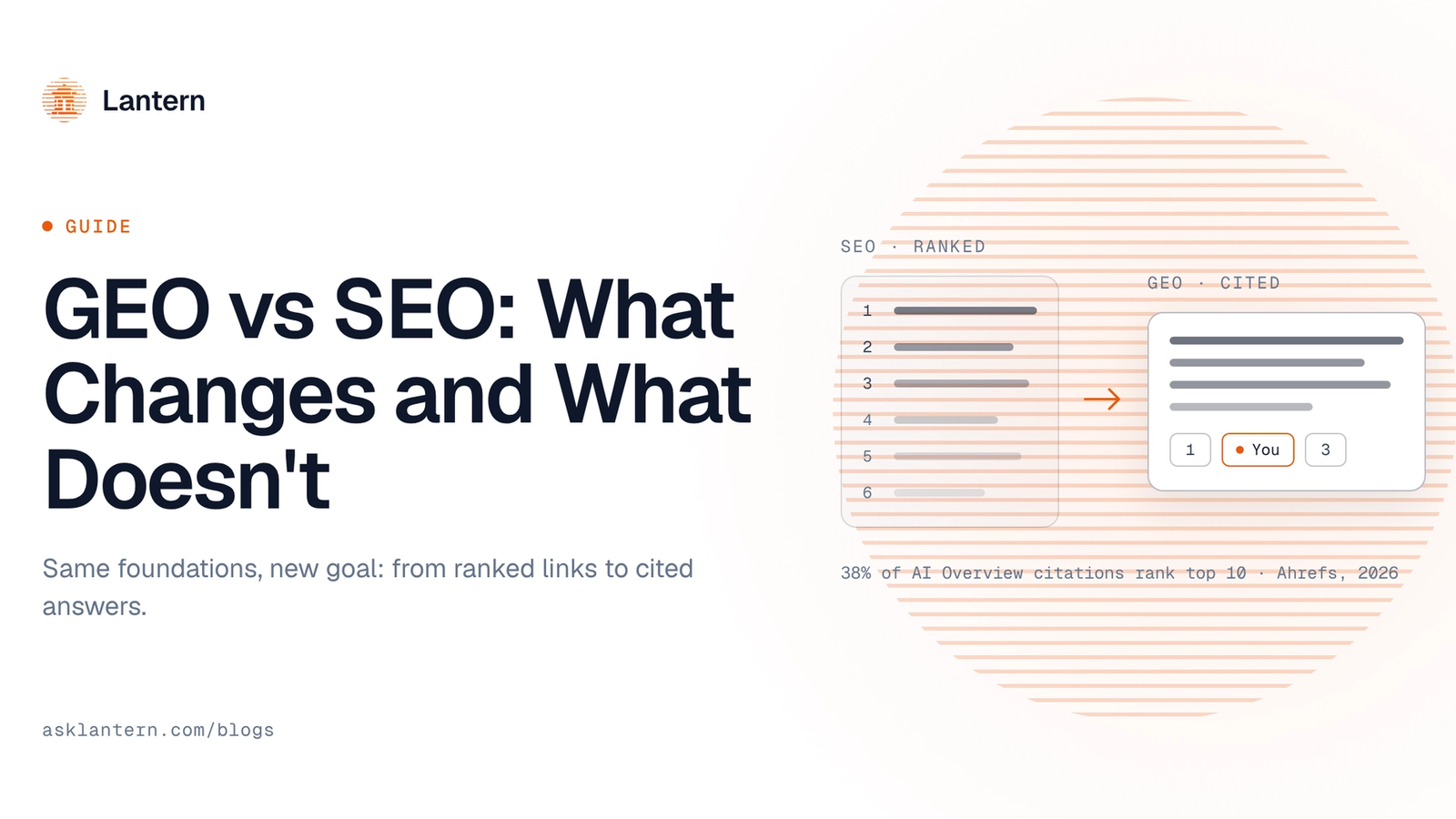
- Ranking still helps, but less than it did. In early 2026, only 38% of pages cited in Google's AI Overviews also ranked in the top 10.
- You don't need a second team. Add a few steps to your current SEO process and track AI visibility alongside rankings.
| What | SEO | GEO |
|---|---|---|
| Goal | Rank a page so people click it | Get your brand named and cited in the AI's answer |
| Where it happens | Google and Bing search results | ChatGPT, AI Overviews, AI Mode, Gemini, Perplexity, Claude, Copilot |
| What counts as success | A ranking and a click | A mention, a citation, a recommendation |
| What the engine uses | Whole pages | Short passages it can quote |
| Main signals | Relevance, links, authority, page experience | Clear answers, facts, mentions on other sites, freshness, bot access |
| Role of your website | The thing that ranks | One source among many |
| How you measure it | Rankings, clicks, organic traffic | Mention rate, citations, share of voice, AI referral traffic |
What stays the same
Most of what you already do for SEO still matters for GEO. Google says there are no additional requirements to appear in AI Overviews or AI Mode beyond being indexed and eligible to show a snippet. It also says you don't need special AI files, markup or schema.
These basics still carry most of the weight:
- Search engines and AI bots can reach your pages. If they can't crawl a page, nothing else matters.
- Your content answers real questions well. Thin pages don't rank, and they don't get cited.
- Your pages link to each other. Internal links help engines find your content and understand how topics connect.
- Other trusted sites mention you. Brands that others talk about tend to rank and tend to get cited.
- Your structured data matches the page. It helps engines understand your content, as long as it reflects what's actually there.
What this means for you: if your SEO basics are weak, fix them first. No GEO tactic will help if AI bots can't read your site.
What changes with GEO
Five things change. Each one adds a step to your process rather than replacing what you do now.
1. The AI picks a few sources, not a ranked list
In regular search, you aim for page one and hope for a click. In an AI answer, the engine reads several sources and writes a single response. Success means being the brand it names or the page it links to. A page in position seven can be cited. A page in position one can be left out.
2. One question becomes many searches
AI engines don't only search for the question as typed. Google calls this query fan-out: the AI splits a question into related sub-questions, searches each one and pulls pages from all of them. That's why AI answers often link to a wider range of sites than a normal results page.
What this means for you: covering a whole topic well matters more than ranking for one main keyword. Pages that show up across many related searches get cited more often.
3. Other websites matter as much as yours
Lantern analyzed more than 200 million AI citations. 91% of brand citations came from pages the brand didn't own, such as review sites, industry roundups, comparison posts, YouTube videos and community threads.
What this means for you: GEO brings PR, reviews and partnerships into the same plan as your content. Our guide to digital PR for AI search shows how to earn those mentions.
4. Each section needs to stand on its own
AI engines quote short passages and drop them into their answers. A passage only works if it makes sense by itself. That means a direct answer under each heading, short paragraphs, real numbers, and tables for comparisons.
What this means for you: a page that only makes sense if you read it top to bottom is hard for AI to use. Write each section so it could be quoted on its own.
5. Clicks are no longer the full picture
Many AI answers give people what they need without a click. Your brand can be recommended to thousands of people and barely show up in your analytics.
What this means for you: add new measures alongside traffic. Track how often you're mentioned for your buyers' key questions, which of your pages are cited, which competitors appear instead, and how accurately the AI describes you.
What the research says works
The term GEO comes from a 2023 research paper by a team from Princeton University and IIT Delhi, presented at the KDD 2024 conference. The researchers tested how different changes to a page affected how often it appeared in AI answers. You can read the full paper on arXiv.
Their main findings:
- Adding quotes from credible sources increased visibility by about 41%, the biggest gain.
- Adding statistics increased it by about 31%.
- Citing sources and improving readability each increased it by about 27–28%.
- Keyword stuffing made visibility slightly worse.
Two findings matter most for marketers. First, what works for AI also makes content more trustworthy to people: evidence, specifics and clear writing. Second, lower-ranked pages gained the most. In one test, citing sources increased visibility for pages in fifth position by 115%. That means GEO gives smaller brands a real chance to compete with bigger sites.
Does ranking in Google still help you get cited?
Yes, but less than it used to. In July 2025, Ahrefs found that 76% of pages cited in Google's AI Overviews also ranked in the top 10 for the same search. In an updated study of 863,000 keywords, reported in March 2026, that figure dropped to 38%, as Search Engine Journal covered.
About 31% of cited pages ranked between positions 11 and 100. Another 31% ranked beyond position 100. Ahrefs pointed to query fan-out as a likely reason, and noted that improvements in how it collects data explain part of the drop.
What this means for you: strong rankings still improve your chances, especially in Google's AI features. But a top-three ranking doesn't guarantee a citation, and a page on page two can still be cited.
How to run SEO and GEO from one plan
You don't need a separate team or a separate budget line. Add these steps to your existing SEO process:
- Start from buyer questions. Turn your keyword research into the questions people actually ask, grouped by topic. This shows you the sub-questions an AI will search for.
- Check bot access every quarter. Make sure Googlebot, Bingbot, OAI-SearchBot, PerplexityBot and Claude-SearchBot can reach your important pages, and that your main content is in the page's HTML.
- Answer first in every section. Start each section with a direct one- or two-sentence answer, then add detail. Include at least one real number or example per section.
- Cover the whole topic. Build a main guide on each topic plus supporting pages, and link them in both directions.
- Get mentioned on other sites. Share data and expert comments with the publications and roundups your buyers read. Keep your review profiles up to date.
- Update your top pages regularly. In our data, 62% of the most-cited pages were published in the past six months. Add new facts, not just a new date.
- Track both. Keep tracking rankings and organic traffic. Add a monthly check of how AI tools answer a fixed set of buyer questions across ChatGPT, Google's AI features, Gemini, Perplexity and Claude.
Lantern handles steps 2, 6 and 7. It tracks your mentions and citations across the major AI tools, shows which pages are winning the answers you're missing, and helps your team create or update content to close the gap.
Common mistakes to avoid
- Treating GEO as a side project. It ends up with no owner. Build it into your current content and SEO process instead.
- Chasing tricks. Hidden prompts, special AI-only files and keyword stuffing don't build lasting visibility. The Princeton research found keyword stuffing made results worse.
- Blocking the wrong bot. Blocking a training bot like GPTBot is a choice about training data. Blocking a search bot like OAI-SearchBot removes you from that tool's answers. Know the difference.
- Only measuring traffic. If you only watch clicks, you'll miss the recommendations that happen without one.
- Ignoring what other sites say about you. If review sites and industry roundups describe you poorly or leave you out, AI answers will do the same.
Our recommendation
Don't start a separate GEO program. Strengthen your SEO foundations, then add three habits: write every section so it can be quoted on its own, earn mentions on the sites AI already trusts in your market, and track AI visibility every month alongside rankings. Teams that do this get credit in both search results and AI answers from the same content.
For more depth, read our guides to generative engine optimization and AEO vs SEO, or check your site with our AEO audit guide. New to the terms? Our GEO glossary explains them.
FAQ
What is the difference between GEO and SEO?
SEO aims to rank your pages in search results so people click them. GEO aims to get your brand mentioned, cited and recommended inside AI-generated answers. They share the same foundations, but GEO measures mentions and citations instead of rankings, and puts more weight on clear passages and mentions on other websites.
Is GEO replacing SEO?
No. GEO builds on SEO. AI tools still rely on search indexes, pages they can crawl and signals of authority. Google says there are no extra requirements to appear in its AI features beyond normal SEO eligibility. What changes is how you measure success and how you write and promote content.
Is GEO the same as AEO?
They overlap almost completely. AEO (answer engine optimization) and GEO both focus on getting cited in AI answers. Some people use AEO for direct-answer features and GEO for AI chat tools, but the work is nearly the same. Our AEO guide explains the difference in naming.
Do I need different content for GEO?
You need better-structured content, not different content. Start each section with a direct answer, use real numbers and sources, add comparison tables and keep pages up to date. These changes help both your rankings and your AI citations.
How do I measure GEO?
Pick 30 to 50 questions your buyers ask and run them on ChatGPT, Google's AI features, Gemini, Perplexity and Claude every month. Record whether you're mentioned, which of your pages are cited, which competitors appear instead and how accurately you're described. Add AI referral traffic from your analytics for the full picture.
Does schema markup help with GEO?
It can help search engines understand your pages, but Google says you don't need special schema to appear in AI Overviews or AI Mode. Use structured data that accurately matches the page, and focus first on clear content and bot access.