- generative Engine Optimization
- Answer Engine Optimization
AI Search Statistics 2027: Usage, Traffic and Citation Data
The AI search statistics marketing teams need for 2027 planning: usage, traffic share, referrals, clicks and citations, with Lantern data from 200M+ AI citations.
 Collins
On this page
- Key takeaways
- AI search usage statistics
- AI search traffic share by platform
- AI referral traffic statistics
- AI Overviews and click-through statistics
- AI citation statistics
- The most-cited domains in AI search
- How content age affects AI citations
- AI crawler statistics
- How to use these statistics in your 2027 plan
- Our recommendation
- About this data
- FAQ
- How many people use AI search?
- How much website traffic comes from AI search?
- Do AI Overviews reduce clicks?
- Where do AI engines get their sources?
- What content format gets cited most by AI?
- Do AI search visitors convert better?
AI search is now a daily habit for more than a billion people, but it still sends only a small share of website traffic. Both facts matter for how you plan 2027: AI answers shape what buyers think before they ever click, and the clicks that do arrive convert far better than average.
This page collects the AI search statistics marketing teams need for 2027 planning, as of November 2026. It combines Lantern's own data from more than 200 million AI citations with the most reliable public figures. Every number has a source and a date.
Key takeaways
- More than a billion people use AI search every month. ChatGPT reached about 900 million weekly users in early 2026, and Google's Gemini app and AI Mode each pass 1 billion monthly users.
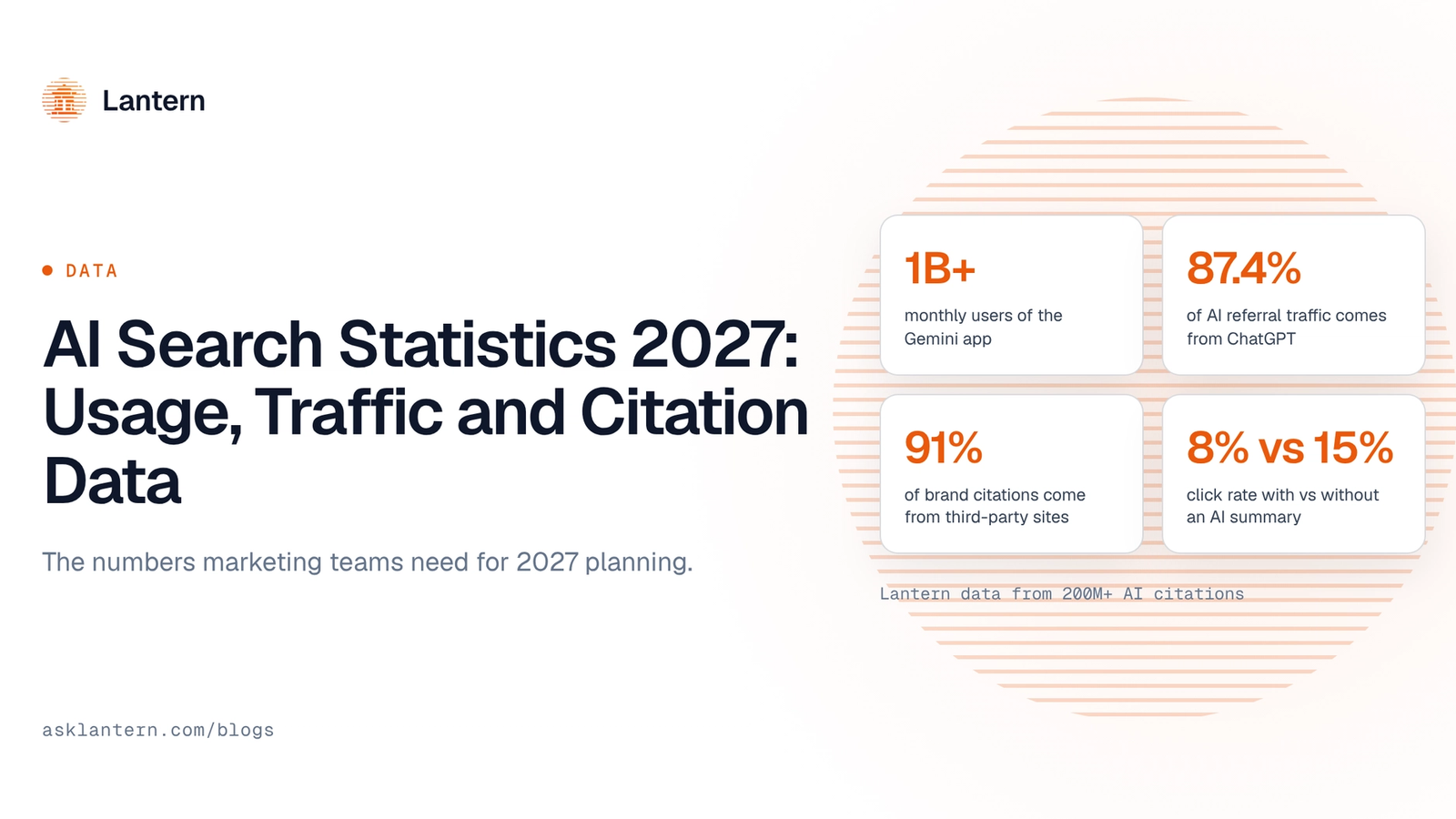
- ChatGPT sends 87.4% of AI referral traffic across sites Lantern tracks, even though its share of AI usage is closer to 55%.
- AI answers cut clicks, but being cited softens the blow. Google searches with an AI summary got a click 8% of the time, against 15% without one.
- 91% of brand citations come from other people's websites, and listicles are the most-cited format at 35.6%.
- Freshness counts. 62% of the most-cited pages were published in the last six months.
AI search usage statistics
AI assistants have moved from early adopters to the mainstream in under three years. These are the latest official user numbers for the major AI search products.
| Platform | Users | Date | Source |
|---|---|---|---|
| ChatGPT | About 900 million weekly active users | February 2026 | OpenAI, reported by [eWeek](https://www.eweek.com/fr/news/chatgpt-hits-900m-weekly-users/) |
| Gemini app | More than 1 billion monthly active users | Q3 2026 | Alphabet, reported by [PPC Land](https://ppc.land/gemini-app-gains-350m-users-in-a-year-to-pass-1bn-alphabet-says/) |
| Google AI Mode | More than 1 billion monthly active users | Q2 2026 | [Alphabet Q2 2026 earnings](https://blog.google/company-news/inside-google/message-ceo/alphabet-earnings-q2-2026/) |
| Claude | Unique visitors up about 180% from the first to the second half of the year | 2026 | Anthropic, via [Lantern](https://www.asklantern.com/blogs/how-ai-search-traffic-share-has-shifted-over-the-past-year) |
- Gemini added about 350 million users in a year, rising from 650 million monthly users in Q3 2025 to more than 1 billion in Q3 2026 (Alphabet, Q3 2026).
- AI Mode queries are about three times longer than traditional searches, and one in five AI Mode searches uses voice, images or documents (Alphabet, Q3 2026).
- Google search queries are still growing. Alphabet reported its highest year-over-year query growth in five years in Q3 2026, which means AI search adds to search rather than replacing it.
What this means for you: your buyers use several AI tools, not one. Measure visibility across ChatGPT, Gemini, Google's AI features, Perplexity and Claude, not just the one you use yourself.
AI search traffic share by platform
ChatGPT still leads AI search, but its lead is shrinking as Gemini and Claude grow. These shares come from Lantern's tracking of AI search traffic in September 2026.
| Platform | Share three months earlier | Latest share |
|---|---|---|
| ChatGPT | 52.7% | 55.5% |
| Gemini | 27.8% | 25.6% |
| Claude | About 9% | About 9% |
A year earlier, ChatGPT held most of the category on its own. Today, roughly four in ten AI search visits go to other platforms, so a ChatGPT-only strategy misses a large share of your buyers.
AI referral traffic statistics
AI search sends a small but fast-growing, high-quality stream of visitors. The figures below come from Lantern's analysis of AI referral traffic across the sites we track.
- ChatGPT drives 87.4% of all AI referral traffic. Perplexity, Gemini, Claude and Copilot share the remaining 12.6%.
- AI referrals are about 1% of total sessions for most brands today, and growing.
- AI-referred visitors convert 4.4 times better than standard organic search visitors on average. Conversion varies by industry, and ecommerce sites often see lower revenue per session than B2B.
- Much AI traffic is hidden. ChatGPT visits from apps often arrive without a referrer and show up as direct traffic unless you set up a custom channel group in GA4.
Why ChatGPT's share of referrals (87.4%) is higher than its share of usage (55.5%): ChatGPT combines high volume with clickable citations in most search answers. An engine that answers well but rarely links sends little traffic.
What this means for you: set up AI referral tracking in GA4 before you set 2027 targets. Without it, you'll undercount the channel and its conversion rate.
AI Overviews and click-through statistics
AI answers reduce clicks to websites. Every major study agrees on the direction, even if the size of the effect varies.
| Finding | Number | Source and date |
|---|---|---|
| Google visits with a click on a result when an AI summary appears | 8% | [Pew Research Center](https://www.seroundtable.com/pew-google-ai-overviews-39808.html), March 2025 data |
| Google visits with a click on a result when no AI summary appears | 15% | Pew Research Center, March 2025 data |
| Visits where users clicked a link inside the AI summary | 1% | Pew Research Center, March 2025 data |
| Visits that ended the browsing session after an AI summary | 26% (vs 16% without) | Pew Research Center, March 2025 data |
| Lower click-through rate for the top result when an AI Overview appears | 58% | [Ahrefs](https://ahrefs.com/blog/ai-overviews-reduce-clicks-update), December 2025 vs December 2023 |
| US Google searches ending without a click | 58.5% | [SparkToro and Datos](https://sparktoro.com/blog/2024-zero-click-search-study-for-every-1000-us-google-searches-only-374-clicks-go-to-the-open-web-in-the-eu-its-360/), 2024 |
Being cited in the AI answer changes the picture. In Seer Interactive's 2026 study of 53 brands and 5.47 million queries, brands cited in an AI Overview earned about 20,700 organic clicks per million impressions on informational queries, against about 9,400 for brands that weren't cited. That's roughly 120% more clicks for the same visibility. Seer notes this is a correlation, since stronger brands are more likely to be cited.
What this means for you: expect fewer clicks per impression on informational queries. The goal shifts from ranking to being the source the AI answer cites, because cited brands keep far more of the clicks that remain.
AI citation statistics
These figures come from Lantern's AI Citation Content Visibility Report, based on more than 200 million citations collected from the live interfaces of ChatGPT, Perplexity, Gemini and Claude in February 2026.
- 91% of brand citations come from third-party sources. Only 9% point to the brand's own website (full analysis).
- Review platforms drive 44% of those external citations, and YouTube drives 28%.
- Listicles are the most-cited content format at 35.6% of all citations, more than 13 points ahead of the next format (full analysis).
- Comparison pages earn 9.3% of citations, a high share for a format most teams publish little of.
Each AI engine favours different formats. ChatGPT is the outlier: it cites product pages 50 times more often than Perplexity does.
| Content type | Gemini | Perplexity | Claude | ChatGPT |
|---|---|---|---|---|
| Listicle | 42.5% | 46.8% | 42.0% | 33.1% |
| Blog or guide | 26.6% | 23.5% | 28.6% | 29.4% |
| Homepage or brand page | 13.6% | 5.8% | 8.0% | 1.7% |
| Comparison | 9.2% | 14.3% | 12.1% | 10.3% |
| Product page | 0.4% | 0.4% | 2.3% | 20.1% |
| Review or aggregator | 1.1% | 2.0% | 3.4% | 2.1% |
The most-cited domains in AI search
A small group of independent platforms earns a large share of citations. These were the top ten domains across all four engines in February 2026 (full analysis).
| Rank | Domain | Share of all citations |
|---|---|---|
| 1 | youtube.com | 3.10% |
| 2 | g2.com | 1.38% |
| 3 | medium.com | 0.63% |
| 4 | appsumo.com | 0.60% |
| 5 | zapier.com | 0.50% |
| 6 | reddit.com | 0.42% |
| 7 | techradar.com | 0.34% |
| 8 | capterra.com | 0.28% |
| 9 | slashdot.org | 0.24% |
| 10 | sourceforge.net | 0.16% |
Citation sources can shift fast. Reddit's share of visible citations in ChatGPT search answers fell from 3.83% to 0.52% between July and August 2026, an 86.4% drop in under a month.
How content age affects AI citations
AI engines strongly favour recent content. Here's the age of the most-cited pages in Lantern's February 2026 data (full analysis).
| Content age | Share of top citations |
|---|---|
| 0 to 3 months | 37% |
| 3 to 6 months | 25% |
| 6 to 12 months | 22% |
| 1 to 2 years | 9% |
| More than 2 years | 9% |
Most of the older pages that still get cited sit on very high-authority domains such as YouTube, G2 and Reddit. For a typical brand blog, pages older than a year earn very few citations.
What this means for you: put more of your effort into third-party presence, comparison content and regular refreshes of your best pages. Those three areas account for most of the citations your brand can win.
AI crawler statistics
Whether AI tools can read your site is the first condition for being cited. These are the latest figures on how AI crawlers use the web and how sites respond.
- Training made up 79% of AI crawling in July 2025, against 17% for search and about 3% for user-triggered visits (Cloudflare).
- 17% of sites on Cloudflare restrict AI training, while fewer than 1% block search crawlers (Cloudflare, September 2026).
- Crawlers that collect for both search and training make up 36.6% of verified crawler traffic on Cloudflare's network (Cloudflare, September 2026).
- 97% of llms.txt files received zero requests in a month, in an Ahrefs study of 137,210 domains in May 2026 (our llms.txt guide).
- Most AI crawlers don't run JavaScript. Content that only loads client-side is invisible to them (our analysis).
Our AI crawler list explains which bots to allow and which you can safely block.
How to use these statistics in your 2027 plan
Numbers only help if they change what you do. Here's how we'd turn them into a plan.
- Set a baseline for AI visibility. Measure how often AI answers mention your brand for the 50 to 100 prompts your buyers ask, across every major engine.
- Fix tracking first. Add an AI referral channel group in GA4 so you can see the traffic and its conversion rate.
- Shift budget toward third-party presence. With 91% of citations coming from other sites, reviews, comparisons, YouTube and press coverage deserve a real line in the plan.
- Publish and refresh the formats AI cites. Plan listicles, comparison pages and product pages, and refresh your top pages at least every six months.
- Report the full picture. Add AI mentions, citations and share of voice next to rankings and traffic in your monthly report.
Our recommendation
Treat AI search as a channel in 2027, with its own budget, targets and reporting. The traffic is still small, but it converts well, it's growing, and AI answers already shape how buyers see your category before they visit any website.
Start with measurement. You can't win citations you can't see, and Lantern's free AI visibility report shows where your brand appears today across ChatGPT, Gemini, Perplexity, Claude and Google's AI features.
About this data
Lantern figures come from our AI Citation Content Visibility Report (February 2026, more than 200 million citations from the live interfaces of ChatGPT, Perplexity, Gemini and Claude) and from ongoing tracking of AI traffic and citations in 2026. Third-party figures are linked to their sources. Studies use different methods and time periods, so compare trends rather than exact numbers across sources. We update this page as new data is published.
FAQ
How many people use AI search?
More than a billion people use AI search every month. ChatGPT had about 900 million weekly users in February 2026, and Google reports more than 1 billion monthly users each for the Gemini app and AI Mode.
How much website traffic comes from AI search?
For most brands, AI referrals are about 1% of total sessions today, and the share is growing. ChatGPT sends 87.4% of that traffic across sites Lantern tracks.
Do AI Overviews reduce clicks?
Yes. Pew Research found that Google visits with an AI summary led to a click on a result 8% of the time, against 15% without a summary. Ahrefs measured a 58% lower click-through rate for the top result on queries with an AI Overview.
Where do AI engines get their sources?
Mostly from third-party sites. In Lantern's data, 91% of brand citations come from sources outside the brand's website, led by review platforms, YouTube and community sites.
What content format gets cited most by AI?
Listicles, at 35.6% of all AI citations in Lantern's data, followed by blog posts and guides. ChatGPT is the exception that cites product pages often, at 20.1% of its citations.
Do AI search visitors convert better?
On average, yes. Across sites Lantern tracks, AI-referred visitors convert 4.4 times better than standard organic search visitors, though the lift varies by industry.