- generative Engine Optimization
- Answer Engine Optimization
Why AI Keeps Repeating an Old Story About Your Brand
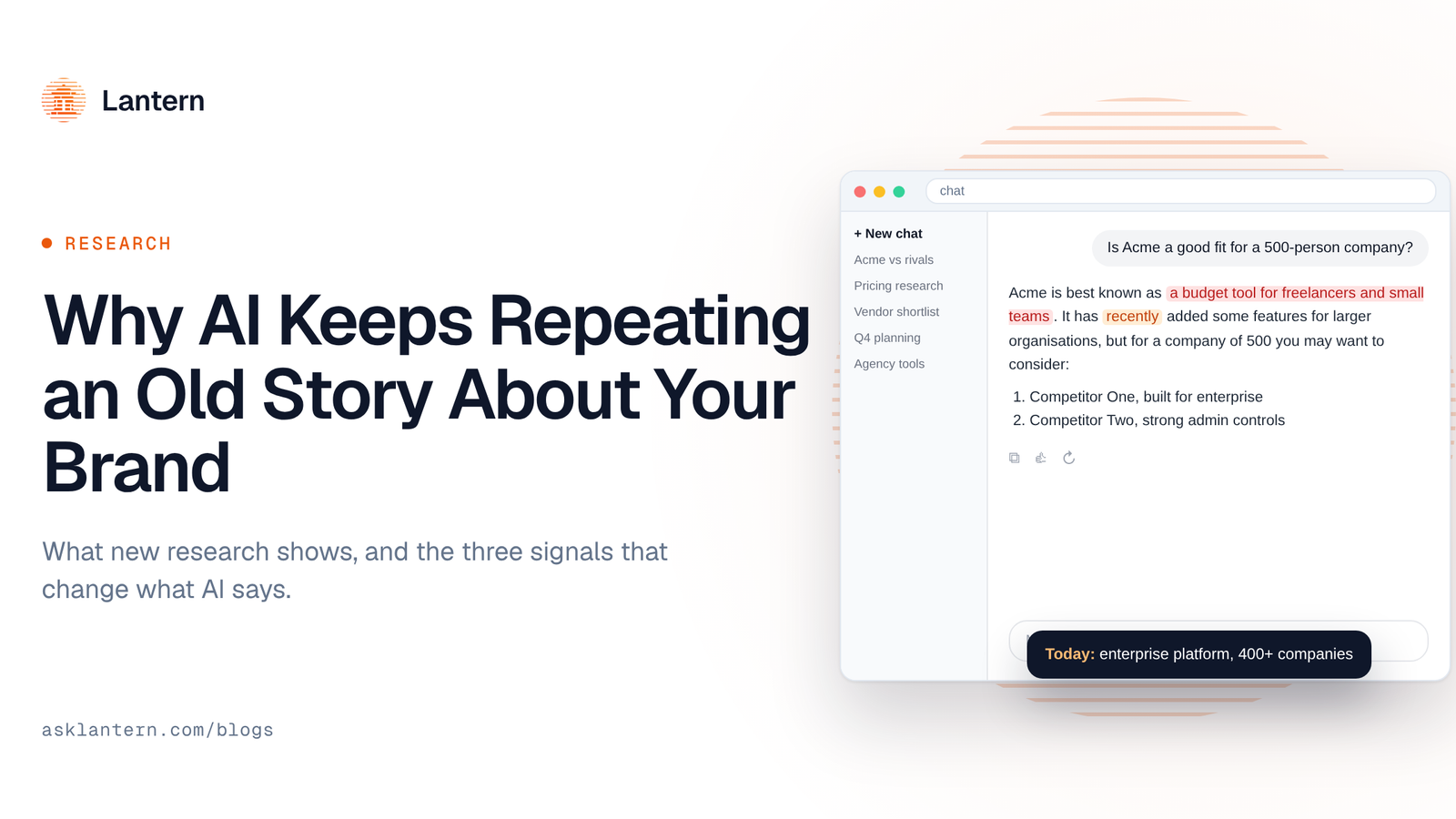
AI engines repeat the most familiar story about a brand, even after the facts change. What new research shows, and the three signals that change what AI says about you.
 Collins
On this page
- Key takeaways
- What the research found
- Why AI repeats an outdated story about your brand
- The three signals that shape what AI says
- 1. Entity authority: define who you are
- 2. Third-party validation: have others explain why you matter
- 3. Community discussion: amplify what's already true
- Why short campaigns don't change the story
- How to check what AI really thinks of your brand
- Our recommendation
- FAQ
- Why does ChatGPT describe my brand incorrectly?
- How long does it take AI to update what it says about a brand?
- Does Wikipedia affect AI visibility?
- Does Reddit help AI visibility?
- Will a press release change what AI says about my brand?
- What should I measure besides brand mentions?
AI engines don't describe your brand from scratch each time someone asks. They repeat the story they already know. If that story is out of date, AI keeps telling it, even after the facts have changed and even when it gets the facts right.
That's the clearest finding from recent research into how AI forms its view of people and brands. Here's what the research found, why it happens, and the order in which to build the signals that change what AI says about you.
Key takeaways
- AI tends to repeat the most familiar story about a brand, rather than checking for the best current answer.
- Outdated framing outlasts outdated facts. In one large study, about 1 in 5 factually correct AI answers still used the old framing three weeks after events had changed it.
- Strong signals produce far more visibility. Entities with strong signals were mentioned 7.8 times more than those with weak ones.
- Wikipedia and Reddit carry outsized weight. Wikipedia page views were the strongest single predictor of AI visibility, and Reddit was cited 3 to 15 times more than other social platforms.
- Build signals in order: define your brand, then earn independent coverage, then encourage community discussion.
What the research found
Seer Interactive studied more than 231,000 AI answers across seven AI platforms, including ChatGPT, Google AI Mode, Perplexity, Gemini, Meta AI and Claude, over 52 days of the 2026 Winter Olympics. Athletes made a useful test case: their stories changed daily, so the researchers could see how quickly AI caught up with new facts.
| Finding | Result |
|---|---|
| Strong signals vs weak signals | About 12,174 AI mentions vs about 1,565, a 7.8x gap |
| Strongest predictor of AI visibility | Wikipedia page views over the previous 7 days |
| Reddit vs other social platforms | Cited 3 to 15 times more than Instagram, TikTok or X |
| Outdated framing | About 1 in 5 correct answers still used the old framing three weeks later |
| Mixed outcomes vs clear reversals | Mixed outcomes were about 2.8 times harder for AI to correct |
| Geographic bias | The US appeared in 36.8% of neutral prompts, against 16% for Norway, the medal leader |
The study looked at athletes, not companies, but the same mechanics apply to brands. AI engines learn about any entity from the same places: its own canonical sources, independent coverage and public discussion.
Why AI repeats an outdated story about your brand
AI engines complete the most familiar pattern. When someone asks about your brand, the model draws on what it learned in training and on whatever it finds in a live search. If most of what's been written about you describes an old product, old pricing or an old position in the market, that's the story the answer leans toward.
Three things make the old story stick:
- Training data changes slowly. A model's built-in knowledge only updates when a new model is trained. Until then, answers that don't trigger a search reflect the past.
- Search results favour well-established pages. Older pages with more links and mentions often rank above your recent announcement, so the AI reads them first.
- Corrections don't replace framing. AI often adds a caveat to the old story ("previously known as…", "though recently…") instead of rewriting it. As the researchers put it, "caveats are not corrections."
What this means for you: a press release or a product page update won't change what AI says on its own. You have to change what the wider web says about you.
The three signals that shape what AI says
The research identified three signals, and found they work best when built in order.
| Signal | What it is | Examples | Build it |
|---|---|---|---|
| Entity authority | Sources that define who you are | Your website, Wikipedia page, official profiles, product listings | First |
| Third-party validation | Independent sources explaining why you matter | News coverage, industry publications, analysts, reviews, comparison articles | Second |
| Community discussion | People talking about you | Reddit threads, forums, social posts | Third |
1. Entity authority: define who you are
Start with the sources AI treats as the official record. Make sure your website states clearly what you do, who you serve and what makes you different, in plain words near the top of key pages. Keep your profiles consistent everywhere they appear: LinkedIn, Crunchbase, G2, app stores and directories.
If your brand qualifies for a Wikipedia page, treat it as a primary asset. In the research, Wikipedia page views were the single strongest predictor of AI visibility. Our guide to entity SEO for AI search covers how to build this foundation.
2. Third-party validation: have others explain why you matter
Independent coverage is where AI learns why your brand is significant. This matches what we see in Lantern's data: 91% of brand citations in AI answers come from sites other than the brand's own, led by review platforms, YouTube and industry publications.
Earn coverage that states the current story: trade press features, analyst mentions, detailed customer reviews and inclusion in comparison articles. Our guide to digital PR for AI search covers how.
3. Community discussion: amplify what's already true
Reddit and forums amplify a story, but they can't create one. Discussion works when it reflects signals that already exist. Encourage genuine conversation from real customers, rather than planting posts. Platforms change fast: Reddit's share of ChatGPT's visible citations fell 86.4% in a month this year, so community discussion should never be your only signal.
Why short campaigns don't change the story
A launch or campaign spike rarely changes what AI says for long. The research found that short-term bursts of attention didn't translate into lasting AI visibility. Entities with a solid base of signals kept their visibility; those without it faded once the attention passed.
Freshness still matters, but it has to be sustained. In Lantern's data, 62% of the most-cited pages were published in the last six months. AI rewards a steady flow of current, accurate coverage, not a single big moment.
How to check what AI really thinks of your brand
Most brands only check whether AI mentions them. That's not enough. As the research puts it: "Mention rate tells you if you're in the room and brand accuracy tells you what the room thinks of you."
- Ask judgment questions, not just factual ones. Ask "Which project management tools are worth considering for an agency?", not just "What is [your brand]?". Judgment questions show how AI positions you against competitors.
- Check the framing, not just the facts. Note the words AI uses to describe you. Is it the current story or an old one? Are there caveats that keep the old story alive?
- Compare platforms. AI engines update at different speeds. Engines that search the web catch up faster than answers based on training data alone.
- Trace the sources. For every outdated description, find the pages AI cites. Those are the pages to update, or to outweigh with newer coverage.
- Recheck monthly. Narrative changes take weeks, not days, so track the trend over time.
Our guide to correcting AI mistakes about your brand covers the fixes for factual errors.
Our recommendation
Stop treating AI visibility as a mention count. What matters is the story AI tells about you, and that story is written by your official sources, by independent coverage and by public discussion, in that order.
Fix the foundation first: a clear, consistent description of your brand everywhere it appears. Then invest steadily in independent coverage that tells the current story. Measure the narrative every month, across every major AI engine, so you know when the story has changed.
FAQ
Why does ChatGPT describe my brand incorrectly?
Usually because most of what's been written about your brand describes an older version of it. AI repeats the most familiar story, so outdated pages, profiles and coverage outweigh recent updates until enough new sources tell the current story.
How long does it take AI to update what it says about a brand?
It varies by platform. AI engines that search the web can reflect new facts within days or weeks, but outdated framing often lasts longer. In one study, about 1 in 5 correct answers still used old framing three weeks after events changed.
Does Wikipedia affect AI visibility?
Yes, strongly. In Seer Interactive's study of more than 231,000 AI answers, Wikipedia page views were the single strongest predictor of how often AI mentioned an entity.
Does Reddit help AI visibility?
Reddit is cited far more than other social platforms, 3 to 15 times more in one study. But it amplifies existing signals rather than creating them, and its share of citations can change quickly.
Will a press release change what AI says about my brand?
Not on its own. A press release adds one source. Changing the story takes consistent official information, independent coverage that repeats the new story, and time.
What should I measure besides brand mentions?
Measure how AI describes you in judgment questions, whether the framing is current, which competitors appear next to you, and which sources AI cites. Lantern tracks mentions, citations and the sources behind them across every major AI engine.