- generative Engine Optimization
- Answer Engine Optimization
What Are Google AI Overviews? How They Work and Choose Sources
What Google AI Overviews are, how Google builds them and picks its sources, what they do to your traffic, and how to get your content cited.
 Collins
On this page
- Key takeaways
- What is a Google AI Overview?
- How many people see AI Overviews
- How Google builds an AI Overview
- How Google chooses which sources to cite
- What AI Overviews do to your traffic
- Ads in AI Overviews
- How to get your content into AI Overviews
- How to control what Google shows from your site
- How to track your performance in AI Overviews
- Our recommendation
- FAQ
- What is an AI Overview on Google?
- How does Google choose sources for AI Overviews?
- Can you turn off AI Overviews in Google?
- Do AI Overviews reduce website traffic?
- How do I get my website in Google AI Overviews?
- What is the difference between AI Overviews and AI Mode?
Google AI Overviews are now the first thing many people see when they search. For marketers, that changes two things: fewer people click through to websites, and the pages Google quotes in the overview get the attention the top result used to get.
This guide explains what AI Overviews are, how Google builds them and picks its sources, what they do to your traffic, and what you can do to be one of the sources Google cites.
Key takeaways
- An AI Overview is an AI-written summary at the top of Google's results. It answers the search directly and links to the pages it used.
- They reach a huge audience. Google said AI Overviews had over 2 billion monthly users across more than 200 countries and territories in July 2025.
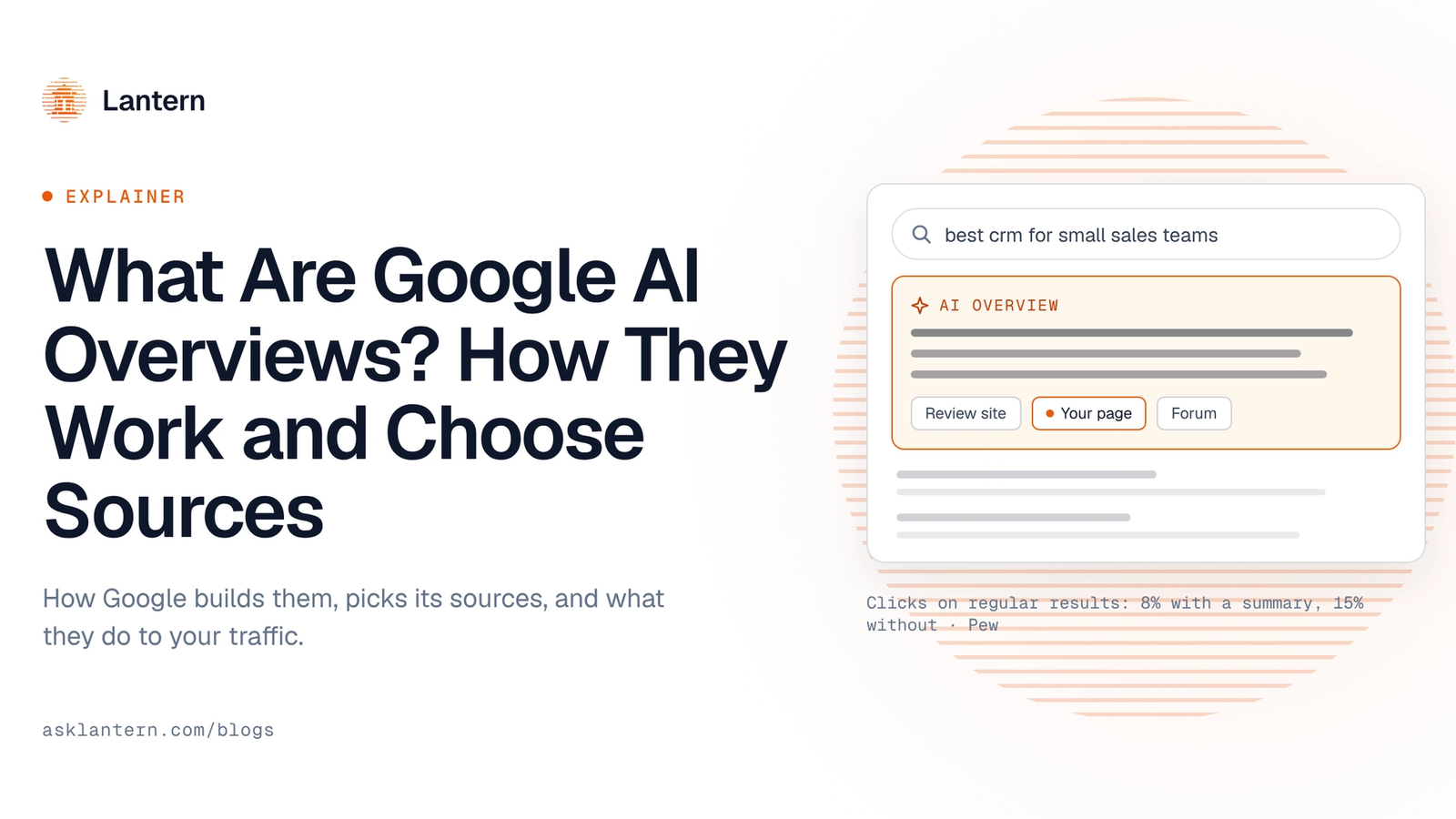
- They reduce clicks on regular results. Pew Research found people clicked a regular result on 8% of visits with an AI summary, versus 15% without one.
- Google picks sources by running many related searches. A page doesn't need to rank first to be cited, and ranking first doesn't guarantee a citation.
- There's no special markup needed. Google says normal SEO eligibility is enough. Clear, well-structured content and strong mentions elsewhere do the rest.
What is a Google AI Overview?
A Google AI Overview is a short, AI-generated answer that appears at the top of Google's search results. It summarizes information from several web pages and shows links to those pages so people can read more. Google describes it as a snapshot of key information "with links to dig deeper".
Google launched AI Overviews in the US in May 2024 and has since expanded them globally. Since January 2026, they run on Gemini 3, Google's latest AI model. On mobile, tapping "Show more" on an overview now opens a chat in AI Mode, so people can ask follow-up questions without starting a new search.
| What | AI Overviews | AI Mode | Classic results |
|---|---|---|---|
| Where it appears | At the top of normal Google results | A separate chat-style tab in Google Search | Below AI Overviews, as ranked links |
| When it appears | Only when Google decides it will help | Whenever someone uses AI Mode | On every search |
| What people get | A short summary with source links | A longer answer, with follow-up questions | A list of pages to choose from |
| Can people turn it off? | No, but the "Web" filter shows links only | Yes, by not using it | Not applicable |
| How your site appears | As a linked source | As a linked source | As a ranked result |
What this means for you: an AI Overview is now often the first impression your buyers get of your category, before they see any website, including yours.
How many people see AI Overviews
AI Overviews reach more people than any other AI search product. On Google's July 2025 earnings call, CEO Sundar Pichai said AI Overviews had over 2 billion monthly users across more than 200 countries and territories and 40 languages, up from 1.5 billion the quarter before. In July 2026, he said AI Mode had passed 1 billion monthly users.
How often an overview appears depends on the search. Pew Research found that 18% of Google searches in its March 2025 study produced an AI summary. Industry trackers reported much higher rates in mid-2026: Search Engine Roundtable reported figures of about 43% and 48% of queries from two SEO data vendors, though neither published its method. Rates are higher for longer, question-style searches and lower for short searches and brand names.
What this means for you: the exact percentage varies by source, but the trend is clear. For the longer, research-style questions your buyers ask, an AI Overview is now more likely than not.
How Google builds an AI Overview
Google hasn't published the full process, but its developer documentation explains the main steps.
- Google decides whether to show one. AI Overviews only appear when Google's systems judge that they add something beyond normal results.
- It runs many related searches. Google calls this query fan-out. It issues "multiple related searches across subtopics and data sources" to build the answer. Our guide to query fan-out explains how this works.
- It pulls supporting pages from its index. Only pages that are indexed and eligible to show a snippet in Google Search can be used.
- Gemini writes the summary. The AI model combines what it found into a short answer.
- It adds links to its sources. Google says this lets it "display a wider and more diverse set of helpful links" than classic search.
Google is also open about the limits. Its help page warns that "AI Overviews can and will make mistakes" and advises people to check important information.
How Google chooses which sources to cite
Because of query fan-out, Google doesn't simply cite the top results for the search. It cites the pages that best answer the smaller questions behind it.
That's why ranking matters less than it used to. In July 2025, Ahrefs found that 76% of pages cited in AI Overviews also ranked in the top 10 for the same search. In an updated study of 863,000 keywords, reported in March 2026, that fell to 38%, as Search Engine Journal covered. About 31% of cited pages ranked between positions 11 and 100, and another 31% ranked lower still.
The type of site matters too. Pew Research found that Wikipedia, YouTube and Reddit were the most-cited sources in AI summaries, and that government (.gov) sites made up 6% of sources, versus 2% in regular results. Across all AI tools, Lantern's analysis of more than 200 million citations found that 91% of brand citations come from pages the brand doesn't own. More in LLM Citations Explained.
What this means for you: to be cited, your page needs to answer the specific smaller questions clearly, and your brand needs to appear on the other sites Google trusts.
What AI Overviews do to your traffic
AI Overviews answer many questions directly, so fewer people click through to websites. Several studies agree on the direction, though the size of the drop varies.
- Pew Research (July 2025): people clicked a regular search result on 8% of visits with an AI summary, versus 15% without one. Only 1% of visits included a click on a link inside the summary. 26% of visits with a summary ended the browsing session, compared with 16% without.
- Ahrefs (February 2026): for searches with an AI Overview, the click-through rate of the first result was about 58% lower than expected, based on desktop data from 300,000 keywords. Ahrefs notes this shows a strong link, not proven cause.
Google's view is different. Pichai said in July 2026 that Google is "sending billions of clicks to websites every week" through its AI features, and Google's documentation says clicks from pages with AI Overviews are "higher quality". Google hasn't published data to support that claim.
What this means for you: expect fewer clicks on informational searches, even when you rank well. Measure AI visibility alongside traffic, or you'll miss how often your brand is seen without a click. Our guide to zero-click search covers this in more detail.
Ads in AI Overviews
Google now shows ads inside and around AI Overviews for some commercial searches, so paid and organic results compete for the same space. We covered how they interact in AI Search Ads Are Here.
How to get your content into AI Overviews
Google says there are no additional requirements to appear in AI Overviews beyond being indexed and eligible for a snippet. Its AI optimization guide adds that AI features are built on Google's core ranking systems, that no special schema or llms.txt file is needed, and that you don't need to rewrite content in a special style for AI. What it asks for is "non-commodity" content: a real point of view or first-hand experience, not a restatement of what others have said. In practice, these steps make the biggest difference:
- Make sure Google can index your page. Allow Googlebot, keep important content in the HTML, and check the page in Search Console's URL Inspection tool.
- Don't block snippets on pages you want cited. The nosnippet and max-snippet controls limit what Google can show, including in AI Overviews.
- Cover the whole topic. List the smaller questions behind your main search and answer each one on the page or on linked supporting pages.
- Answer first in every section. Start each section with a direct one- or two-sentence answer that makes sense on its own, then add detail.
- Add evidence. Use real numbers, named sources and dates. Original data is the hardest thing for competitors to copy.
- Get mentioned on trusted sites. Reviews, industry roundups and press coverage feed AI Overviews too. Our digital PR for AI search guide shows how.
- Keep key pages up to date. Refresh facts and figures on a schedule, not just the date.
For a step-by-step plan, read our guide to ranking in Google AI Overviews and AI Mode.
How to control what Google shows from your site
Google offers a few controls if you want to limit how your content is used:
- nosnippet or data-nosnippet: stops Google showing text from a page, or part of a page, in results and AI features.
- max-snippet: limits how much text Google can show.
- noindex: removes the page from Google Search entirely.
- Google-Extended: limits use of your content for AI training and grounding in some of Google's other AI systems. Google's documentation doesn't say it removes you from AI Overviews.
Use these with care. A page that blocks snippets can't be cited as a source in AI Overviews.
How to track your performance in AI Overviews
Google Search Console counts AI Overview and AI Mode traffic in its main Performance report, under the "Web" search type. Google's AI optimization guide, updated in July 2026, also points site owners to a Generative AI performance report in Search Console for a view of how pages perform in AI features.
Search Console shows what happens on Google. It doesn't show how often your brand is named without a click, or how you compare with competitors. To get the full picture:
- Track a fixed set of buyer questions. Check each month whether an AI Overview appears, whether your brand is mentioned and which pages are cited.
- Watch click-through rates on informational pages. A falling rate with steady rankings often means an AI Overview is answering the question.
- Track AI referral traffic in GA4. Our AI referral traffic guide shows how to set it up.
Lantern tracks AI Overviews alongside ChatGPT, Perplexity, Gemini and Claude, and shows which pages are being cited for the questions your buyers ask.
Our recommendation
Treat AI Overviews as a new front page for your category, not just a threat to your traffic. Make sure Google can index and quote your key pages, cover each topic in full so you appear across the related searches Google runs, and earn mentions on the sites it already trusts. Then measure your visibility in AI Overviews directly, because your Search Console clicks won't tell the whole story.
FAQ
What is an AI Overview on Google?
An AI Overview is an AI-generated summary at the top of Google's search results. It answers the search directly using information from several web pages and shows links to those pages. Google uses its Gemini AI model to write it.
How does Google choose sources for AI Overviews?
Google runs many related searches for one question, a process it calls query fan-out, and pulls pages from its index that best answer each part. Pages must be indexed and eligible to show a snippet. Ranking helps, but in early 2026 only 38% of cited pages also ranked in the top 10 for the same search.
Can you turn off AI Overviews in Google?
No. Google says the feature can't be turned off. People can choose the "Web" filter after searching to see only text links, without AI Overviews.
Do AI Overviews reduce website traffic?
Studies say yes for many searches. Pew Research found people clicked a regular search result on 8% of visits with an AI summary, versus 15% without one. Google says clicks from pages with AI Overviews are higher quality but hasn't published data to support that.
How do I get my website in Google AI Overviews?
Make sure Google can index your page and show snippets from it, cover the full topic, start each section with a direct answer, add real data and sources, and earn mentions on trusted sites in your industry. Google says no special markup is needed.
What is the difference between AI Overviews and AI Mode?
AI Overviews are short summaries that appear at the top of normal Google results when Google thinks they'll help. AI Mode is a separate chat-style experience for longer questions and follow-ups. Both use query fan-out and link to their sources.