SEO Agents: What They Are, How They Work and the Best Ones to Try
An SEO agent does multi-step SEO work with your data: keyword research, briefs, on-page fixes, refreshes, internal links and audits. Here's how SEO agents work, what Google's rules mean for AI content, how to score one, eight agents compared with October 2026 prices, and a 30-day rollout plan.
On this page
On this page
An SEO agent is AI software that does multi-step SEO work toward a goal you set. It reads your real data, such as Google Search Console, decides what to do next, then does the work: keyword research, briefs, on-page fixes, content refreshes, internal links and audits. The good ones stop and ask a person before anything goes live.
This guide covers how SEO agents work, what they can safely do, what Google's rules mean, how to score one, and eight agents worth trying.
Quick picks :
- Agents grounded in your brand and search data, with human approval: Lantern
- A platform plus hands-on strategy help: AirOps
- Teams already paying for Ahrefs: Letaido by Ahrefs
- SEO, AI visibility and AI writing in one plan: Writesonic
- Hands-off technical fixes: Search Atlas OTTO SEO
- Bulk on-page changes across many sites: Alli AI
- Building your own SEO agents: Relevance AI
- Small businesses with no content team: SEO.AI
What is an SEO agent?
An SEO agent uses a large language model to plan and carry out SEO tasks with your data and tools. You give it a job, like "find pages losing clicks and draft refreshes," and it works through the steps without waiting for your next prompt.
OpenAI's practical guide to building agents calls agents "systems that independently accomplish tasks on your behalf." Simple chatbots and single-turn LLMs don't count, because the model doesn't control the workflow.
Anthropic separates workflows from agents: a workflow follows predefined steps, while an agent directs its own. Many SEO agents mix the two, which keeps their work easy to review.
The phrase "SEO agent" gets used for four different things, which is why search results for it look so mixed:
- AI SEO agent: software that does the work. This is what most of this guide covers.
- SEO tool: software that shows you data, like a rank tracker or crawler. You decide and do the work.
- SEO agency: a company you pay to set strategy and do the work for you.
- A person: some people searching "SEO agent" want a human SEO specialist or consultant to hire.
Many teams use an agent for repeatable work and people or an agency for strategy and PR. If you're weighing outside help, see how to choose an AEO agency. For agents beyond SEO, read our guide to marketing agents for AI search.
How does an SEO agent work?
Most SEO agents run the same loop: read signals, make a plan, act, then hand the work to a person for review. After that, they measure what changed and start again.
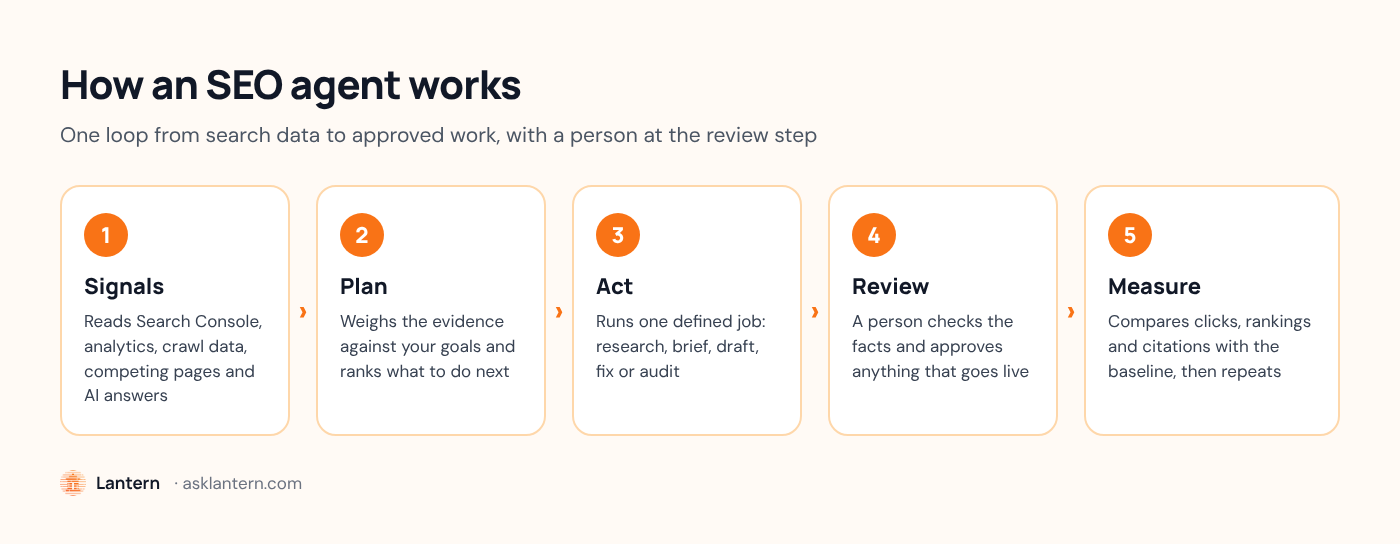
- Signals. It reads Search Console, analytics, crawl data, competing pages and, in some tools, how AI answers mention your brand.
- Plan. It weighs that evidence against your goals and ranks what to do next.
- Act. It runs a defined job: research, brief, draft, fix or audit.
- Review. A person checks the facts, asks for changes and approves anything that goes live.
- Measure. It compares clicks, rankings and citations with the starting point, then repeats.
A made-up but typical example: a software company's pricing guide slips from position 4 to 11 over 28 days, so the agent drafts a refresh that answers two questions newer pages cover and adds three internal links. The content lead fixes one claim and approves it, and the agent tracks clicks from there.
What can SEO agents do for content and growth teams?
SEO agents are best at repeatable work you can check against data. These are the jobs most of them cover, and what a person should still check.
| Job | What a good agent does | What a person checks |
|---|---|---|
| Keyword research | Pulls Search Console queries, adds volume and difficulty, clusters by intent | Clusters match how buyers think |
| Content briefs | Turns a gap into a brief with intent, outline, sources and links | The angle, and what only you can add |
| On-page fixes | Drafts titles, meta descriptions, schema and alt text | Every line that can show in search |
| Content refreshes | Finds pages losing clicks and drafts updates | Facts, dates and an unchanged URL |
| Internal linking | Suggests in-context links between related pages | Relevant anchors, no over-linking |
| Technical audits | Flags broken links, redirect chains, indexing and canonical issues | Anything touching robots.txt, noindex or redirects |
| AI search visibility | Tracks how ChatGPT, Gemini and Google's AI mention and cite you | Enough prompts to trust the trend |
Refreshes are often the fastest win. Start with old content that's losing AI citations.
AI search needs its own tracking, because most of what AI answers cite isn't your site. In our AI Recognition Gap research, which followed four emerging brands from April to September 2026, third-party sites made up 98.9% of ChatGPT source links and 99.5% of Google AI source links. If you need a tracker for that, our AI visibility tools buyer's guide compares the main options.
What can't SEO agents safely do yet?
Agents are weak wherever the work needs first-hand knowledge, judgment or relationships, and none can guarantee results.
- Get facts right alone. LLMs can state wrong numbers confidently, so every statistic needs a checked source.
- Supply experience or strategy. Customer stories, original data, expert opinion and priorities come from your team.
- Earn links and mentions. An agent can find the right sites and draft the pitch. The relationship takes people.
- Promise rankings or citations. Google says there are no additional requirements or special optimizations for AI Overviews and AI Mode, and meeting every requirement still doesn't guarantee a page is crawled, indexed or shown.
- Make hard-to-undo changes alone. OpenAI's guide says actions that are "sensitive, irreversible, or have high stakes" need human oversight. Our open SEO skill for AI agents treats robots.txt, noindex, canonical and redirect changes, page deletions and AI crawler blocking as approval-only.
Does Google penalize content made by SEO agents?
Not for being made with AI. Google acts against low-value pages made at scale to game rankings, however they were produced.
Google's guidance on AI-generated content sums up its stance in a section heading: "Rewarding high-quality content, however it is produced." What breaks its spam policies is automation used "with the primary purpose of manipulating ranking in search results."
The policy to know is scaled content abuse. Google's own example: "Using generative AI tools or other similar tools to generate many pages without adding value for users."
Hallucinated facts are the other risk. Google's guidance on using generative AI content, updated 1 October 2026, notes that "generative models don't retrieve facts, but predict a likely sequence of words." It says to fact-check all AI content before publishing, including titles, meta descriptions, structured data and alt text.
Guardrails that keep an SEO agent inside those rules:
- Draft-first by default. Nothing goes live without a named reviewer.
- Source every number. No source, no figure.
- Match volume to review time. If your editor can review 10 pages a week, publish 10, not 200.
- Give the least access that works. Read-only in Search Console, draft-only in your CMS.
- Keep a change log and an undo.
- Check link building. Google's spam policies list excessive link exchanges as link spam.
How to evaluate an SEO agent: a scoring rubric
Judge an SEO agent on the job it does with your data, the control you keep, and how clearly it shows its work. Score each line 0, 1 or 2 in a demo or trial.
| Criterion | Ask the vendor | 0 points | 2 points |
|---|---|---|---|
| Job fit | Which jobs does it run end to end? | Open-ended chat | A named output per job, like a brief |
| Real data | Where does every number come from? | Model memory, no sources | Search Console, analytics and crawl data, cited |
| Brand context | How does it learn our products and voice? | Pasted into every prompt | One brand kit used at every step |
| Human control | What can go live without sign-off? | Publishes by default, full admin access | Draft-first, read-only options, approval per action |
| How fixes ship | Do changes land in our CMS or get injected with JavaScript? | Script injection only | Changes visible in the raw HTML |
| Logs and undo | Can we see and reverse every change? | No log | Change log with rollback |
| AI search | Which AI engines, and how many prompts? | Google only | Your buyers' engines, large prompt set |
| Cost clarity | What counts as a run or credit? | Unclear until the bill | Usage shown before a batch runs |
Our rule of thumb: anything under 11 out of 16 needs a strong reason to stay on your shortlist.
On fixes, many AI crawlers read only the HTML your server sends, so changes added by JavaScript may be invisible to them (here's why). On AI search, our research found that growing a tracked prompt set from 10 to 100 questions cut variation in reported brand coverage by about 73%.
The best SEO agents to try in 2026
The best SEO agent is the one built for your most common job. Here's how eight options compare as of 26 October 2026.
| Tool | Best for | Human approval | Starting price |
|---|---|---|---|
| Lantern | Brand- and data-grounded work | Before publishing or consequential changes | Free; Pro $89/month |
| AirOps | Platform plus strategy team | Review inbox | Not published |
| Letaido by Ahrefs | Ahrefs customers | Not described | $99/month |
| Writesonic | SEO, AI visibility and writing | Not described | $79/month billed annually |
| Search Atlas OTTO SEO | Hands-off technical fixes | Optional approval mode | $99/month |
| Alli AI | Many sites at once | Review or revert (beta agent) | $249/month billed annually |
| Relevance AI | Building your own agents | You configure it | Free plan; paid not published |
| SEO.AI | Small businesses | Optional drafts or review | $149/month |
1. Lantern SEO Agent
What it is: One of five specialist agents in Lantern. It researches demand, inspects competing pages and builds repeatable optimization workflows from your Search Console data and a shared Brand Knowledge Base.
Best for: Content and SEO teams that want agents grounded in their brand and search data, across Google and AI answers, with a person approving the work.
Key features:
- Rank tracking on Search Console data, keyword research with an AI citation filter, an on-page optimizer and a content gap finder.
- AI visibility tracking, plus Beam for running one task across many pages.
- Human review before publishing, then hand-off to WordPress, HubSpot, Sanity or Contentful.
Pricing: Free at $0 (ChatGPT tracking, 1 brand, 10 Agent Runs a month). Pro is $89/month with ChatGPT, Claude, Google and Gemini, 3 brands, 3 seats and 100 Agent Runs.
Watch-outs: It sends consequential changes to your team by design, so it won't push fixes live across many sites untouched. Runs are capped per plan. For tracking only, see the best AEO tools.
2. AirOps
What it is: An AI search growth platform with a strategy team attached. Its agents "research, create, publish, review, monitor, and refresh" content.
Best for: Content teams that want a platform and expert help setting the plan.
Key features:
- Long-running agents that split goals among subagents and remember past runs.
- A review inbox where agents pause until someone edits or approves, with rollback.
- Brand Kits, Knowledge Bases and native CMS integrations.
Pricing: Not published. Plans show "Start for free," pricing follows task volume, and there's a 14-day trial.
Watch-outs: Costs scale with tasks used. The Solo plan covers ChatGPT insights only.
3. Letaido by Ahrefs
What it is: "The AI marketing platform built by Ahrefs," running agents that build reports, tools and automations on Ahrefs data. Ahrefs' old Agent A address now redirects here.
Best for: Teams already paying for Ahrefs.
Key features:
- Reads Site Explorer, Keywords Explorer, Site Audit, Rank Tracker and Brand Radar.
- Scheduled alerts, digests and reports, delivered to Notion, Slack, HubSpot or WordPress.
Pricing: One plan at $99/month, with unlimited users and AI credits included.
Watch-outs: The native Ahrefs connection needs an Ahrefs subscription. Its page doesn't describe an approval step.
4. Writesonic
What it is: An SEO and AI visibility platform whose SEO AI Agent analyzes top content, runs site health checks and "implements proven fixes without touching a line of code."
Best for: Teams that want SEO, AI visibility and AI writing in one subscription.
Key features:
- "SEO & Content AI Agent" on every plan, with Search Console and Google Analytics connections.
- AI visibility tracking for ChatGPT, Gemini and Google AI Overviews (50 prompts on Starter).
Pricing: Starter $79/month, Basic $199, Growth $399, billed annually. Free trial, no card.
Watch-outs: Agentic workflows are limited to 10 trial runs on Starter, and the agent page doesn't describe a review step.
Deciding between Writesonic and AirOps? Our AirOps vs Writesonic comparison looks at content execution, technical fixes and pricing side by side.
5. Search Atlas OTTO SEO
What it is: Search Atlas calls OTTO "the AI agent that executes full search strategies for SEO and AI search." It automates titles, schema, canonicals, broken links and social tags, plus content and local work.
Best for: Agencies and site owners who want technical fixes shipped without developer tickets.
Key features:
- Connects through a header pixel or Cloudflare DNS, or writes into WordPress, HubSpot, Webflow, Shopify, Contentful and Duda.
- Approval mode, bulk actions and rollback.
Pricing: Starter $99/month (1 OTTO project), Growth $199, Pro $399, Agency $999. 7-day trial on Starter.
Watch-outs: OTTO "runs on autopilot" unless you turn on approval mode. If fixes ship through the pixel, check your raw HTML.
6. Alli AI
What it is: A platform that writes titles, schema, internal links and AI-readable structure, then deploys them across your sites without engineering work. Its separate SEO AI Agent is in beta.
Best for: Agencies and multi-site teams that need bulk on-page and technical changes.
Key features:
- Installs with a WordPress plugin, JavaScript snippet or tag manager.
- Serves pre-rendered HTML to 50+ AI crawlers, including GPTBot and ClaudeBot.
Pricing: Business $299/month, or $249/month billed annually; Agency $599, or $499 annually. 10-day trial; the agent beta is free.
Watch-outs: The agent is a beta waitlist (with review, approve and revert options), and its page doesn't name supported CMSs.
7. Relevance AI
What it is: An AI agent builder with six ready-made SEO agents you can clone, such as a Blog Post Outliner and Content Refresh Strategist.
Best for: Teams with an operations-minded marketer who wants to build their own agents.
Key features:
- Templates you clone and train on your own process.
- Platform features for approvals, scheduling, knowledge and version control.
Pricing: The SEO page advertises a free plan. Paid pricing isn't published ("Talk to sales").
Watch-outs: You own the setup, data and review steps, and the page pitches publishing "on autopilot," so switch approvals on yourself.
8. SEO.AI
What it is: In its words, the "AI SEO agent that plans, writes, and publishes content for you," with backlinks through a link exchange network.
Best for: Small businesses with no content team.
Key features:
- Publishes to WordPress, Webflow, Wix, Squarespace, Shopify and Magento.
- Automatic publishing, drafts or review, with an email before anything publishes.
Pricing: Single Site $149/month, Multi Site $299/month, 25% off annually. 7-day trial.
Watch-outs: Google lists excessive link exchanges as link spam, so ask exactly how the network works, and keep review mode on.
We also looked at Surfer, whose Surfy Agent is listed as coming soon, and Semrush, where we found no product marketed as an SEO agent. If you're really choosing an SEO suite rather than an agent, our Semrush vs Ahrefs comparison covers the two big ones.
Your first 30 days with an SEO agent
Start with one job, run it beside your current process, and expand only when the numbers say so. This plan suits a content team of three to ten people.
| Week | Focus | The agent | Your team | Done when |
|---|---|---|---|---|
| 1 | Set up | Connects Search Console, analytics and CMS as read-only or draft-only | Loads the brand kit, picks one job, names reviewers | Baseline agreed |
| 2 | Shadow run | Runs the job on 20 pages beside your normal process | Compares output, logs errors | Accuracy scored |
| 3 | Supervised work | Drafts refreshes, briefs or fixes for approved pages | Edits, approves and publishes 5 to 10 pages | Review time measured |
| 4 | Decide | Reports output, errors and early search data | Expands, adjusts or stops | Go or no-go call made |
Week 1 matters most. Without your positioning and approved claims, an agent writes generic copy, so set up a brand kit before your agents write a word.
Track four numbers: drafts approved with light edits, review minutes per item, errors caught, and clicks on changed pages versus the previous 28 days. Recheck traffic at 60 and 90 days.
Where Lantern fits
If you want an SEO agent that starts from your Search Console data and brand knowledge, covers Google and AI answers, and waits for your approval, that's the job we built Lantern for. See how our AI marketing agents work. If you want fixes deployed with no review step, or a done-for-you service, another pick above will suit you better.
Two free ways to start: get a free AI Visibility Report to see how AI answers describe your brand today, or sign up for Lantern's free plan, which includes ChatGPT tracking and 10 Agent Runs a month at $0.
Frequently asked questions
Can an AI agent do SEO for my website?
Yes, for much of the repeatable work: research, audits, briefs, drafts, internal links, refreshes and reports. It can't supply first-hand expertise, set strategy or earn links on its own. The safest setup is draft-first, with a person approving anything that goes live.
Can ChatGPT do SEO?
ChatGPT can outline a page, rewrite titles or explain a technical issue. On its own it works one prompt at a time and can't see your Search Console data. An SEO agent adds the data, the multi-step workflow and the review step.
Which AI agent is best for SEO?
It depends on the job. For content work grounded in your brand and search data, with approval built in, start with the first two picks above. For hands-off technical fixes, look at Search Atlas OTTO SEO or Alli AI.
How much does an SEO agent cost?
As of 26 October 2026, published paid plans in this guide start between $79 and $299 a month, and some vendors only quote on request. Many meter runs, tasks or credits, so check what one job costs. Budget for review time too.
Is SEO dead now that AI agents can do it?
No. Agents change who does the repeatable work, not what search engines reward. Google says AI Overviews and AI Mode need no special optimizations, so SEO basics carry over to AI search.
Can I build my own SEO agent?
Yes. You can clone templates in a builder such as Relevance AI, connect an assistant like Claude to your data, or start from open playbooks like our skills library for AI agents. You get control, but you maintain everything.