How to Choose an AEO Agency (and When a Platform Is Enough)
An AEO agency helps your brand get cited and recommended in ChatGPT, Google AI and other answer engines. Here's what the work includes, what agencies actually charge, the red flags Google warns about, 18 questions to ask, a scoring rubric and when a platform is enough.
On this page
On this page
An AEO agency (answer engine optimization agency) helps your brand get mentioned, cited and recommended in AI answers from ChatGPT, Google AI Overviews and AI Mode, Gemini, Perplexity and Claude.
What does an AEO agency do?
An AEO agency measures how AI answers describe your brand, fixes what stops AI systems from finding or trusting your pages, creates content worth citing, and earns mentions on the third-party sites AI already relies on. GEO (generative engine optimization) agencies and AI SEO agencies sell the same work.
Much of it overlaps with SEO. Google's guide to optimizing for generative AI features says optimizing for generative AI search "is optimizing for the search experience, and thus still SEO." What's new is measuring answers platform by platform; our explainer on what AEO is covers the basics.
| Deliverable | What good looks like |
|---|---|
| AI visibility baseline | Results per platform, with the prompt list attached |
| Prompt research | 100 or more prompts from sales calls, support tickets and Search Console |
| Technical access | AI crawler rules, indexing and rendering checked and fixed |
| Answer-ready content | Comparison, use-case and FAQ pages, plus refreshes of stale ones |
| Off-site evidence | Digital PR, real reviews, expert quotes and accurate listings |
| Brand accuracy | A log of wrong AI facts found, traced to a source and fixed |
| Reporting | Per-platform trends tied to the work shipped |
Off-site work matters more than most teams expect. In our study of where new brands earn AI authority, independent sources such as publications, directories, reviews and communities made up 67.7% of ChatGPT and 77.6% of Google AI citation activity. The brands' own sites made up 1.1% and 0.5%.
How much does an AEO agency cost?
As of October 2026, agencies that publish prices charge about $1,000 to more than $15,000 a month, and one-off audits cost a few hundred to several thousand dollars. There's no independent benchmark yet, so be wary of any single "average" price.
Four agencies we read publish AEO or GEO pricing on their own sites. We're not naming them, but this is what their pricing pages said on 26 October 2026.
| Agency type | Entry offer | Monthly price | Term | Price scales with |
|---|---|---|---|---|
| Productized AI visibility and SEO service | $299 diagnostic | $999 to $3,999 | Month to month | Pages optimized, assets, outreach, prompts tracked |
| B2B content and SEO agency | Monthly plans only | $3,000 to $15,000 | Month to month; discounts for 6 or 12 months | Articles, refreshes, depth of AI citation tracking |
| AI search agency in Europe | €4,370 diagnostic, credited if you sign within 14 days | From €6,995 (6-month rate) to €15,995 and up | Month to month with 30 days' notice | Content volume, landing pages, team size |
| Full-service digital agency | Two-month setup, $8,600 to $21,400 | $2,900 to $9,200 after setup | 6-month commitment | Keywords, prompts targeted (100 to 250), pages |
All four bundle AI search work with SEO and content work, and none offers pay-for-results pricing. Three other agencies we read publish no prices at all.
These are the engagement models you'll see most:
- Audit or diagnostic: a one-off baseline and roadmap, sometimes credited to month one if you sign quickly.
- Monthly retainer: the most common model, priced by output such as articles, refreshes and outreach.
- Project or advisory: a fixed scope, such as a technical clean-up, or strategy time while your team does the work.
- Agency plus platform: ask whose name the account is in and whether tool fees are marked up.
To compare quotes, list each one's monthly deliverables side by side. A cheaper retainer that ships half as much isn't cheaper.
Red flags when hiring an AEO agency
Walk away from guarantees, secret methods and manufactured mentions. Google, OpenAI and the FTC have each spelled out why.
- Guaranteed placement in AI answers. Google's advice on hiring an SEO says "No one can guarantee a #1 ranking on Google," and its AI guide adds that "No third-party tool has access to our internal ranking or AI systems." OpenAI says advertisers have no ability to shape, rank, or alter ChatGPT's responses, so doubt any agency that claims it can.
- Claimed inside access. Google warns about SEOs who claim a "special relationship" with Google. Apply the same test to claims about any AI company.
- No per-platform reporting. In our AI Recognition Gap research, ChatGPT correctly identified the tracked brands in 95.0% of answers that named them, while Google AI did so in 56.8%. A blended score hides both.
- Black-box "AI hacks." Google says that for Google Search you can ignore "chunking" content, unnecessary AI text files like llms.txt, and pursuing inauthentic mentions. If an agency can't explain its method plainly, you can't judge it.
- Fake mentions and seeded posts. Google's spam policies define spam to include "attempting to manipulate generative AI responses in Google Search." They also list paying for links or for posts that contain links, and spammy forum posts, as spam.
- Bought or fake reviews. The FTC's final rule on fake reviews and testimonials bans fake reviews, paying for reviews that must be positive or negative, undisclosed insider reviews and fake social media indicators.
- Mass AI-written pages. Google counts "using generative AI tools or other similar tools to generate many pages without adding value for users" as scaled content abuse.
- Secrecy and lock-in. No change log, a request for write access to Search Console, a prompt set you never see, or 12 months with no exit.
One question that filters fast: Ask every agency: "What won't you do?" Good agencies answer right away: no guarantees, no fake reviews, no seeded forum posts, no paid links passed off as editorial.
Green flags: what a good AEO agency looks like
Good agencies are specific about the work, honest about the overlap with SEO, and happy to be measured.
- They ask about your buyers, sales calls and support tickets before pitching.
- They back their advice with official documentation, as Google's hiring page suggests you check.
- They start off-site work from the sources AI already cites in your category.
- They hand over the prompt set, data and accounts in writing, and propose a short trial.
18 questions to ask an AEO agency before you sign
Ask these early, then score the answers with the rubric below. Several come from Google's own hiring checklist, which now names "AEO" and "GEO" services.
| # | Question | A good answer |
|---|---|---|
| 1 | Which AI platforms will you track, and will you report each separately? | The platforms your buyers use, one line each |
| 2 | How many prompts will you track, and do we own the list? | 100 or more real buyer questions, exportable |
| 3 | How do you handle answers that change from run to run? | Repeated sampling and trends, not screenshots |
| 4 | How will you tell a platform change from a brand problem? | Compares competitors over the same period |
| 5 | How will you measure AI referral traffic and pipeline? | Analytics segments by platform, plus CRM fields |
| 6 | What will you use from Search Console and Bing Webmaster Tools? | Both AI reports, in the baseline |
| 7 | What exactly will you ship each month? | Named counts of pages, refreshes, fixes and pitches |
| 8 | How do you pick which third-party sites to pursue? | Sources AI already cites for your category |
| 9 | How do you earn mentions, and what won't you do? | Digital PR and real reviews; no seeded posts |
| 10 | How do you find and fix wrong facts AI states about us? | A real example from a past client |
| 11 | What will you do that our SEO work doesn't already? | An honest account of the overlap |
| 12 | Do you use AI to write content, and who reviews it? | Human editing and fact-checking on every page |
| 13 | Will you share every change you make, and why? | Yes, in a running change log |
| 14 | Can you walk me through one engagement, baseline to result? | Per-platform before and after, plus a reference |
| 15 | Can I see a sample monthly report? | Per-platform and prompt-level, linked to shipped work |
| 16 | What access do you need? | Read-only Search Console to start |
| 17 | Who owns the prompts, data, content and accounts if we part ways? | You do, in the contract |
| 18 | Can we start with a 90-day trial, and what if nothing moves? | A short term, a new plan, a clear exit |
How to score an AEO agency
Score each agency from 1 to 5 on six criteria, multiply by the weight, and add up the results. The maximum is 100, and any guarantee of placement is an automatic fail.
| Criterion | Weight | Scores 1 when | Scores 5 when |
|---|---|---|---|
| Measurement | 5 | One blended score, few prompts | Per-platform results, 100 or more prompts you own |
| Monthly deliverables | 4 | Vague "optimization" | Named counts you can check |
| Off-site evidence | 3 | Volume of links or posts | Sources AI already cites, within Google's policies |
| Reporting and attribution | 3 | Mentions only | AI referrals and Search Console tied to pipeline |
| Transparency and proof | 3 | No references or change log | Case walk-through, references, full change log |
| Terms and data | 2 | Long lock-in, they keep the data | Short trial, clear exit, you own everything |
Our suggested cut-offs: 80 or more makes the shortlist, 60 to 79 means negotiate the weak spots first, and under 60 is a pass.
Worked example: an agency scores 4 on measurement (20 points), 4 on deliverables (16), 3 on off-site evidence (9), 3 on reporting (9), 4 on transparency (12) and 2 on terms (4). That's 70, so push for a shorter term and data ownership in writing before signing.
AEO agency vs in-house vs platform: which do you need?
Decide by who will do the work every week. An agency sells people's time, while a platform sells data and capacity your team still has to direct and approve.
| Your situation | Best fit | Why |
|---|---|---|
| Nobody can ship AEO work weekly | Agency | You're buying hands, not software |
| A content or SEO person has a few hours a week | In-house with a platform | Tracking and drafting are automated; your person approves |
| You need PR and outreach you can't staff | Agency for PR, platform for tracking | Relationships are the hardest part to build |
| Your site has serious technical problems | Agency or consultant, as a project | A fixed scope beats an open-ended retainer |
| Your budget is below a typical retainer | Platform | Entry plans cost a fraction of the lowest published retainer |
| You already have an SEO agency | Your current agency, if it passes the 18 questions | Added scope can cost less than a second agency |
| You want outside help but your own data | Hybrid | The agency works in an account you can see |
Prefer to run the technical checks yourself first? Our AEO audit guide walks through them.
When is a platform like Lantern enough?
A platform is enough when someone on your team can review and approve work every week. Lantern tracks how AI answers describe your brand, connects that to Search Console and Google Analytics, and has agents research gaps, write briefs and drafts, and refresh pages, with a person approving anything that gets published.
As of October 2026, our pricing starts with a free plan (ChatGPT only, 10 Agent Runs a month). Pro is $89 a month for ChatGPT, Claude, Google and Gemini, with three brands, three seats and 100 Agent Runs. Our roundups of AEO tools and SEO agents compare the other options, and our AI visibility tools buyer's guide covers tracking quality if you only need measurement.
How to run a 90-day AEO agency trial
Agree on the prompts and metrics before day 1, take a per-platform baseline in the first two weeks, let the agency ship for about two months, and judge day 90 against that baseline. Put all of it in the contract.
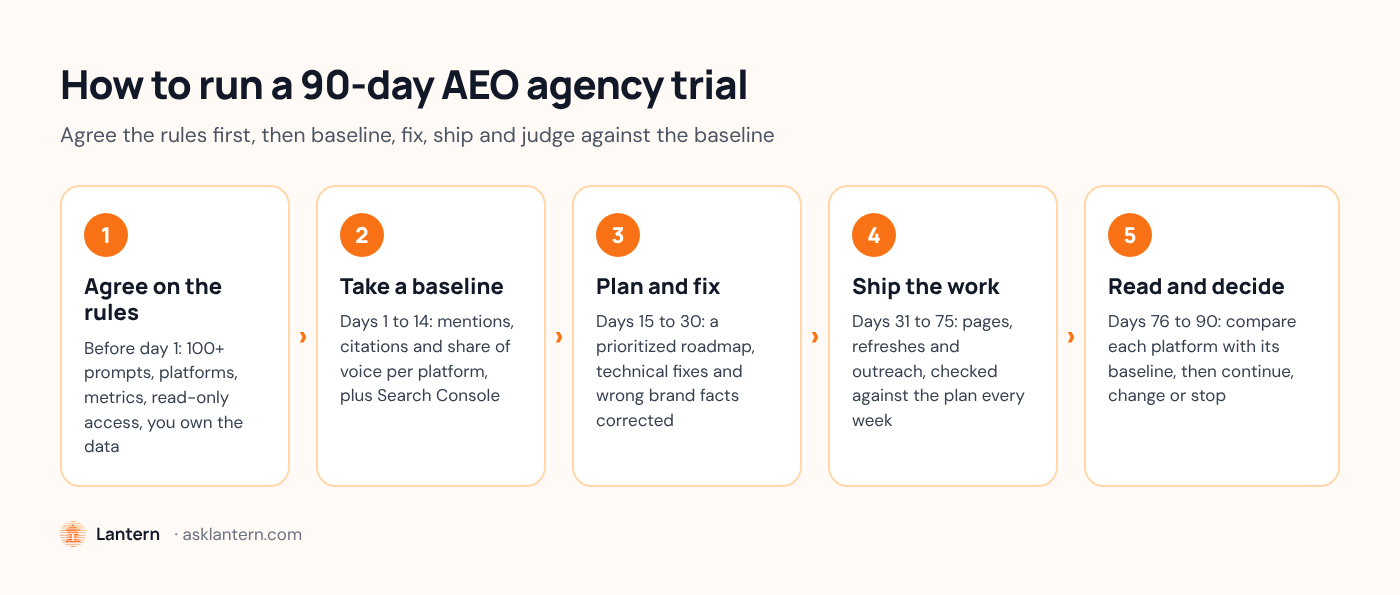
- Before day 1: agree on the rules. Fix the prompt set (100 or more, branded and unbranded), platforms, metrics, read-only access and data ownership. In our research, growing a tracked set from 10 to 100 questions cut variation in reported brand coverage by about 73%.
- Days 1 to 14: take a baseline. Record mentions, citations, share of voice and answer accuracy for each platform. Run a free AI visibility report too, as a second view on the agency's numbers.
- Days 15 to 30: plan and fix. Expect a roadmap, technical fixes and corrections to wrong brand facts, but not big movement: one agency's pricing page says onboarding alone typically takes 30 to 45 days.
- Days 31 to 75: ship the work. Check shipped pages, refreshes and outreach against the plan every week.
- Days 76 to 90: read and decide. Compare each platform with its baseline, separate platform-wide shifts from brand problems, then continue, change scope or stop.
Use first-party data wherever it exists. Search Console's Generative AI performance reports, live for all websites since August 31, 2026, show impressions, pages, countries, devices and dates for AI Overviews, AI Mode and Discover. Bing's AI Performance report, in public preview, shows citations across Microsoft Copilot and Bing's AI summaries.
For ChatGPT, OpenAI's publisher and developer FAQ says it adds utm_source=chatgpt.com to referral URLs, so you can split that traffic out in analytics. Our guide to AI referral traffic and GA4 tracking shows the setup.
| Metric | Source | What to check at day 90 |
|---|---|---|
| Mentions | Prompt tracking | Share of prompts that name you, per platform |
| Citations | Prompt tracking | Answers linking to your site or pages about you |
| Share of voice | Prompt tracking | Your mentions against named competitors, same prompts |
| Answer accuracy | Branded prompts | Errors found, fixed and still showing |
| AI referral traffic | Analytics and CRM | Sessions and leads by AI platform |
| Google AI visibility | Search Console | Generative AI impressions and pages |
| Copilot and Bing citations | Bing Webmaster Tools | Total citations and cited pages |
| Work shipped | Agency change log | Delivered against what was promised |
Set targets together before day 1, and judge process and outcomes separately. If the agency shipped everything and nothing moved, ask for a diagnosis and a new plan; if it didn't ship, that's on the agency. In our research, Google AI recognition fell at about the same time for several unrelated brands, so check competitors before you blame or credit anyone.
How to work with an AEO agency well
Treat the agency as part of your team: give it access, context and fast approvals.
- Budget your own time. One agency's pricing page estimates 6 to 8 hours of client time in the first 30 days, then about 2 to 3 hours a month.
- Name one owner who can approve work within an agreed time, such as two working days.
- Share raw inputs like sales call notes, support tickets and Search Console queries. That's where the best prompts come from.
- Don't pay twice for tools. If the agency runs a platform, agree who pays and who owns the account.
Where to find an AEO agency
Build a shortlist of three to five, then run each through the 18 questions and the rubric. Lantern's GEO and AI Search Agency Directory is one place to start.
If you work at an agency yourself, our guide to AI search visibility for agencies covers tracking and reporting across many clients.
Where Lantern fits
Lantern is a platform, not an agency. In-house teams use it to track AI visibility per platform and have agents turn gaps into review-ready content that a person approves.
It's built for agencies too. Lantern for agencies includes multi-client dashboards and white-label reports, and the Agency plan is $399 a month for three client workspaces, five agency seats and 1,000 Agent Runs, with more available as add-ons.
To see where you stand before you talk to any agency, get a free AI Visibility Report. If you'd rather try a platform first, Lantern's free plan gives you ChatGPT tracking and 10 Agent Runs a month at $0.
Frequently asked questions
What is an AEO agency?
An AEO agency works to get your brand mentioned, cited and recommended in AI answers. Typical services include AI visibility tracking, technical fixes for AI crawlers, answer-ready content, digital PR and per-platform reporting.
Is AEO legit?
Yes, if you treat it as an extension of SEO rather than a bag of tricks. Google says optimizing for its AI features is still SEO. The genuinely new parts are measuring AI answers per platform and building evidence on third-party sites.
Can you pay for AEO?
You can pay an agency or a platform to do AEO work, and you can buy clearly labeled ads in ChatGPT. You can't pay to be placed inside the answer itself: OpenAI says ads don't influence ChatGPT's answers.
How much does an AEO agency cost?
Among agencies that publish prices, retainers ran from about $1,000 to more than $15,000 a month as of October 2026. Price mostly tracks output, so compare quotes by deliverables, not the headline fee.
What's the difference between an AEO agency, a GEO agency and an AI SEO agency?
Mostly the label. Google describes AEO and GEO as terms for work focused on visibility in AI search experiences, and AI SEO is used the same way. Judge an agency by its deliverables and reporting, not its acronym.
What is the best AEO agency for B2B?
There's no single best one, only the best fit for your category, budget and team. For B2B, look for experience with long sales cycles, comparison and use-case content, and reporting that ties AI referral visits to pipeline in your CRM.