- generative Engine Optimization
- Answer Engine Optimization
Google's November 2026 Core Update: What It Means Before Black Friday
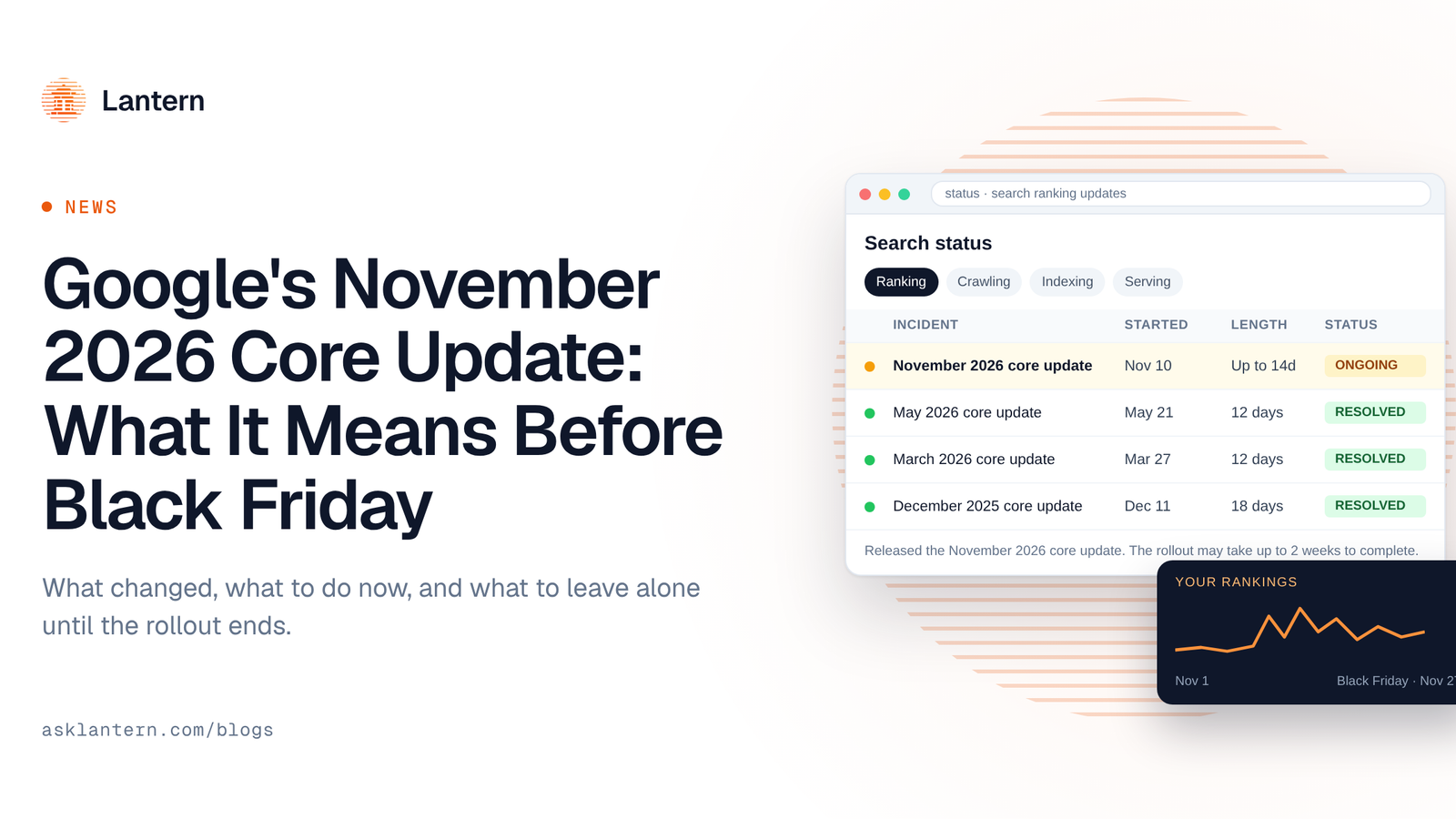
Google's November 2026 core update started on 10 November and may run until 24 November, days before Black Friday. What we know, what it means for AI Overviews, and what to do now.
 Collins
On this page
- Key takeaways
- The November 2026 core update at a glance
- What is a core update?
- How big have 2026 core updates been?
- Why early ranking data is unreliable this time
- What it means for AI Overviews and AI Mode
- What to do before Black Friday
- What to do if your traffic drops
- How to measure the impact
- Our recommendation
- FAQ
- When did the Google November 2026 core update start?
- When will the November 2026 core update finish?
- Will the core update affect Black Friday traffic?
- Should I update my content during a core update?
- Does the core update affect AI Overviews and AI Mode?
- How do I recover from a core update?
Google's November 2026 core update began rolling out on 10 November and may take up to two weeks to finish. That puts the likely end date around 24 November, three days before Black Friday, which means rankings can move during the most important sales week of the year.
This guide covers what the update is, what we know so far, how it relates to AI Overviews and AI Mode, and what your team should and shouldn't do before Black Friday.
Key takeaways
- The November 2026 core update started on 10 November. It applies globally, to all languages, and can take up to two weeks to roll out.
- It's Google's third core update of 2026, after March and May. The March update moved 79.5% of top-three results.
- Don't change pages mid-rollout. Rankings swing before they settle, and early fixes usually chase noise.
- Rank-tracking data is less reliable than usual. Treat early winner and loser lists with caution.
- Check AI visibility separately. AI Overviews and AI Mode run on Google's core systems, so watch citations, not just rankings.
The November 2026 core update at a glance
| Detail | What we know |
|---|---|
| Start date | 10 November 2026, logged on the [Google Search Status Dashboard](https://status.search.google.com/) |
| Expected duration | Up to two weeks, so finishing around 24 November |
| Scope | Global, all languages |
| Type | Broad core update, Google's third of 2026 |
| What Google named | No specific system, content type or industry |
| Black Friday | 27 November 2026, three days after the latest expected finish |
What is a core update?
A core update is a broad change to how Google's main ranking systems assess content. It doesn't target a specific site, technique or penalty. Instead, it re-weighs how relevant and helpful pages are, so some pages rise and others fall even when nothing on them has changed.
That's why Google's long-standing guidance on core updates is the same every time. There's nothing specific to fix after a drop. Pages that lose ground have usually been overtaken by content Google now judges more useful.
How big have 2026 core updates been?
Core updates this year have been large. After the March 2026 core update, 79.5% of top-three URLs changed position, up from 66.8% after the December 2025 update. Aggregator sites took the heaviest losses in March.
| Update | Released | Rollout time |
|---|---|---|
| December 2025 core update | 11 December 2025 | 18 days |
| March 2026 core update | 27 March 2026 | 12 days |
| May 2026 core update | 21 May 2026 | About 12 days |
| November 2026 core update | 10 November 2026 | Up to 2 weeks (expected) |
Our breakdown of the March 2026 core update covers which kinds of sites gained and lost.
Why early ranking data is unreliable this time
Treat any early "winners and losers" list with extra caution. Rank-tracking data has been noisier than usual since September. One tracking provider reported misleading results on about 11% of its daily checks, and another flagged 8% of results pages as unreliable.
Add the normal swings of a two-week rollout, and early movement tells you very little. In our experience, the pattern a site shows in the first three or four days often reverses before the update finishes.
What this means for you: wait for the rollout to complete, then compare a full week after the update with the same week before it in Google Search Console.
What it means for AI Overviews and AI Mode
Core updates affect AI search too. Google's AI Overviews and AI Mode are built on the same core ranking and quality systems as normal search, as Google's guide to generative AI search makes clear. A page that loses rankings can also lose citations in AI answers.
The link isn't one-to-one. AI Overviews cite many pages outside the top ten, and AI Mode runs several related searches for one question, a technique called query fan-out. So a page can drop a few positions and still be cited, or hold its ranking and lose its citation.
What this means for you: measure AI visibility separately. Track how often AI Overviews and AI Mode cite your pages for your key questions, and use the Generative AI performance report in Search Console alongside your normal ranking data.
What to do before Black Friday
The goal for the next two weeks is to protect revenue, not to react to every ranking change. Here's the plan we recommend.
- Freeze big content changes until the rollout ends. Don't rewrite, merge or delete pages because of early movement. Changes made mid-rollout are hard to judge and often undo pages that would have recovered.
- Keep doing planned, genuine updates. Updating Black Friday pages with real prices, stock and offers is fine and expected. Avoid changing dates or adding filler just to look fresh.
- Check that key pages are crawlable. Make sure Black Friday and product pages are indexed, load quickly and aren't blocked by robots.txt or your CDN. Our AI crawler guide covers the AI bots too.
- Spread your traffic risk. If organic traffic matters for Black Friday, line up email, paid search and social so a ranking dip doesn't hit sales directly.
- Take a baseline now. Record rankings, organic traffic and AI citations for your top pages today, so you can compare cleanly once the update ends.
What to do if your traffic drops
Wait until the update completes, then look at the data properly. A drop during the rollout isn't a verdict.
- Compare like with like. Use at least one full week after the update against the week before it, and compare the same days of the week.
- Find which pages and queries moved. In Search Console, look for patterns: one content type, one section of the site, or one kind of query.
- Compare your pages with the ones that rose. Look at what the new top results offer that yours don't: original data, first-hand experience, clearer answers or more recent information.
- Improve the pages, not the signals. Add genuine value: new data, updated facts, better structure and expert input. Google calls this kind of original, non-commodity content the factor that matters most over time.
- Give it time. Improvements are often only fully reflected after the next core update, which is usually months away.
Our guide to how to optimize content for LLMs covers the same principles for AI search, and why older content loses AI citations.
How to measure the impact
Use three views together, because no single report shows the whole picture.
- Search Console performance: clicks, impressions and average position by page and query, before and after the update.
- Search Console Generative AI report: how your pages perform in AI Overviews and AI Mode.
- AI visibility tracking: whether Google's AI features, ChatGPT and other AI engines still mention and cite your brand for the questions your buyers ask. Lantern tracks this daily, so you can see whether a ranking change also changed your AI visibility.
Our recommendation
Hold steady until the November 2026 core update finishes, and put your energy into Black Friday instead. Make sure key pages are crawlable and accurate, line up other channels, and take a clean baseline today.
Once the rollout ends, judge the results with full weeks of data, and respond by making your best pages genuinely better. That's what has held up through every core update this year, and it's what AI search rewards too.
FAQ
When did the Google November 2026 core update start?
It started on 10 November 2026, according to the Google Search Status Dashboard. Google said it may take up to two weeks to complete.
When will the November 2026 core update finish?
Google said the rollout may take up to two weeks, so the latest expected finish is around 24 November 2026. Google confirms the end date on its Search Status Dashboard.
Will the core update affect Black Friday traffic?
It can. Rankings may still be shifting during Black Friday week, so it's worth lining up email, paid and social traffic in case organic rankings dip.
Should I update my content during a core update?
Avoid major rewrites until the rollout finishes, because early movement often reverses. Routine, genuine updates such as current prices and stock are fine.
Does the core update affect AI Overviews and AI Mode?
It can. Google's AI search features run on the same core ranking and quality systems, so changes in how Google assesses pages can also change which pages AI answers cite.
How do I recover from a core update?
There's no specific fix. Compare your pages with the ones that gained, then improve them with original information, clearer answers and up-to-date facts. Recovery often shows after a later core update.