- Answer Engine Optimization
- generative Engine Optimization
ChatGPT Now Handles 20% of Google's Search Volume, OpenAI Says
OpenAI says ChatGPT handles about a fifth of Google's search volume. How the claim compares with independent data, what Google reports, and what it means for marketers.
 Collins
On this page
- Key takeaways
- What OpenAI announced
- How OpenAI counts a search
- What independent data shows
- What Google reports
- What we see in Lantern's data
- What it means for marketers
- What to watch next
- FAQ
- Does ChatGPT really handle 20% of Google's searches?
- How many people use ChatGPT?
- Is ChatGPT bigger than Bing?
- Is ChatGPT replacing Google?
- How much traffic does ChatGPT send to websites?
- What should marketers do about it?
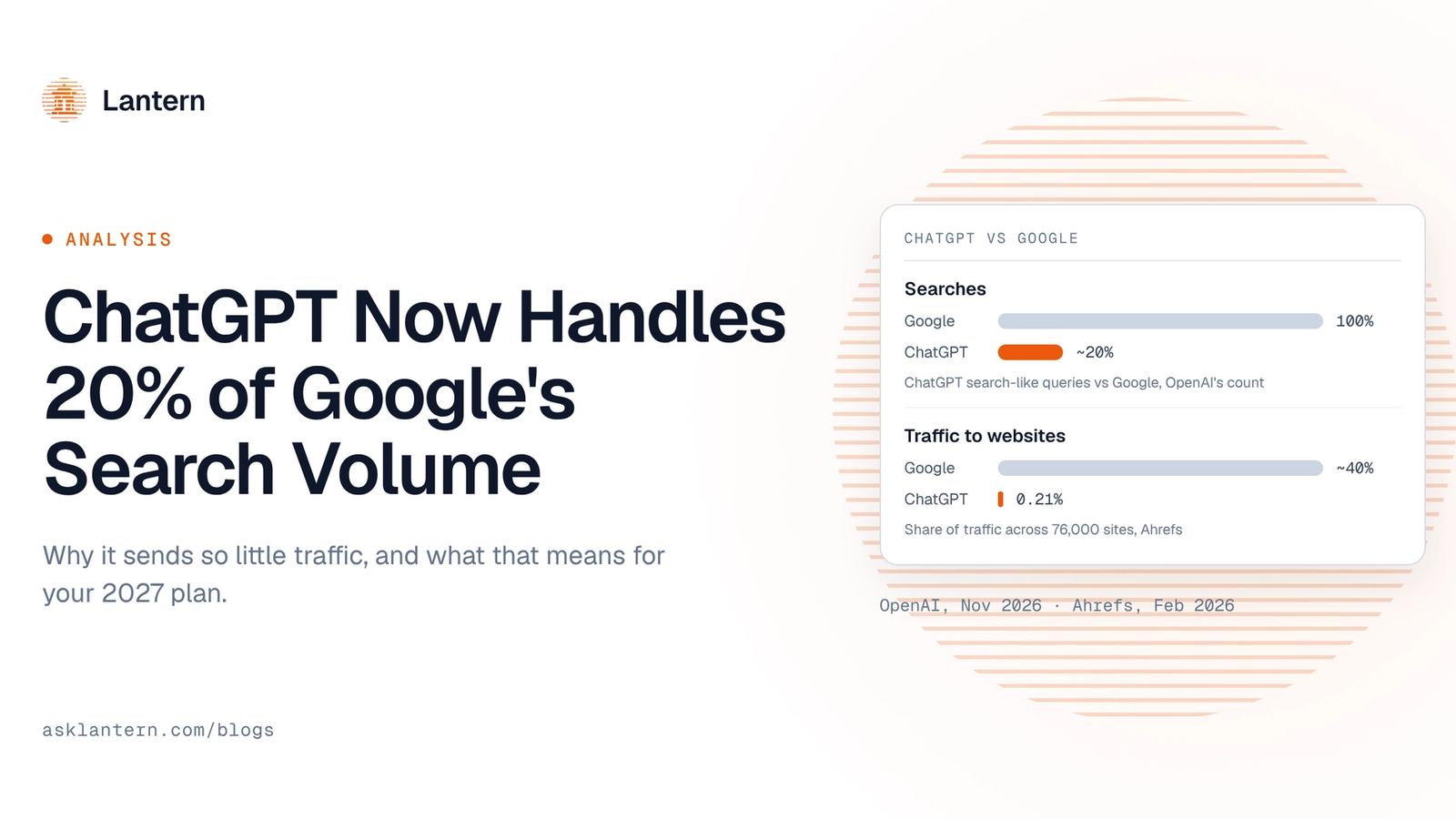
ChatGPT now handles about a fifth as many searches as Google, according to OpenAI. Adam Fry, who leads ChatGPT's consumer product, shared the figure in an interview with Big Technology published on 3 November 2026: "ChatGPT's volume of search-like queries is now roughly one-fifth the volume of queries of Google."
It's the first time OpenAI has compared ChatGPT's search volume directly with Google's. Here's what OpenAI said, how the number holds up against independent data, and what it means for marketing teams.
Key takeaways
- OpenAI says ChatGPT handles about 20% of Google's search volume. It counts every question that leads ChatGPT to search the web.
- Independent estimates are lower. Ahrefs put ChatGPT at about 12% of Google's volume, and seoClarity at about 7.5%.
- ChatGPT reached 1.2 billion weekly users, up from 1 billion about two months earlier, by OpenAI's figures.
- Google is still growing. Alphabet reported its strongest search query growth in five years in Q3 2026.
- The traffic gap is huge. Google sends roughly 70 times more traffic to websites than ChatGPT, so the 20% is about attention, not clicks.
What OpenAI announced
OpenAI shared several new ChatGPT numbers at once. Fry gave the search figure at an OpenAI dinner in New York, in conversation with Big Technology's Alex Kantrowitz.
- Search volume: search-like queries are now roughly one-fifth of Google's query volume.
- Users: ChatGPT grew from 1 billion to 1.2 billion weekly users in about two months.
- Voice: about 250 million people use voice in ChatGPT each week, including dictation and spoken conversations.
- Ads: ChatGPT's ad business passed $1 billion in annual revenue run rate within 200 days of launch, according to FourWeekMBA's summary of the interview.
Fry said the growth comes from questions people used to take to a search engine: "It's basically anything that a user would have traditionally gone to a traditional search engine for, but is now deciding to go to ChatGPT for." He named people, places, finance and health as the main areas.
How OpenAI counts a search
OpenAI's definition is broad. In Fry's words: "Every time you ask a question and go search the web, that's a search."
That definition explains much of the gap with outside estimates. One ChatGPT conversation can trigger several web searches, and some searches only confirm what the model already knows. OpenAI also didn't say which Google figure it compared against, which time period it used or which markets it covered.
None of that makes the number wrong. It means it measures something different from a Google search, where one query usually means one person typing one question.
What independent data shows
Independent estimates put ChatGPT well below 20%, but all of them show a large and growing channel.
| Measure | ChatGPT compared with Google | Source |
|---|---|---|
| Search volume, OpenAI's count | About 20% | OpenAI, November 2026 |
| Search volume, independent estimate | About 12% | Ahrefs, February 2026 ([PPC Land](https://ppc.land/chatgpt-sends-190x-less-traffic-than-google-despite-12-search-volume/)) |
| Search volume, independent estimate | About 7.5% | seoClarity, via [Forbes](https://www.forbes.com/sites/gabrielalinzainescu/2026/11/05/chatgpt-search-hits-20-of-googles-query-volume-openai-says/) |
| Share of traffic to websites | 0.36% vs 24.74% for Google | Ahrefs, 118,671 sites, October 2026 ([Search Engine Journal](https://www.searchenginejournal.com/googles-search-volume-is-about-5x-chatgpts-openai-says/595817/)) |
| Bing's share of search, for comparison | About 5% | Reported by Big Technology |
The comparison with Bing caught the SEO community's attention. Even the most cautious estimate puts ChatGPT's search activity in the same range as Bing's, and OpenAI's own figure puts it well ahead.
What Google reports
Google's search business is still growing. On its Q3 2026 earnings call, Alphabet reported its highest year-over-year growth in search queries in five years, and Gemini passed 1 billion monthly users.
There's a softer signal underneath. Google Search revenue grew 12% in Q3, down from 17% in Q2, according to Forbes. Google's figures report growth rates rather than counts, so they can't confirm or rule out OpenAI's ratio.
The likeliest reading is that people are asking more questions online overall, and ChatGPT is taking a growing share of the new ones rather than simply replacing Google.
What we see in Lantern's data
Our data points the same way: ChatGPT is the dominant AI search platform, but it sends little traffic compared with its reach.
- ChatGPT drives 87.4% of AI referral traffic across the sites Lantern tracks (full analysis).
- AI referrals are about 1% of total sessions for most brands.
- AI-referred visitors convert 4.4 times better than standard organic visitors on average.
- ChatGPT held 55.5% of AI search traffic in September 2026, ahead of Gemini at 25.6% (full analysis).
- 91% of brand citations in AI answers come from third-party sites, not the brand's own website (full analysis).
The pattern is consistent: buyers do much of their research inside ChatGPT's answers, and only a small share click through. When they do, they arrive ready to act.
What it means for marketers
Treat ChatGPT as a search channel in its own right. Whether its true share is 7.5% or 20%, it's now large enough to plan, budget and report on separately from Google.
- Track visibility, not just traffic. ChatGPT shapes shortlists inside its answers, so measure how often it mentions and cites your brand for the questions your buyers ask. Traffic alone will understate its effect.
- Fix how you measure AI traffic. Set up an AI referral channel in GA4, because ChatGPT app visits often show up as direct traffic. Then report AI-referred conversions next to organic.
- Cover the questions that are moving to ChatGPT. Fry named people, places, finance and health, but the same shift is happening in product research. Comparison pages, product pages and clear answers to buyer questions are what ChatGPT cites. Our guide to where ChatGPT gets its information explains which sources it uses.
- Plan for ChatGPT ads. With ads past a $1 billion run rate, paid placement in ChatGPT is becoming a real line item. Test it alongside organic visibility, not instead of it.
What to watch next
- Whether OpenAI publishes its method. A named Google baseline, time period and market would make the 20% comparable with other data.
- Referral traffic trends. Ahrefs publishes monthly referral shares, which are the best outside check on whether ChatGPT's reach turns into clicks.
- Google's Q4 numbers. Another quarter of record query growth alongside slower revenue growth would support the idea that search is expanding while value shifts to AI answers.
- ChatGPT ad formats. How ads appear in answers will decide how much budget moves from Google search ads.
Our AI search statistics page is updated as new figures come out.
FAQ
Does ChatGPT really handle 20% of Google's searches?
That's OpenAI's own figure, based on a broad definition: every question that leads ChatGPT to search the web counts as a search. Independent estimates from Ahrefs and seoClarity put it between about 7.5% and 12%.
How many people use ChatGPT?
About 1.2 billion people use ChatGPT every week, according to OpenAI in November 2026, up from about 1 billion two months earlier.
Is ChatGPT bigger than Bing?
By search activity, likely yes. Bing has about 5% of search, and every recent estimate puts ChatGPT's search volume at or above that level relative to Google.
Is ChatGPT replacing Google?
Not yet. Google reported its strongest query growth in five years in Q3 2026. People are asking more questions overall, and ChatGPT is taking a growing share of them.
How much traffic does ChatGPT send to websites?
Far less than Google. Across 118,671 sites in Ahrefs' October 2026 data, ChatGPT sent 0.36% of tracked traffic against 24.74% for Google. In Lantern's data, all AI referrals together make up about 1% of sessions.
What should marketers do about it?
Measure how often ChatGPT mentions and cites your brand, set up AI referral tracking in GA4, and publish the comparison and product content ChatGPT cites. Our guide on how to rank in ChatGPT covers the full setup.