- Answer Engine Optimization
- generative Engine Optimization
Ads Are Moving Into AI Answers: Every New Format in AI Mode, ChatGPT and Bing
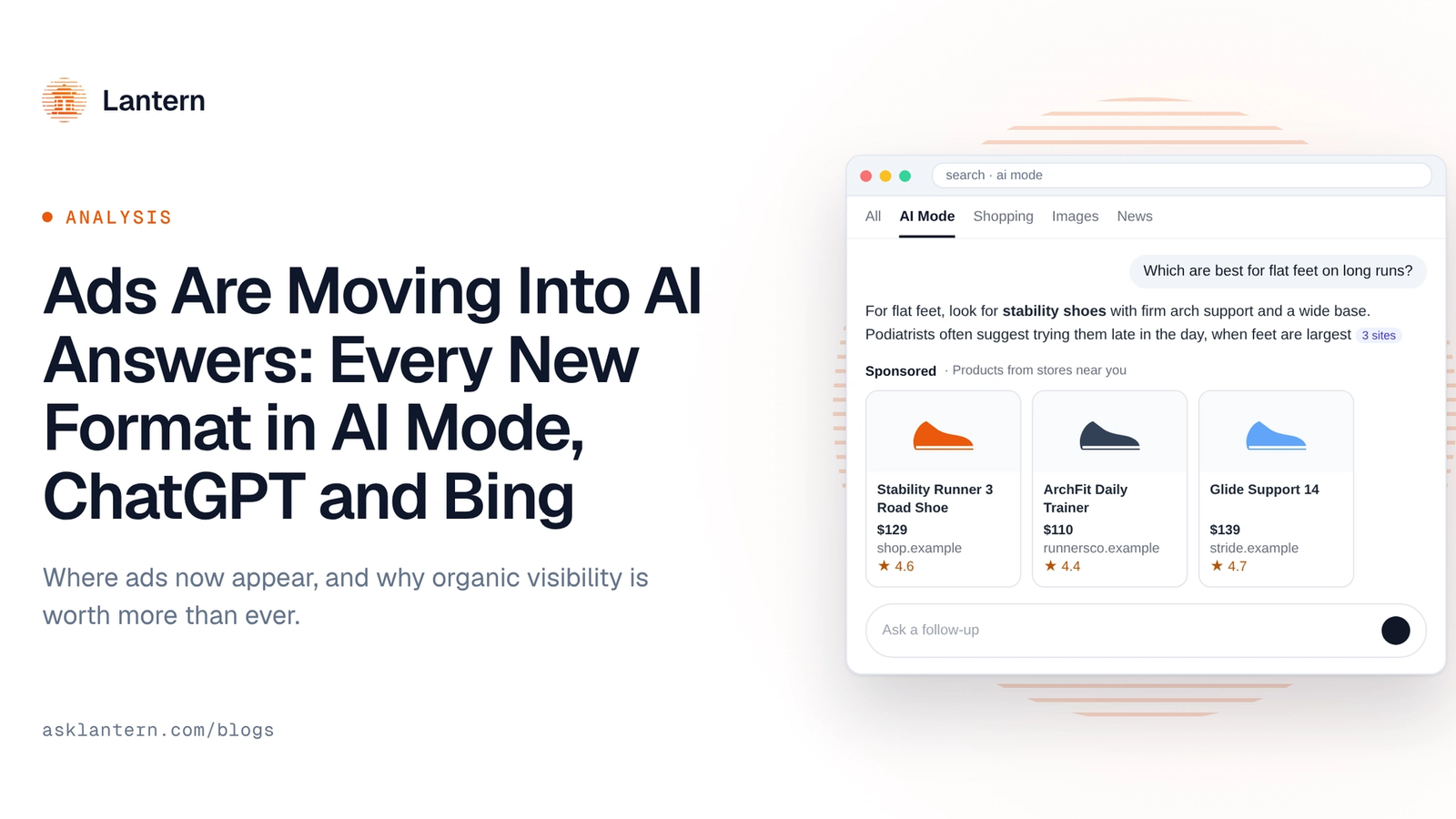
Google AI Mode, ChatGPT, Bing AI Mode and Yahoo Scout are all adding ads to AI answers. Every new format, where it runs, and what it means for organic visibility.
 Collins
On this page
- Key takeaways
- Ad formats in AI answers at a glance
- Google AI Mode: ads on every turn of the conversation
- Why Google is adding ads so quickly
- ChatGPT: a $1 billion ad business in its first year
- Bing AI Mode and Yahoo Scout
- What ads in AI answers mean for organic visibility
- What to do now
- Our recommendation
- FAQ
- Does Google show ads in AI Mode?
- Can I opt out of ads in AI Mode?
- Does ChatGPT have ads?
- Do ads change what AI answers recommend?
- Does Bing show ads in AI answers?
- Should I spend on AI search ads or organic AI visibility?
Ads are now part of AI answers. In the space of a few weeks, Google added ads to follow-up questions in AI Mode, Bing put ads at the top of its AI answers, and ChatGPT started showing image ads while people generate pictures. AI search is turning into an advertising channel, fast.
This changes the job for marketing teams. The free space inside an AI answer is shrinking, and the brands named in the answer itself become more valuable. Here's every new format, where it runs, and what to do about it.
Key takeaways
- Every major AI search product now shows ads, or has announced it will: Google AI Mode and AI Overviews, ChatGPT, Bing AI Mode and Yahoo Scout.
- Google AI Mode now shows ads on follow-up questions, up to four text ads per answer, and a sponsored local retailer pack. Ads expanded to 10 more countries in October.
- ChatGPT's ad business passed a $1 billion annual run rate, and visual ads now appear alongside generated images in the US.
- Google's search revenue growth slowed to 12% in Q3 2026, and Google partly blamed lower monetization in AI Mode. More ads in AI answers is the response.
- Organic visibility in AI answers is worth more, not less. As sponsored slots spread, being named in the answer itself is the part money can't buy.
Ad formats in AI answers at a glance
| Platform | Format | What it looks like | Status |
|---|---|---|---|
| Google AI Mode | Multi-turn ads | Sponsored ads on answers to follow-up questions, not just the first one | Live in the US, confirmed November 2026 |
| Google AI Mode | Text ads | Up to four text ads below an answer, up from one to three | Seen November 2026 |
| Google AI Mode | Sponsored local retailers | Four sponsored product cards from nearby stores under an answer | Seen November 2026 |
| Google AI Mode | Shopping ads | Sponsored products in product lists and panels | Live since February 2026 |
| Google AI Overviews | Search and shopping ads | Ads above, below or inside the AI Overview | Live, expanding to more queries |
| ChatGPT | Conversational ads | Labelled ads below relevant answers | Live since early 2026 |
| ChatGPT | Visual ads | Image ads shown while ChatGPT generates an image | US, Free and Go plans, from October 2026 |
| ChatGPT | Sponsored business agents | An ad that opens a brand's own chat assistant | US ecommerce and online services, beta |
| Bing AI Mode | Search and shopping ads | Ads at the top of AI answers and on follow-ups | Seen November 2026 |
| Yahoo Scout | Ads in AI answers | Not yet detailed | Announced for "the coming months" |
Google AI Mode: ads on every turn of the conversation
Google is moving fastest. AI Mode now shows ads on follow-up questions as well as the first one. Google calls these multi-turn ads: "Multiturn ads show up on responses to follow-up user queries as users engage in back-and-forth conversations with AI Mode." They're labelled "Sponsored", and Search Engine Roundtable saw them on the third and fourth follow-up questions in a single conversation.
Other placements have appeared at the same time, as PPC Land reported:
- Up to four text ads below an answer, where one to three was normal.
- A sponsored local retailer pack: four product cards from stores, shown under an answer to a shopping question.
- Sponsored stores and products inside AI Mode's product panels and lists.
On 28 October 2026, Google extended AI Mode ads to 10 more markets: Australia, Canada, India, Kenya, Malaysia, New Zealand, Nigeria, Pakistan, the Philippines and Singapore. Brazil, Mexico and the UK are due before the end of the year. Advertisers can't opt out of AI Mode separately from Search, so most search campaigns will start appearing there automatically.
Why Google is adding ads so quickly
The reason is revenue. Google's Search revenue grew 12% in Q3 2026 to $63.35 billion, its slowest growth of the year, down from 19% in Q1 and 17% in Q2. Google's chief business officer listed "the lower monetization we were seeing in AI Mode" among the reasons.
AI answers satisfy more questions without a click, which means fewer chances to show an ad. Google's response is to put ads inside the answers themselves, and it says it's scaling ads in AI Overviews and AI Mode "to more users and more queries".
Some advertisers are moving budget elsewhere. AdExchanger reported advertisers shifting spend to Meta after Google budgets stopped delivering enough reach.
ChatGPT: a $1 billion ad business in its first year
ChatGPT launched ads earlier this year and has grown quickly. Its ad business passed a $1 billion annualized run rate, and OpenAI says more than 100,000 advertisers have run ChatGPT ads.
Two new formats arrived this autumn:
- Visual ads. Image ads appear alongside pictures users ask ChatGPT to create, for users on the Free and Go plans in the US. OpenAI says they're clearly labelled and don't influence ChatGPT's answers (TechCrunch).
- Sponsored business agents. A brand's own chat assistant, built from its product and policy information, can be the destination for a ChatGPT ad. It's limited for now to eligible US ecommerce and online service businesses, and launched alongside the ChatGPT Business Hub.
Our guides to ChatGPT ads and how to run ads on ChatGPT cover setup, costs and targeting.
Bing AI Mode and Yahoo Scout
Microsoft has renamed Copilot Search as Bing AI Mode, and it now shows search and shopping ads at the top of AI answers, including on follow-up questions. Search Engine Roundtable noted that the "Sponsored" labels are easy to miss (report). Bing also shows ads inside its AI overviews.
Yahoo's AI answer engine, Scout, left beta in November with more than 3 billion answers served. Yahoo has said Scout will bring new advertising opportunities in AI search, though it hasn't announced formats yet. Our guide to Yahoo Scout covers what it means for marketers.
What ads in AI answers mean for organic visibility
Ads don't make organic AI visibility less important. They make it more valuable, for three reasons.
- There's less free space in each answer. With up to four ads and sponsored product cards around an answer, the places left for organic mentions and citations are fewer, so competition for them gets tougher.
- The answer itself isn't for sale. Ads sit next to the answer and are labelled as sponsored. OpenAI says its ads don't influence ChatGPT's answers. Being named in the answer is the placement money doesn't buy, and buyers trust it more.
- Ads and organic work together. A brand that's cited in the answer and advertised next to it takes up more of the page. Early Google data shows sponsored and organic product listings in AI Mode get similar click-through rates, so neither replaces the other.
There's a fair caveat: none of these platforms has published data on how ads in AI answers affect organic clicks yet. Watch your own numbers closely as ads expand.
What to do now
- Know where you appear organically. Before spending on AI ads, measure how often AI answers mention and cite your brand for your key questions, across Google, ChatGPT and Bing. That's your baseline.
- Check which of your campaigns already run in AI Mode. Search and Shopping campaigns can appear there automatically. Review your search terms and placements, especially in the 10 new markets.
- Test ChatGPT ads with a clear goal. Start small, use a distinct landing page, and track conversions separately. Our analysis on proving value on ChatGPT ads explains how.
- Keep investing in what earns organic citations. Comparison pages, product pages, reviews and third-party coverage drive most AI citations. In Lantern's data, 91% of brand citations come from sites outside the brand's own.
- Report paid and organic AI visibility together. Track share of voice in AI answers alongside ad spend, so you can see whether ads are filling a gap or paying for visibility you'd earn anyway.
Our recommendation
Treat AI answers as a channel with both paid and organic space, like search results have always been. Ads in AI Mode and ChatGPT are worth testing, especially for shopping queries, but don't let them replace the work that gets your brand named in the answer itself.
The brands that win in 2027 will do both: earn the organic mention, then use ads to reinforce it where the buying decision happens. For the background, see our earlier analysis of AI search ads.
FAQ
Does Google show ads in AI Mode?
Yes. AI Mode shows text ads, shopping ads, sponsored local retailers and, from November 2026, ads on follow-up questions. Ads in AI Mode run in the US and, since 28 October 2026, in 10 more markets, including Australia, Canada, India and Kenya.
Can I opt out of ads in AI Mode?
Not separately. Google doesn't let advertisers opt out of AI Mode while staying in Search, so eligible Search and Shopping campaigns can appear there automatically.
Does ChatGPT have ads?
Yes. ChatGPT shows labelled ads below relevant answers, and in the US it shows visual ads alongside generated images for Free and Go users. OpenAI's ad business passed a $1 billion annualized run rate in 2026.
Do ads change what AI answers recommend?
Ads are labelled as sponsored and sit alongside the answer, and OpenAI says its ads don't influence ChatGPT's answers. That's why being named in the answer itself stays so valuable.
Does Bing show ads in AI answers?
Yes. Bing AI Mode, formerly Copilot Search, shows search and shopping ads at the top of AI answers, including on follow-up questions.
Should I spend on AI search ads or organic AI visibility?
Both, in that order. Measure and build organic visibility first, because it's the placement buyers trust most, then test ads where buying intent is highest, such as shopping questions.