Introducing AI Search Page Tracking
Want to track how your content performs in AI search? Lantern’s page tracker shows which pages get cited in ChatGPT, Claude, Perplexity, and major AI models.

On this page
On this page
For years, content teams have optimized for Google. Rankings, clicks, impressions, and backlinks were all measurable. But SEO is no longer enough.
AI search transformed that model.
Today, buyers are discovering brands through ChatGPT, Claude, Gemini, Perplexity, and Google AI Overviews. They’re asking questions and making decisions based on AI-generated answers. But most teams have no visibility into whether their content is even showing up.
You might publish a well-researched blog post, but you have no idea if it’s being cited in AI responses. Brand monitoring tools might tell you whether your company name appears, but they won't tell you which URLs are driving those citations or why. And here lies the problem; you can’t optimize your marketing efforts if you can’t measure the impact.
As AI search becomes a primary channel for product discovery, content teams need a way to track, analyze, and optimize visibility at the page level.
That gap is exactly what Lantern’s AI search URL tracking feature is designed to close.
What is Page Tracking?
Page tracking involves monitoring how specific pages perform across AI search engines. Instead of guessing whether your blog posts, product guides, or landing pages appear, you can view the exact URLs from your domain getting cited.
Here’s what URL tracking does:
- Track specific page performance across ChatGPT, Claude, Google AI, and Perplexity: Add any URL, published blog posts, product pages, or PR content you've created through Lantern's content studio or thord party placement and monitor whether it appears as a citation in AI-generated answers.
- Get performance data over time: See citation frequency, positioning, and trends week over week. Understand which content consistently appears and what needs optimization.
- Benchmark against competitors: Add competitor URLs to understand their AI search strategy and see how you stack up.
How Lantern’s Page Tracker Works
Here’s how Lantern’s workflow works:
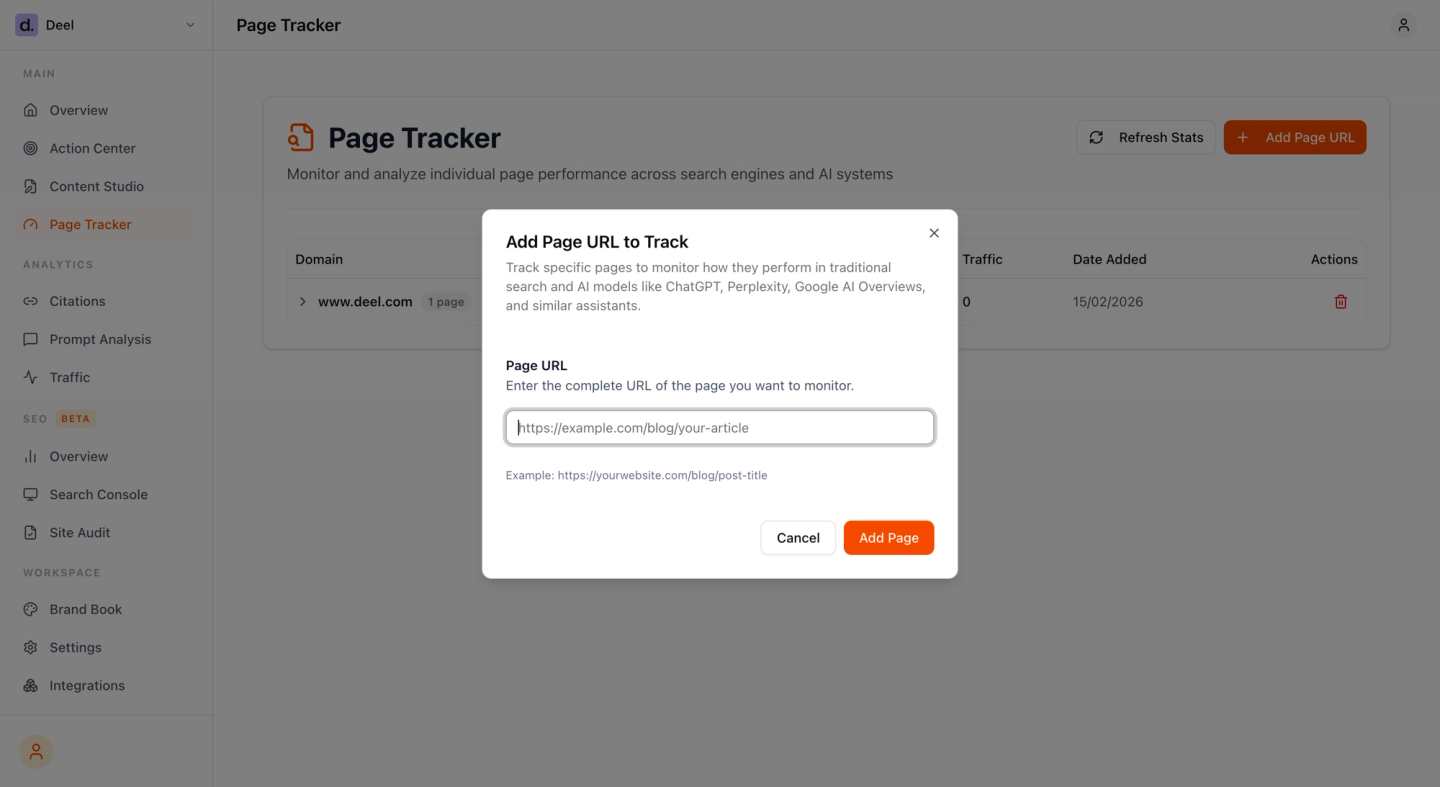
Step 1: Add URLs to Track
Start by pasting any URL you want to monitor. This could be your latest pillar page, product page, third-party PR efforts, or content optimized with Lantern. You can add them individually or in bulk via CSV upload.
Step 2: Automated Cross-Engine Citation Monitoring
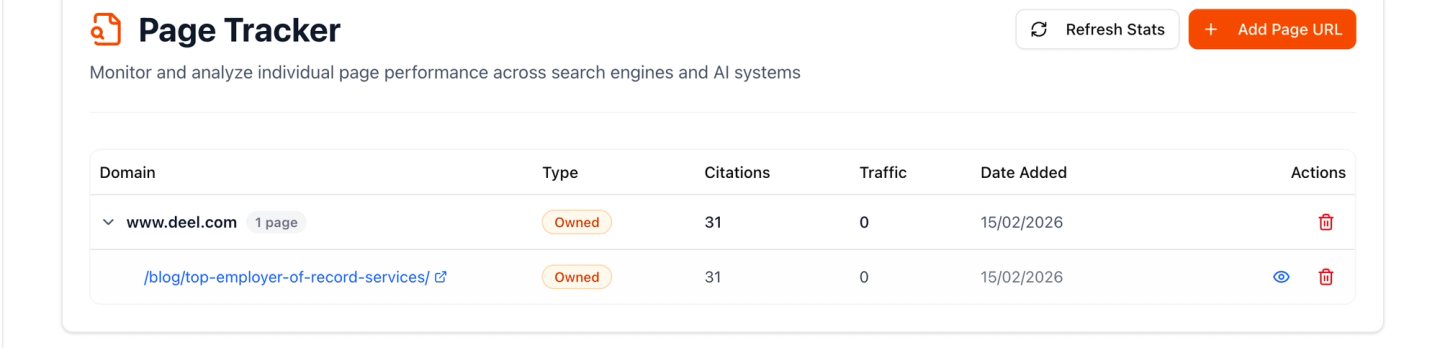
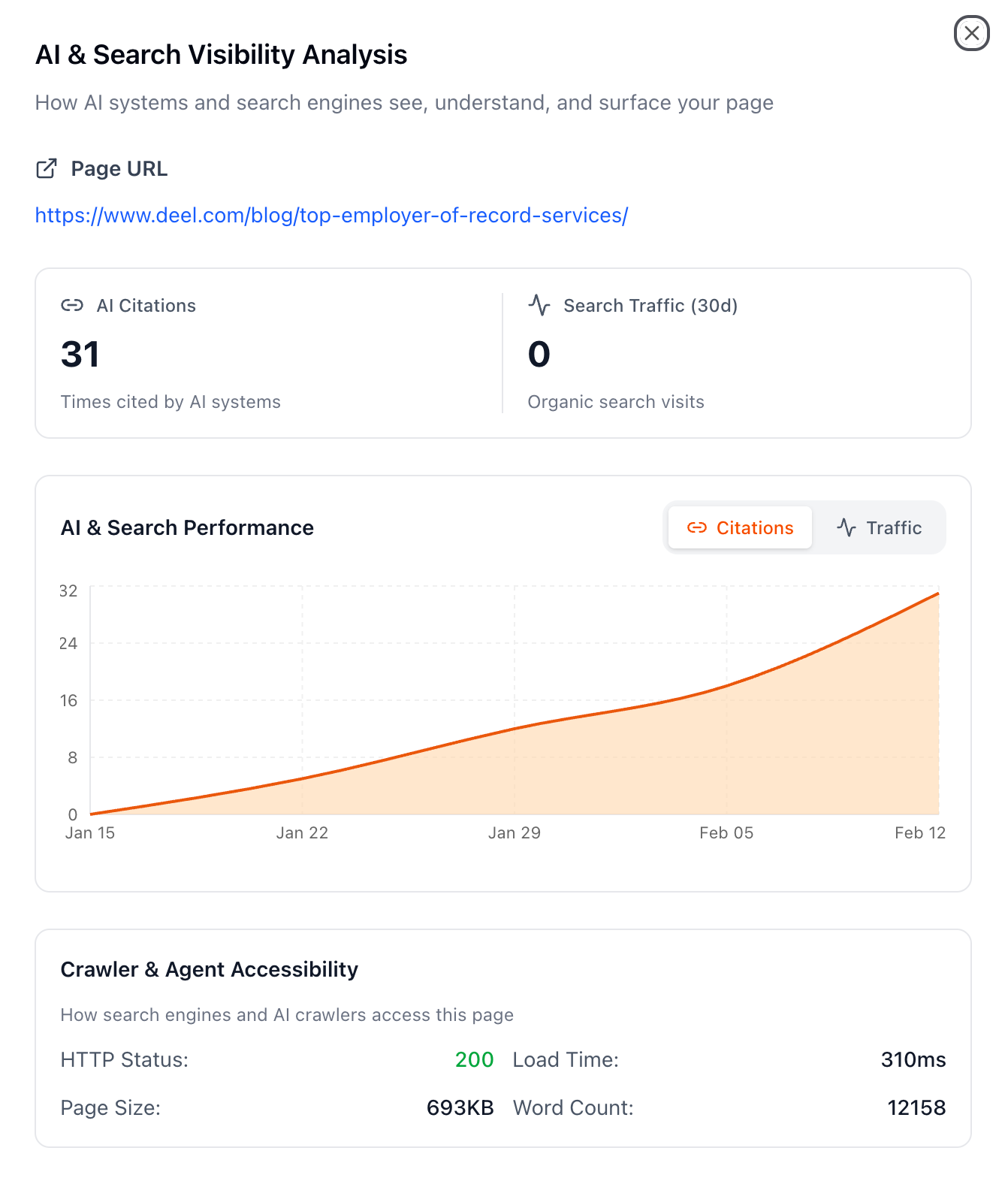
Lantern continuously analyzes ChatGPT, Claude, Gemini, Perplexity, and Google AI Overviews to see whether your URLs are cited. You can capture key insights, including citation frequency, content position, and context. Historical tracking lets you spot trends over time.
Step 3: Content & Technical AI Search Analysis
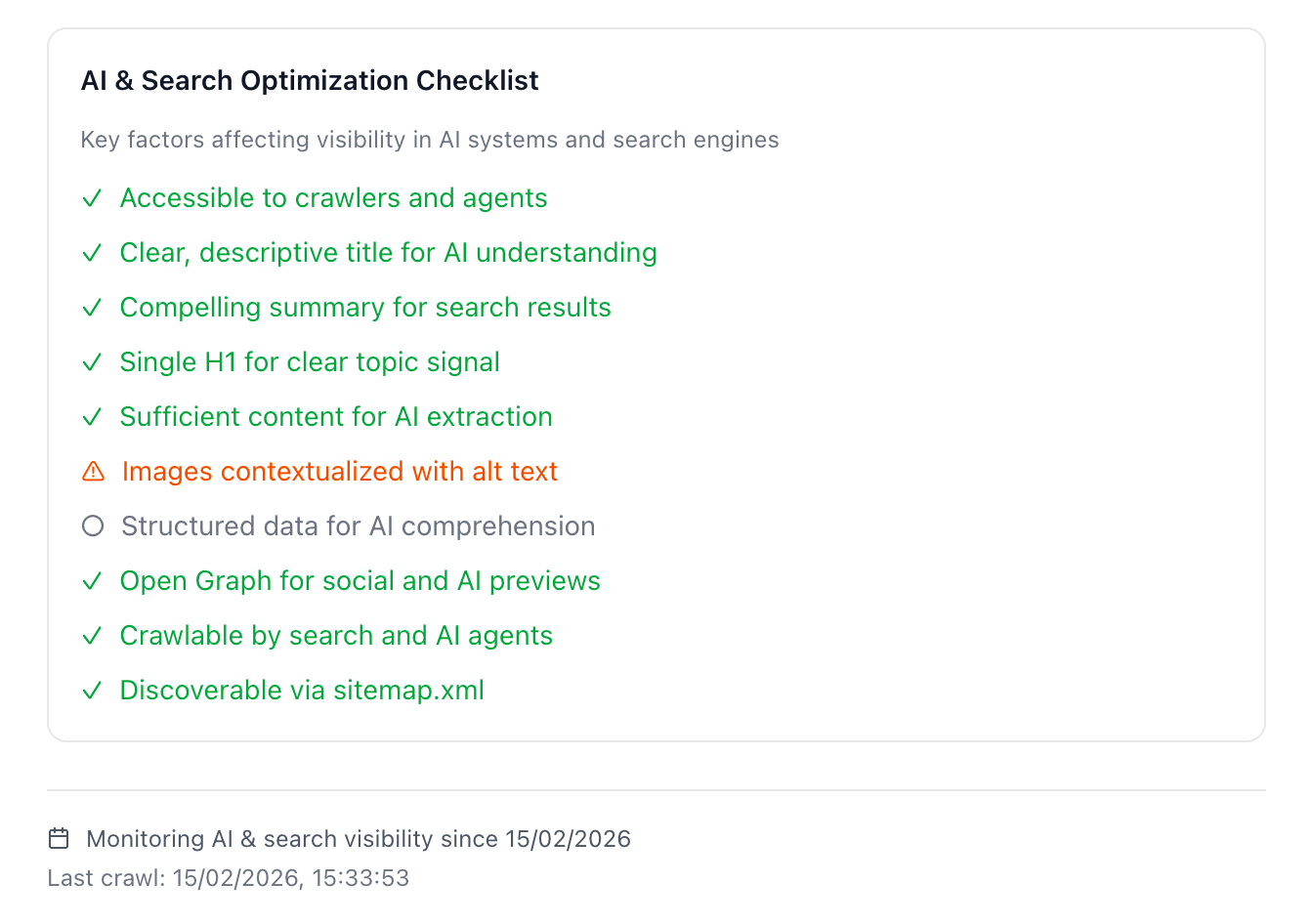
Every URL is then analyzed for AI readiness. This evaluation covers:
- Readability: Have you used short paragraphs, bullet lists, and tables?
- Technical structure: Do you offer direct answers (1-2 sentences) and clear headings?
- Content depth: Is your information credible and comprehensive?
Step 4: Citability Score
Each URL receives a citability score from 0 to 100, showing how well-optimized your content is for AI models. The score is based on structure, clarity, technical implementation, topic coverage, and freshness. For instance, you may get “Content Structure: 75/100” or “Technical: 60/100” to help you prioritize improvements.
Step 5: Actionable Recommendations
Instead of generic advice, Lantern delivers specific recommendations with details on what you need to fix and why it matters.
What the Analysis Covers
Here's what Lantern analyzes for every URL you track:
Pillar 1: Content Structure
Once you publish your content, Lantern evaluates:
- The heading hierarchy and organization that allows AI engines to extract your content
- Your answer capsule presence. Do you have concise, direct answers that AI engines love to cite?
- If your content is comprehensive enough to cover the full query fanout, or are there gaps?
Pillar 2: Technical Implementation
Schema markup matters. Lantern checks whether your article includes FAQs, HowTos, and product schema to help AI engines understand your content type. It also verifies crawlability by AI bots, such as GPTBot, PerplexityBot, and ClaudeBot, to confirm your content is accessible.
Pillar 3: Content Quality
ChatGPT, Claude, Gemini, Perplexity, and Google AI Overviews prioritize authoritative, comprehensive content. Lantern analyzes your marketing content for:
- Unique data and statistics that set your content apart
- Authority signals like sources, expert quotes, and credentials
- Freshness through last update dates
- Content depth
Pillar 4: AI Citation Analysis
Lantern gives a comprehensive AI citation analysis when your URL appears in search results. We break down:
- Queries that triggered the citation
- Citation sentiment , positive mention, neutral reference, or comparison with competitors
- Co-citations to show what other sources appear alongside yours
- Queries where competitors are getting cited
Why Does AI Search URL Tracking Matter for Content Teams?
URL tracking offers multiple benefits
- Measure ROI beyond pageviews: Once your URL is cited by ChatGPT, Claude, Perplexity, and Google AI Overviews, it provides validation that your content is authoritative. You can measure the ROI of your PR efforts and understand which content formats work.
- Stop guessing, start optimizing: AI-powered URL search tracking gives you data-driven insights to help you optimize.
- Close the loop on AI-generated content: If you create content with Lantern, you can track how it performs after publication, building a feedback loop from generation → publishing → tracking → optimization.
- Gain competitive intelligence: Understanding your competitors' AI search strategy gives you an edge. Track competitor URLs to see which content earns citations and improve.
How to Get Started With Lantern
Here’s a simple 3-step framework:
Step 1: Identify your top URLs
Start with 5-10 of your most important pieces of content. Include recent posts, pillar pages, key PR placements, and AI-generated content.
Step 2: Add to Lantern
Paste your URLs into the tracker and let Lantern do the analysis.
Step 3: Implement & Monitor
Track citation frequency weekly and implement recommendations to grow your AI visibility.
Lantern gives marketing and content teams the AI visibility they need. Start your free trial today and track your URLs!