An Introduction to Content Engineering
Content engineering is the practice of designing, building, and optimizing systems that produce content at scale, rather than producing content directly.
On this page
On this page
We are officially entering the agentic era of marketing. Over the last few years, growth and content teams have quickly adopted AI to speed up production and do more with less. But we are hitting a turning point. Technology is moving from being built solely for human users to being built for AI agents that generate, optimize, distribute, and test content alongside your team.
Thriving in this new era requires more than just giving your writers access to ChatGPT. It demands a fundamental rethinking of how we structure our growth teams. You cannot just bolt new tools onto old, manual workflows. To operationalize AI at scale, you need a new type of role on your team: The Content Engineer.
Here is a look at what a Content Engineer does, how they fit into a modern marketing team, and why they are the key to scaling your brand's presence in an AI-first world.
What is a Content Engineer?
The Content Engineer is the natural evolution of the content strategist. They bridge the gap between your marketing goals, your human writers, and your AI tech stack.
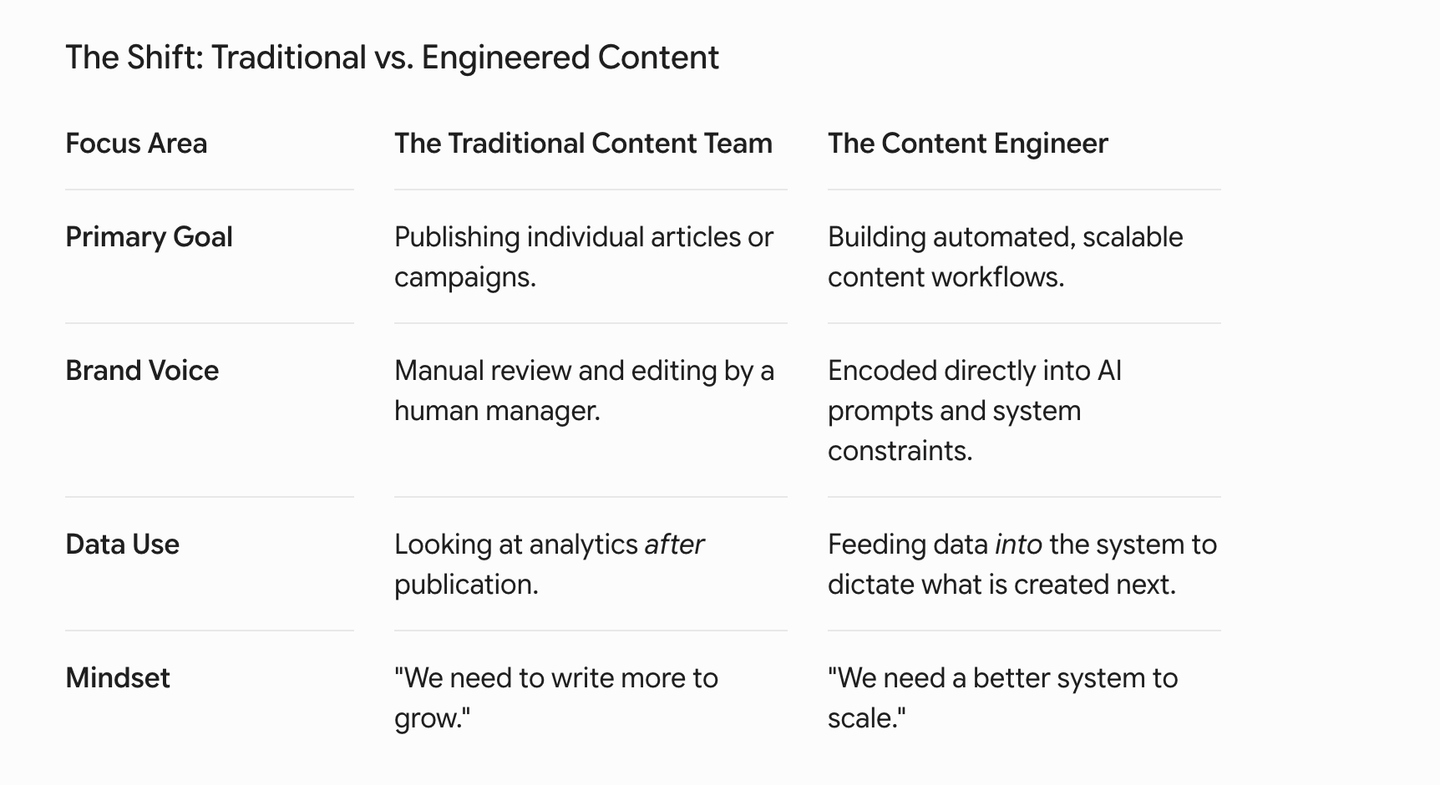
While a traditional content marketer asks: "What piece of content should we write next?"
A Content Engineer asks: "How do we build a system that produces the right content consistently, at scale?" They aren't just writing blog posts. They design, orchestrate, and govern the AI-powered systems that scale your brand. In a landscape increasingly dominated by zero-click search, Content Engineers build the operational foundation that allows your strategy to actually work.
The Shift: Traditional vs. Engineered Content
What Content Engineers Actually Do
The content engineer is not a writer, not a developer, and not a traditional content strategist. They sit at the intersection of editorial judgment, systems thinking, and AI orchestration. Here is what the role looks like in practice:
- Design Workflow Architecture: They map the full journey from topic identification to publication. They decide where automation applies, where human judgment is required, and remove every manual step that does not need to be manual.
- Build Content Infrastructure: They codify brand documentation, voice guidelines, and product positioning into a centralized knowledge base so AI systems can reference them consistently.
- Integrate AI at Every Stage: From research and brief generation to first draft creation and distribution scheduling, the engineer decides which stage gets automated, at what quality threshold, and with what human checkpoint.
- Systematize Brand Voice: Brand alignment at scale requires systems, not manual review. They encode brand voice directly into the creation process through prompt libraries and automated quality checks.
- Orchestrate Cross-Channel Output: They build workflows that expand a single piece of content across formats. A deep research report automatically becomes a blog post, a FAQ cluster, a comparison page, and a social series without separate manual production runs.
- Architect Feedback Loops: They design systems that capture citation rates, traffic, and conversion data, feeding it automatically back into topic selection. The system gets smarter with every cycle.
What Content Engineering is NOT
When teams start building systems instead of pieces, they often run into a few misconceptions. Let's clear them up:
- It is NOT just about using AI to write faster. Speed is a byproduct, not the goal. Teams that use AI purely for speed just produce mediocre content faster. The content engineer uses AI to produce better-structured, more deeply researched content than competitors.
- It does NOT remove the human element. It’s the exact opposite. Content engineering removes operational grunt work so that human attention goes to what actually matters: editorial judgment, brand voice decisions, and strategic calls. The system protects creative energy.
- It is NOT just a tool stack. Adding AI writing tools to a broken workflow produces a faster broken workflow. Content engineering is a systems redesign. Tools support the system; they do not substitute for it.
- It is NOT the same as content operations. Content ops focuses on people, processes, and tech to produce content efficiently. Content engineering goes further: it makes those operations automatic and self-improving through AI integration.
How Lantern Equips the Content Engineer
The content engineer designs the system. Lantern's marketing agents run it. Manual production cannot keep pace with AI search demands. The volume and velocity of content needed to maintain visibility across ChatGPT, Perplexity, Gemini, Claude, and Google AI Overviews makes manual workflows structurally insufficient.
Lantern provides the exact infrastructure the content engineer needs to scale research, production, distribution, and tracking:
1. Brand Knowledge Base
Lantern acts as the central hub where your brand documentation, voice guidelines, product knowledge, and competitive positioning are codified. Every agent operates from this foundational knowledge base to ensure complete consistency at any volume.
2. Research Agents
Before a writer even opens a blank page, Lantern surfaces your exact citation gaps the queries where AI engines cite your competitors but ignore your brand. Writers receive briefs that already contain this deep-dive analysis.
3. Content Agents
Lantern produces structurally sound first drafts targeted directly at those citation gaps. Every draft generated includes the semantic structure, FAQ blocks, and heading hierarchies that AI engines require to cite sections independently.
4. Distribution Agents
Lantern’s agents publish directly to your CMS (WordPress, HubSpot, Sanity, and others) without manual handoffs. Content moves from editorial review to a live URL without the writer or editor touching the operational layer.
5. Tracking and Feedback Loop
A system is only as good as its feedback. Lantern tracks citation rates by page, AI referral traffic, conversion data, and pages losing their citation share. This data automatically connects back to your strategy, dictating exactly what the system should produce next.
The talent gap is real and widening. Don't wait for your competitors to build a better engine. Try Lantern for free today and see how our agents can help your team scale.