What is Semantic Chunking
Semantic chunking is the practice of structuring your content into self-contained, meaning-complete segments so that when AI systems break your page into pieces to retrieve and cite, each piece makes sense on its own.
On this page
On this page
You have great content. But ChatGPT, Perplexity, and Google's AI Overviews are not citing it. The reason is almost always the same: your content is not structured in a way that AI systems can cleanly extract and attribute. Semantic chunking is the fix and understanding it is the single most important shift you can make to your content strategy in 2026.
Quick Answer
Semantic chunking is the practice of structuring your content into self-contained, meaning-complete segments so that when AI systems break your page into pieces to retrieve and cite, each piece makes sense on its own. Every heading, paragraph, and answer you write should be able to stand alone as a citable unit. Content that does this naturally gets cited. Content that does not gets skipped.
Why AI Systems Skip Most Content
When an AI like ChatGPT or Perplexity answers a question, it does not read your whole page and summarise it the way a human would. It retrieves specific segments chunks from across the web, scores them for relevance and credibility, and stitches together an answer from the best ones.
If your content is not structured into clear, self-contained segments, two things happen:
- The AI retrieves a chunk that contains half an idea and half of something else and discards it as unclear
- The AI finds a better-structured competitor page that answers the same question more cleanly and cites that instead
This is not a technical problem with your content. It is a structural one. And semantic chunking is how you fix it.
For a broader look at how AI search works and why it demands a different content approach than traditional SEO, see our guide on how AI search differs from traditional SEO.
What is Semantic Chunking?
Semantic chunking is the practice of writing and structuring content so that every section, paragraph, and answer is semantically complete meaning it contains one full idea, expressed clearly enough that it needs no surrounding context to make sense.
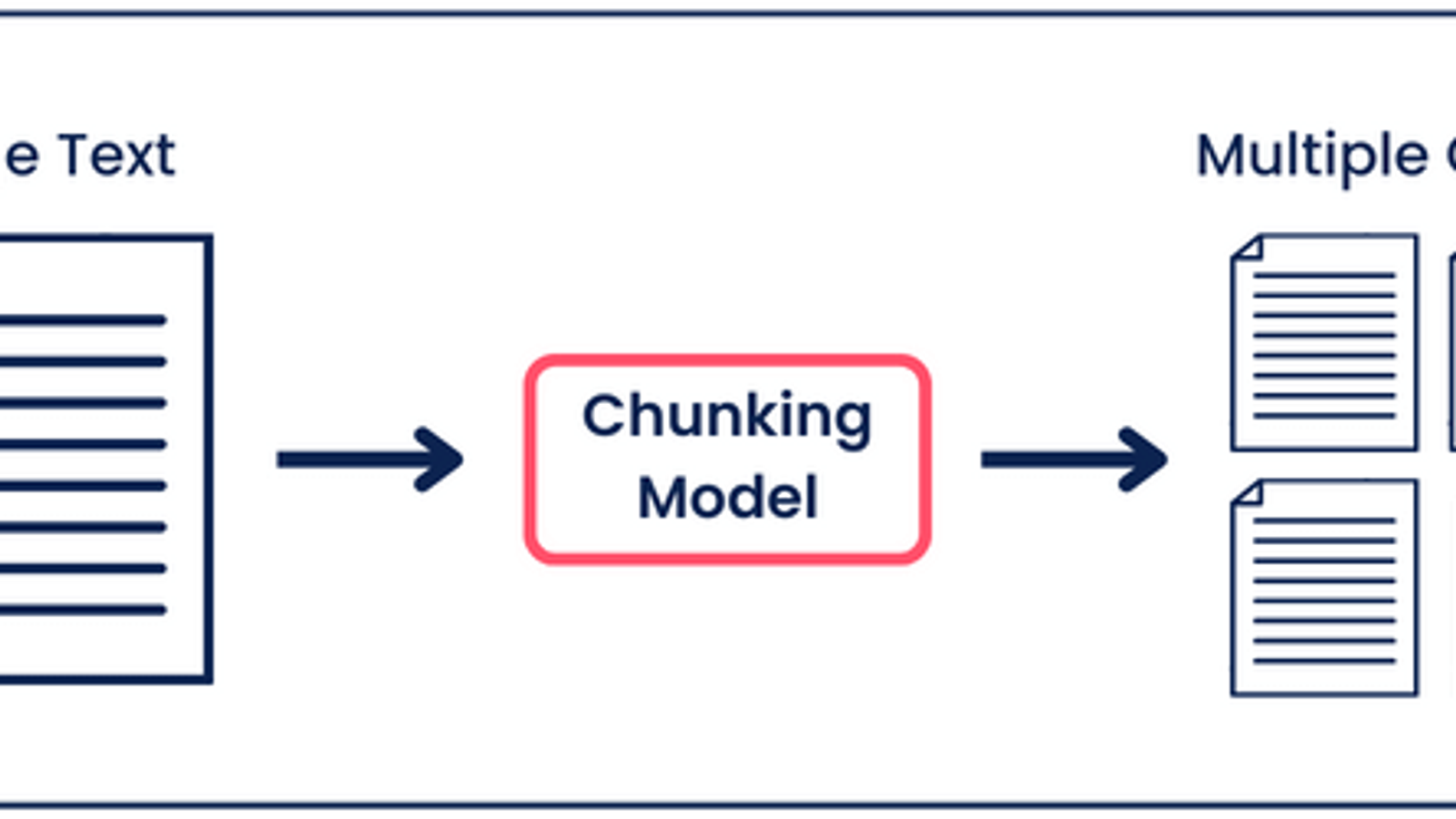
The term comes from AI and RAG (Retrieval-Augmented Generation) engineering, where it describes the process of splitting documents into meaning-based segments before indexing them. When AI systems crawl your website, they do exactly the same thing to your content automatically. The difference is that you can write your content in a way that makes those automatic splits clean and accurate or messy and incomplete.
Think of it this way. If an AI lifts one paragraph from your page, does it still answer a question clearly? If yes, that paragraph is a good semantic chunk. If it references something from three sections earlier or trails off into a thought completed elsewhere, it will get discarded.
Why Semantic Chunking Matters for AI Citations
AI systems like ChatGPT, Claude, Perplexity, and Google's AI Overviews are now the first stop for millions of searches that used to go directly to Google's blue links. Getting cited in those AI responses is the new first page of search.
The content that gets cited consistently shares three characteristics:
- It answers a specific question completely within a single section no hunting across the page required
- It is written by a credible, named source with clear expertise signals
- It is factually precise specific enough that an AI can attribute it without risk of misrepresenting the source
Content that rambles across topics, buries the answer in long preamble, or requires the reader to hold ten things in their head at once does not get cited. It gets passed over in favour of something cleaner.
Lantern's own research on AI citation patterns shows the same pattern across ChatGPT, Perplexity, and Google's AI Overviews.
The Three Principles of Citation-Worthy Content Structure
1. Write in self-contained answer units
Every H2 and H3 section should open with a direct answer to the question implied by its heading. Do not make the reader or the AI read the whole section before they understand what it is saying. Put the answer first, then support it.
Weak structure (gets skipped): "There are many factors that go into how AI systems decide what to cite. Researchers have studied this extensively and there are several competing theories, but before we get into that it is worth understanding how retrieval works in general..."
Strong structure (gets cited): "AI systems cite content that answers a specific question completely within a single section. The question must be clear from the heading, the answer must appear in the first two sentences, and the supporting detail must not require outside context to make sense."
The strong version is a semantic chunk. It can be lifted and cited on its own. The weak version cannot.
2. Match your headings to real questions
Your H2 and H3 headings should be the exact questions your audience is asking not clever titles, not vague category labels. AI systems match content to queries, and headings are the strongest signal of what a section is about.
Instead of: "Our Approach to Content" Write: "How should I structure content for AI search?"
Instead of: "Key Considerations" Write: "What makes content citation-worthy for ChatGPT and Perplexity?"
This is not just good semantic chunking it is also how you capture the featured snippets and AI Overviews that now dominate search real estate. Google's own guidance confirms that question-and-answer formatted content is the structure most likely to be surfaced in AI-generated responses.
3. Make every claim specific and attributable
Vague claims do not get cited. Specific, attributable claims do. AI systems are risk-averse they will not cite a claim they cannot verify or that could embarrass them if it turns out to be wrong. Specificity signals credibility.
Weak: "AI citations have become more important recently."
Strong: "According to Menlo Ventures, enterprise RAG adoption reached 51% in 2024, up from 31% in 2023 making AI-generated responses a primary discovery channel for a majority of enterprise buyers."
The strong version gives an AI system something concrete to cite, a source to attribute, and a number its users can check. That is what gets pulled into an answer.
For a practical checklist of what makes a claim citation-worthy, see our guide on LLM citation optimization.
How AI Systems Actually Chunk Your Content
Understanding the mechanics helps you write better. When AI crawlers like GPTBot or ClaudeBot index your page, they do not store it as one big document. They break it into segments chunks and embed each one as a vector in a database. When a user asks a question, the system retrieves the chunks most semantically similar to that question and uses them to build an answer.
The chunking happens automatically. But how cleanly it happens depends entirely on how your content is structured.
Content that chunks cleanly:
- Uses clear H2/H3 headings that signal topic shifts
- Keeps each section focused on one idea
- Answers the heading's implied question in the opening sentence
- Does not carry context, caveats, or definitions from one section into another
Content that chunks badly:
- Buries the answer at the end of a long buildup
- Uses headings that do not reflect what the section actually covers
- Mixes multiple ideas into a single section
- Relies on the reader having read the previous section to understand the current one
This is the same principle that powers RAG pipelines in enterprise AI the technique that developers call semantic chunking in document retrieval. The difference is that developers apply it to documents programmatically. You apply it to your content by writing it well.
Content Formats That Get Cited Most
Some content formats are naturally better semantic chunks than others. Based on Lantern's citation monitoring data and published research on AI retrieval behaviour, these are the formats that appear most frequently in AI-generated citations:
Direct definition answers
"[Term] is [definition]. It works by [mechanism]. The key benefit is [outcome]."
This format is cited constantly because it is self-contained, specific, and matches the structure of how people ask definitional questions. Every piece of content you publish should have at least one section in this format.
Numbered process explanations
Step-by-step answers are highly citable because each step is its own semantic unit and the numbered structure makes the content easy to parse. AI systems retrieve process content readily because it maps directly to "how do I" queries.
Comparison answers
"The difference between X and Y is [specific distinction]. X is better when [condition]. Y is better when [condition]."
This format matches comparison queries directly some of the highest-volume searches across every industry. A clean comparison answer is almost always pulled into AI responses when it exists.
Data-backed claims
Any sentence of the form "[Specific number] according to [credible source]" is highly citable. It gives AI systems a concrete, attributable fact they can reuse confidently.
FAQ sections
Question-and-answer formatted content is one of the strongest citation formats because the question itself signals intent and the answer is inherently self-contained. Google's own structured data documentation recommends FAQ schema for exactly this reason it tells AI systems explicitly that each Q&A pair is a standalone unit.
What Kills AI Citations: Common Mistakes
Writing for the full page, not the individual section
The biggest mistake in content written before the AI search era is assuming the reader will start at the top and read sequentially. AI systems do not. They retrieve individual sections. Every section must earn its citation independently.
Burying the answer
"Many experts have debated this question for years, and the answer depends on a variety of factors including your industry, your audience, and your goals. With that context in mind, here is what we recommend..." this is three sentences of preamble before the answer starts. AI systems do not wait. They move to the next result.
Vague headings
A heading like "Things to Consider" or "Our Perspective" tells an AI system nothing about what the section covers. It will not retrieve that section for any specific query.
Thin original content
AI systems strongly favour content with original data, original research, or original perspective. Content that only restates what other sources already say is less likely to be cited because the AI can go directly to those other sources instead. Lantern's brand monitoring tools help you identify where competitors are being cited instead of you and what kind of original content would close that gap.
Missing author credibility signals
AI systems trained on E-E-A-T principles Experience, Expertise, Authoritativeness, Trustworthiness deprioritise content without clear author credentials. Named authors with visible professional backgrounds, publication dates, and organisational affiliation signal to AI systems that the content is trustworthy enough to cite.
How to Audit Your Existing Content for Semantic Chunking
Run this checklist on any existing blog post or page before deciding whether to refresh or rewrite it:
Section structure
- Does every H2 and H3 heading state a specific question or topic clearly?
- Does the first sentence of each section answer the heading directly?
- Can each section be read and understood without reading anything above it?
Claim quality
- Are claims specific (numbers, names, dates) rather than general?
- Is every statistic attributed to a named, credible source?
- Is there at least one piece of original data, perspective, or research on the page?
Citation signals
- Is there a named author with a visible professional bio?
- Does the page have a visible publication and last-updated date?
- Is the content organised into clearly distinct topic sections rather than one long continuous flow?
If the answer to more than three of these is no, the page needs a structural rewrite not just a copy refresh. For pages that are already ranking but not generating AI citations, a structural rewrite is almost always the highest-leverage action. See our full guide on how to refresh content for AI search visibility.
Semantic Chunking and Internal Linking
Internal linking is part of semantic chunking strategy too. When you link from one piece of content to a related one, you signal to both Google and AI systems that these topics are connected and that your site has depth on the subject, not just a single isolated page.
For AI visibility specifically, internal linking builds topical authority the signal that your site is a comprehensive, trustworthy source on a topic rather than a one-off publisher. AI systems are more likely to cite sources they recognise as authoritative across a topic cluster.
A strong internal linking structure for a topic like AI visibility looks like:
- This pillar page (semantic chunking and content citation) links to →
- How AI search works and why it differs from Google
- LLM citation optimization: a practical guide
- How to monitor your brand in AI search
- What is AI visibility and how do you measure it
Each of those pages links back here, and to each other, creating a content cluster that signals deep expertise on AI visibility to every system human, Google, and AI that encounters it.
How Lantern Helps With AI Citation Strategy
Knowing that your content should be semantically chunked is one thing. Knowing which of your pages is being cited, which competitor pages are being cited instead of yours, and what those cited pages are doing differently — that is where the real work happens.
Lantern monitors your brand across ChatGPT, Perplexity, Claude, and Google's AI Overviews in real time. We surface:
- Which of your pages are being cited and for which queries
- Where competitors are appearing in AI responses instead of you
- What content gaps are causing you to be skipped
- How AI-driven traffic translates to pipeline and revenue
If you are serious about AI search visibility in 2026, deploy a Lantern agent to get your citation baseline and start closing the gap.
Frequently Asked Questions
What is semantic chunking in simple terms?
Semantic chunking means structuring your content so that each section, paragraph, or answer makes complete sense on its own without requiring the reader to have read everything before it. When AI systems retrieve and cite content, they pull individual sections, not whole pages. Each section needs to be a complete, standalone answer.
How is semantic chunking different from regular SEO?
Traditional SEO optimised content for keyword density, backlinks, and page-level authority. Semantic chunking optimises at the section level making each individual passage citation-worthy. It is the content strategy equivalent of what AI engineers do to documents when building RAG systems, applied to your website by writing each section as a self-contained answer unit.
Which AI systems does semantic chunking affect?
All of them. ChatGPT, Perplexity, Claude, Google's AI Overviews, Microsoft Copilot, and any other system that retrieves web content to generate answers. They all use some form of retrieval that rewards self-contained, clearly structured content segments.
Does semantic chunking replace traditional SEO?
No it complements it. You still need strong backlink profiles, technical SEO fundamentals, and keyword-targeted content. But traditional SEO alone no longer guarantees visibility in AI-generated responses. Semantic chunking is the additional layer that makes your content citation-worthy in the AI search layer that is rapidly becoming the primary discovery channel.
How do I know if my content is being cited by AI systems?
You monitor it. Tools like Lantern track your brand's appearance across AI-generated responses, surface which queries you are and are not appearing for, and attribute AI-driven traffic to revenue. Without monitoring, you are flying blind on what is increasingly the most important discovery channel for B2B content.
What is the fastest way to improve AI citation rates?
Audit your top-performing SEO pages and apply the semantic chunking checklist: rewrite headings as explicit questions, move the answer to the first sentence of each section, add one specific data point per major claim, and ensure every section can be understood without the surrounding context. Pages that already rank on Google but are not appearing in AI responses are the highest-leverage starting point because the topical authority is already there — the structure just needs fixing.