How to Measure Your Brand's AI Search Visibility
When AI Overviews appeared in Google search results, click-through rates drop by 47–61%. In Google's AI Mode and chat-style interfaces like ChatGPT and Perplexity, zero-click rates climb above 93%—meaning users get answers without ever leaving the AI interface.
Collins
September 17, 2025

How to Measure Your Brand's AI Search Visibility: 5 Metrics That Actually Matter
For the past decade, marketing leaders have relied on a simple equation:
Better rankings = more clicks = higher revenue.
Google Search Console showed rankings. Google Analytics showed traffic. The math was straightforward.
But that equation is breaking down.
When AI Overviews was introduced in Google search results, click-through rates drop by 47–61%. In Google's AI Mode and chat-style interfaces like ChatGPT and Perplexity, zero-click rates climb above 93%—meaning users get answers without ever leaving the AI interface.
Meanwhile, your traditional analytics platforms remain silent. They don't capture brand mentions inside ChatGPT. They don't track citations in Perplexity responses. They don't measure visibility in Google AI Overviews.
You could be losing share of voice in AI search without even noticing.
This is the measurement crisis facing marketing leaders in 2025: AI is becoming the primary discovery layer for billions of users, but most marketers have no way to measure it.
This guide introduces a framework—five critical metrics that actually reflect AI search visibility—and walks you through how to implement each one.
1. Why SERP Metrics Fail in AI Search
Before diving into solutions, it's important to understand why the old playbook broke.
Traditional SEO metrics measure clicks, not visibility
Google Search Console shows you rankings. Google Analytics shows you organic sessions. These metrics made sense when search was a list of links.
But rankings and traffic no longer tell the full story.
Recent research reveals the disconnect:
- Google processes 9.1–13.6 billion searches daily, far more than 2024.
- Yet AI Overviews now appear on 13–21% of queries, with appearances growing 102% in just the first quarter of 2025 alone.
- When AI Overviews are present, cited sources receive only ~1% of clicks—even though they appear in the summary.
In other words: your brand can gain significant visibility in AI Overviews and lose organic traffic at the same time.
Zero-click behavior hides AI visibility in analytics
Zero-click searches—where a user gets an answer without clicking any external link—now account for 58–77% of all search activity depending on geography and device. In AI-driven environments, this rises to 93%.
A zero-click visitor never hits your website. They never appear in Google Analytics. Their phone never makes a request to your server.
Yet they:
- See your brand mentioned
- Read your product description
- Understand your positioning
- Potentially remember your name for a future purchase
This zero-click visitor is invisible to traditional analytics, but they are a real awareness touchpoint.
AI platform silos fragment your view
Unlike Google, which owns both the search interface and the ecosystem, AI visibility is fragmented:
- ChatGPT operates independently
- Perplexity maintains its own index
- Google Gemini runs in parallel to traditional search
- Microsoft Copilot integrates Bing
- Claude has its own interface
Each platform cites brands differently. Each has different training data. Each treats "authority" differently.
Most analytics platforms capture none of this.
If you measure only organic traffic from Google Search Console, you're missing the entire visibility landscape that matters increasingly to your business.
2. The Five Critical Metrics for AI Search Visibility
To address this gap, marketing leaders need a new measurement framework. These five metrics—directly tied to brand awareness, competitive positioning, and business outcomes—form the foundation of effective AI search visibility measurement.
Metric 1: AI Mention Share of Voice
What it measures: The percentage of AI-generated responses mentioning your brand vs. competitors when key questions are asked in your category.
Why it matters:
In traditional search, you competed for rankings. In AI search, you compete for mentions.
When someone asks ChatGPT "best CRM software for small business" or searches "how to measure AI visibility," the AI generates an answer that mentions 3–5 brands (not a ranked list). Your question is simple: Are you in that answer?
Share of voice quantifies this. It answers:
- How often do AI platforms mention you vs. competitors?
- Are you the default mention in your category?
- Are you losing ground?
How to measure it:
- Identify your 10–15 most strategic queries that trigger AI responses. Examples:
- "What is [your category]?"
- "Best [your category] tools for [use case]"
- "How to [problem you solve]"
- "How does [your product] compare to [competitors]"
- Document baseline mentions manually (if no tools available):
- Ask each query in ChatGPT, Perplexity, Google AI Overviews, Gemini.
- Note whether your brand is mentioned.
- Record competitor mentions.
- Track the sentiment (positive/neutral/negative).
- Establish a monthly tracking cadence:
- Run the same queries each month.
- Log mentions and competitor presence.
- Calculate share of voice: (Your mentions / Total mentions across all brands) × 100
- Use specialized tools for scale :
- Platforms like Lantern and others track AI mention frequency automatically across ChatGPT, Perplexity, Gemini, and Google AI Overviews.
- These tools reduce manual effort from hours per month to minutes.
Benchmark:
- Weak visibility: 0–15% share of voice
- Competitive parity: 20–40% share of voice
- Strong leadership: 40%+ share of voice in your top queries
Business correlation:
Brands improving from 20% to 40% AI mention share of voice typically see correlated increases in branded organic search volume within 4–12 weeks, followed by traffic and lead growth.
Metric 2: Citation Quality Score
What it measures: The authority and relevance of sources linking to your brand content inside AI answers.
Why it matters:
Not all citations are equal.
If ChatGPT cites your whitepaper, that's more powerful than ChatGPT citing a one-line mention on a third-party directory. If Perplexity pulls from your official documentation, that's more trustworthy than pulling from a forum post mentioning your brand.
Citation Quality Score captures this distinction. It answers:
- Which sources are AI platforms citing you from?
- Are they high-authority or low-authority domains?
- Are the citations accurate and in-context?
- Which content pieces drive the most AI citations?
Studies on AI Overviews reveal that when an AI answer cites you, it typically pulls from 1 of 3-5 top-authority sources. Being one of those sources dramatically increases your credibility.
Additionally, if AI cites you from low-authority or outdated sources, that signals a content gap: AI is finding information about you in the wrong places.
How to measure it:
- Manually audit citation sources (small scale):
- When your brand appears in an AI answer, screenshot it.
- Note which domain was cited.
- Assess authority: Is it your official site, a reputable publication, a review platform, or a forum?
- Track how the AI described your brand based on that source.
- Build a simple tracking sheet:
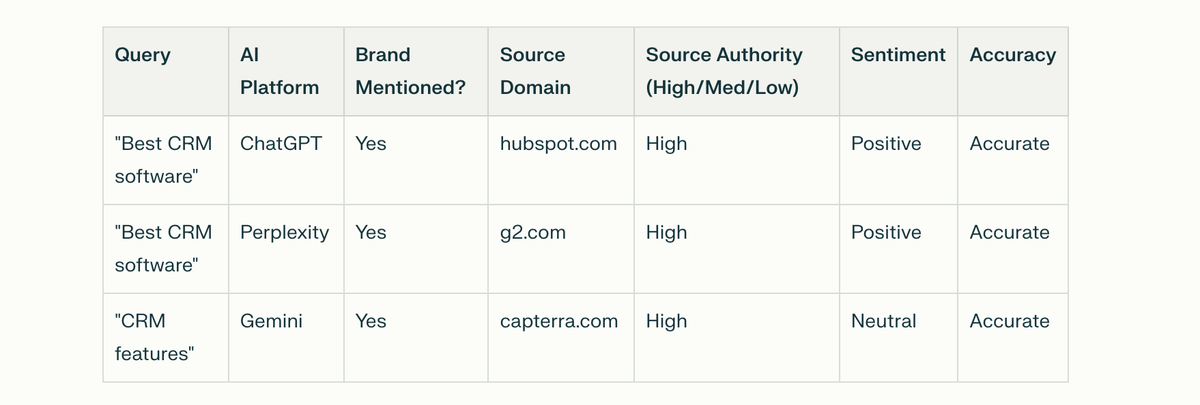
3. Use tools for automated source tracking:
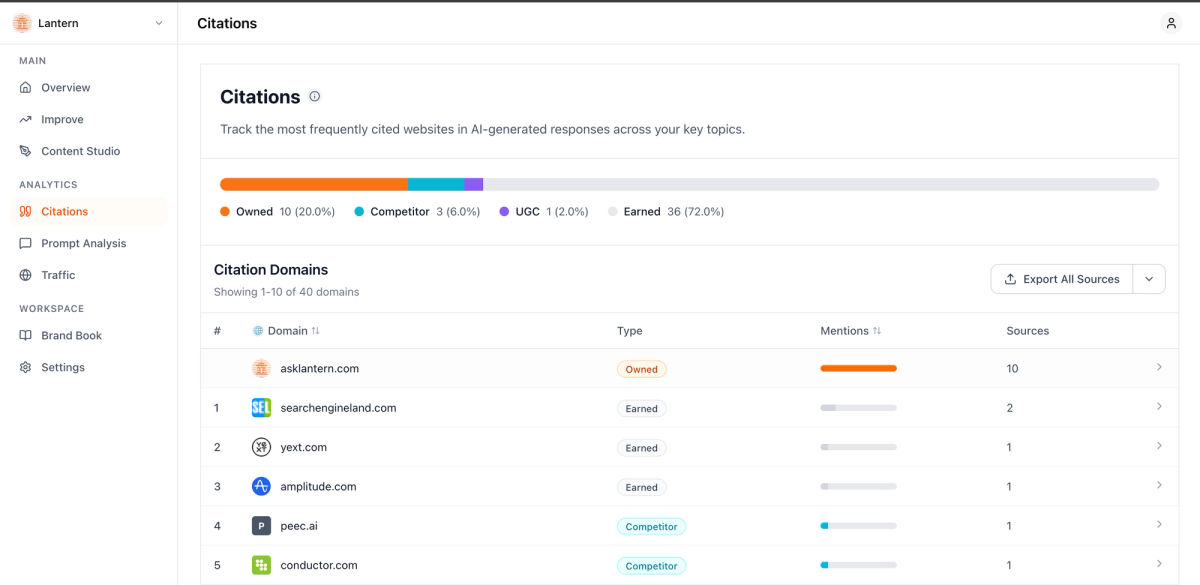
- Lantern, and other platforms automatically identify which domains AI cites when mentioning your brand.
- These tools categorize sources by authority and track citation trends.
Strategic implications:
High Citation Quality Scores correlate with:
- More accurate brand descriptions in AI responses
- Fewer hallucinations or outdated information
- Better brand positioning vs. competitors
If your Citation Quality Score is low, it signals you need to:
- Publish more authoritative content on your own domain
- Earn more citations from reputable third-party sources (industry publications, analyst reports, etc.)
- Update product pages and documentation for AI discoverability
Benchmark:
- Weak: Score 1.0–1.5 (mostly low-authority sources citing you)
- Competitive: Score 1.5–2.2
- Strong: Score 2.2+ (predominantly high-authority sources)
Metric 3: AI Accuracy Rate
What it measures: The percentage of AI-generated brand descriptions that are factually correct, current, and not contradictory.
Why it matters:
Accuracy is an emerging crisis in AI search.
Because LLMs synthesize information from training data (often outdated or conflicting), they frequently:
- State outdated pricing
- Describe features that no longer exist
- Confuse your product with competitors'
- Misrepresent your target customer
When a CMO searches ChatGPT for "What is [our company]?" and sees an inaccurate answer, that's a brand reputation problem.
Beyond reputation risk, accuracy directly impacts conversion. Research on AI Overviews shows that when AI descriptions are inaccurate, conversion rates from zero-click visitors drop significantly.
How to measure it:
- Audit AI descriptions quarterly:
- Document how AI platforms describe your brand.
- Check each claim:
- Pricing (is it current?)
- Features (are they accurate?)
- Target market (is it correct?)
- Positioning (does it reflect your strategy?)
- Comparisons (are competitor comparisons fair?)
- Identify root causes:
- Are AI platforms pulling from outdated sources?
- Is your own website out of date?
- Are third-party sites spreading misinformation?
Strategic actions if Accuracy Rate is low:
- Update your website to match current pricing, features, and positioning
- Publish fresh, authoritative content that clarifies your positioning
- Correct inaccurate information on third-party platforms (G2, Capterra, Wikipedia, etc.)
- Reach out to publications citing you with corrections
- Implement structured data (schema) so AI can correctly parse your entity
Benchmark:
- Poor: <70% accuracy rate
- Acceptable: 70–85% accuracy rate
- Strong: 85%+ accuracy rate
Metric 4: Zero-Click Conversion Influence
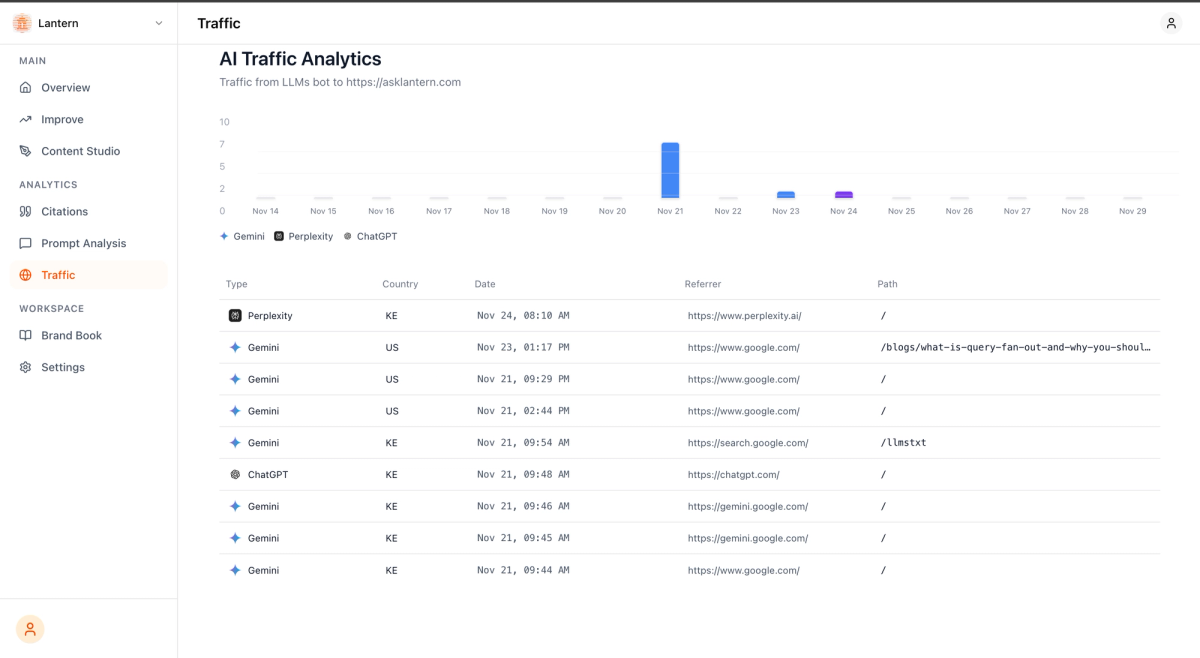
What it measures: Correlation between AI-generated mentions of your brand and downstream traffic/conversions.
Why it matters:
This is the metric that closes the loop between AI visibility and business impact.
A zero-click visitor who sees your brand in an AI answer doesn't immediately click through. But they may:
- Search your brand name directly later (branded search)
- Remember you during a buying decision
- Tell a colleague about your solution
- Visit your site directly the next week
Zero-Click Conversion Influence attempts to measure these indirect effects.
The challenge is attribution. Analytics platforms don't easily capture:
- Which user saw your brand in ChatGPT 3 days ago
- And is now visiting your site directly
- And is buying a product
However, there are proxy indicators that reveal the relationship.
How to measure it:
- Track branded search volume correlation: When AI visibility increases, branded search typically follows within 2–8 weeks.
- Week 1–2: Major AI mention spike
- Week 3–8: Correlated increase in branded keyword searches
- Weeks 8+: Traffic and conversion increases
- Action: Monitor branded search volume (e.g., "[Your Brand Name]") in Google Search Console. When you see spikes, correlate them with your major AI visibility wins.
- Monitor direct and "not set" traffic spikes: Users who see your brand in AI often come back via:
- Direct traffic (typing URL directly)
- "Not set" traffic (from mobile browsers without referrer data)
- When these channels spike after AI visibility increases, that suggests zero-click awareness is converting. Track in Google Analytics:
- Organic → Direct traffic lift after AI mention events
- Weekly "Direct + Not Set" traffic as a percentage of total traffic
- Conversion rate of direct traffic (often higher than cold organic, suggesting warm awareness)
- Conduct simple cohort analysis: If possible, create cohorts:
- Cohort A: Visitors who discovered you in ChatGPT or Perplexity
- Cohort B: Visitors from traditional Google organic search
- Compare their:
- Time-to-conversion
- Conversion rate
- Deal size
- Retention
- AI-aware visitors often convert faster and at higher rates (suggesting they arrive with higher intent).
- Use incrementality testing (advanced): For brands with budget and sophistication:
- Use tools like Amplitude, GrowByData's AI visibility platform, or others that model AI's impact on the customer journey
- These platforms can isolate AI visibility's contribution to revenue
Benchmark:
There's no universal benchmark yet, but here's what to look for:
- Weak: No correlation between AI mention spikes and branded search increases
- Moderate: 15–30% lift in branded search volume 4 weeks post-AI mention
- Strong: 30%+ lift, with measurable conversion rate improvements in cohorts exposed to AI mentions
Business correlation:
Early data suggests that brands winning in AI visibility experience:
- 20–40% growth in branded search volume year-over-year
- 10–25% increase in direct traffic (as % of total traffic)
- Faster sales cycles (prospects arriving with higher awareness)
- Higher customer lifetime value from AI-sourced customers
Metric 5: Competitive AI Positioning Gap
What it measures: The difference in AI visibility between your brand and category leaders.
Why it matters:
The most important AI metric is relative, not absolute.
You could have 25% AI mention share of voice—but if your top competitor has 60%, you're losing.
Competitive AI Positioning Gap quantifies this disadvantage, allowing you to:
- Benchmark against specific competitors
- Identify categories where you're losing
- Prioritize which topics to optimize
- Set realistic targets
How to measure it:
- Establish your competitive set: Identify 3–5 direct competitors you're losing ground to in AI search (not necessarily your largest competitors—those competing for the same queries in AI Overviews and chat).
- Measure each competitor's AI mention frequency: For your 10–15 strategic queries:
- Count how many times competitors are mentioned
- Record which AI platforms mention them
- Note the context (positive/neutral/negative)
- Calculate the gap:
textAI Positioning Gap = (Competitor Average AI Mentions - Your Average AI Mentions) / Competitor Average × 100
- Example:
- Competitor A mentioned in 60% of queries → 6/10 queries
- You mentioned in 40% of queries → 4/10 queries
- Gap = (6 - 4) / 6 × 100 = 33% gap
- Segment by query type: AI positioning gaps vary by query:
- "What is [category]?" → Competitor may lead (26% gap)
- "How to [solve problem]?" → You may lead (-10% gap, meaning you lead)
- "Best tools for [use case]?" → Tie (0% gap)
- This reveals where competitors own AI mindshare and where you have opportunities.
Building Your AI Visibility Dashboard
The measurement crisis is real. Billions of users are discovering brands through AI—and most marketers have no idea if they're winning or losing.
But measurement doesn't have to be complex. The five metrics framework in this guide—Share of Voice, Citation Quality, Accuracy Rate, Zero-Click Influence, and Competitive Gap—gives you a complete picture of your AI search visibility.
The challenge isn't the framework. It's the execution.
Tracking these metrics manually takes 5–13 hours per week. Tracking them at scale—across 50+ queries, 4+ AI platforms, and competitive benchmarking—becomes a full-time job.
This is where Lantern comes in.
Lantern automates the entire AI visibility measurement workflow. In minutes, you get:
- Complete AI visibility baseline across ChatGPT, Perplexity, Gemini, Google AI Overviews, and other LLM platforms
- Automatic citation tracking showing exactly which sources AI is using when mentioning your brand
- Competitive benchmarking so you see how you stack up against category leaders
- Monthly dashboards with all 5 metrics updated automatically—no manual audits needed
- ROI reporting that connects AI visibility improvements directly to branded search, traffic, and lead growth
Instead of spending 10+ hours per month on manual tracking, your team gets automated insights delivered to your dashbaord.
See your brand's AI visibility in real time—without the grunt work.
Start Your Free AI Visibility Analysis
Get a complete snapshot of how your brand shows up across all major AI platforms in the next 48 hours.
Ready to Grow Your AI Visibility?
See how Lantern can help your brand dominate AI search results. Book a personalized demo to discover how leading companies increase their visibility across ChatGPT, Perplexity, Google AI Overviews, Claude and other major AI platforms.


